By Eric Andrew Kristof, RN, CAHIMS | Healthcare IT Professional | HIMSS Arkansas Chapter Member
About This Series: The HIMSS Word of The Day is a running blog series drawing from the HIMSS Dictionary of Health Information and Technology Terms, Acronyms, and Organizations, 6th Edition (2025) — the authoritative reference for healthcare IT professionals and the primary study resource for CAHIMS and CPHIMS certification. Each post paraphrases the term in plain language, grounds it in real-world healthcare IT context, and adds a bedside nursing perspective you won’t find in a textbook.
📖 The Term: ANSI (American National Standards Institute)
Source: HIMSS Dictionary of Health Information and Technology Terms, Acronyms, and Organizations, 6th Edition (2025)
🔍 Plain-Language Definition
The HIMSS Dictionary lists ANSI (American National Standards Institute) in its organizations appendix. It describes ANSI as the national voice of the American standards and conformity assessment system, and it says the membership spans government agencies, companies, other organizations, academic and international bodies, and individuals.
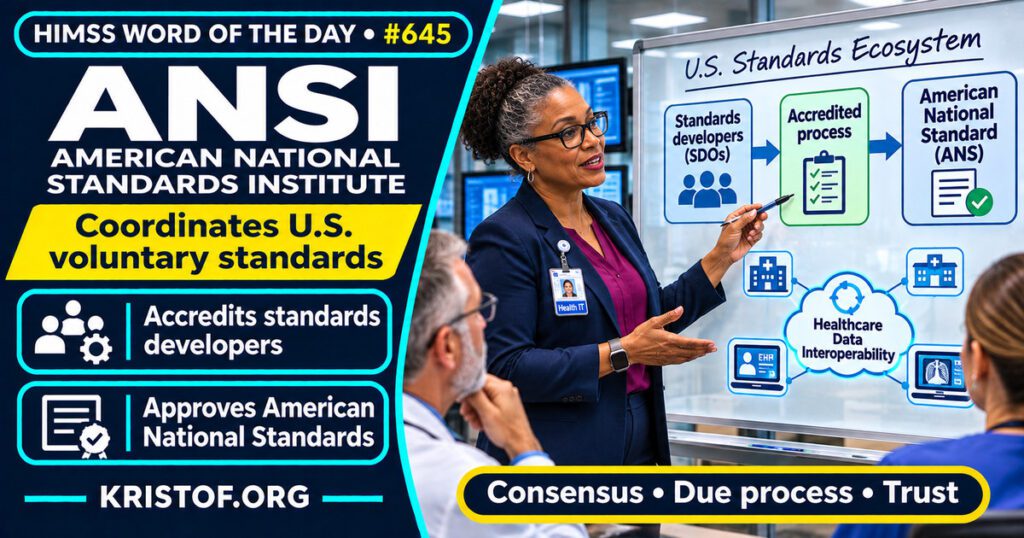
ANSI describes itself on its FAQ page as a private, nonprofit coordinator of the U.S. voluntary standards and conformity assessment system, and it says it is not part of the U.S. government. The same page makes a point that trips up many readers: ANSI says it does not develop standards. Instead, it accredits the procedures of standards developers (the page gives about 240) and approves their documents as American National Standards (ANS), which it counts at more than 13,000 to date. Both figures are ANSI’s own, so check the source if a current number matters.
According to ANSI’s history page, the organization began in 1918 as the American Engineering Standards Committee. Five engineering societies had invited others in 1916 to form a national standards body, and three federal departments later joined as founders. The name became the American Standards Association in 1928, the United States of America Standards Institute in 1966, and ANSI in 1969. The page also says the association helped form the International Organization for Standardization (ISO) in 1946.
For health IT students, the practical point is that standards that move data between systems come from standards development organizations (SDOs), and ANSI sits one level above them as an accreditor.
| Item | Detail |
|---|---|
| Type | Private nonprofit (ANSI’s description) |
| Founded | 1918, as the American Engineering Standards Committee |
| Current name since | 1969 |
| Main role | Accredits standards developers’ procedures and approves American National Standards; does not write them |
| International role | U.S. member of ISO; U.S. member of IEC through its U.S. National Committee; Secretariat of ISO/IEC JTC 1 (all per ANSI) |
| Health IT example | Administered the HITSP panel under an HHS contract (per an ANSI news item) |
| Relation to HIMSS | HIMSS is named as a strategic partner in that HITSP item |
⚠️ Exam Alert: ANSI coordinates the system and accredits standards developers. It is not itself a standards developer and not a certification body. HL7, ASC X12, and NCPDP are standards organizations in health IT. ISO is the international body of which ANSI is the U.S. member. ANAB, an ANSI affiliate, accredits certification bodies. HIMSS is a separate organization that offers the CAHIMS and CPHIMS credentials.
🌐 Why It Matters: Real-World Healthcare IT Context
Because ANSI is an organization rather than a research topic, this section draws on ANSI’s own pages and two government pages, all read directly for this post. The ANSI pages show how ANSI describes its work. They are not an independent evaluation of it.
Role in the standards system. ANSI’s page for standards developers says an organization must be accredited by ANSI before it can sponsor documents for approval as American National Standards. Accreditation means the developer’s voluntary consensus procedures meet ANSI’s requirements for openness and due process, and the developer agrees to keep meeting them. ANSI approves an individual document as an ANS when the sponsoring developer shows that consensus was reached and that ANSI’s Essential Requirements were followed. ANSI says its oversight covers only this activity.
Certification versus accreditation. ANSI’s FAQ page says ANSI does not certify any product, process, service, person, or management system. It says its affiliate ANAB accredits certification bodies and testing laboratories. For a CAHIMS candidate, the useful contrast is that credentials such as CAHIMS come from HIMSS, not from ANSI.
International role. ANSI states that it is the U.S. member of ISO, that its U.S. National Committee is the U.S. member of the IEC, and that it serves as Secretariat of ISO/IEC JTC 1, Information Technology.
Health IT connection. An ANSI news item describes the Healthcare Information Technology Standards Panel (HITSP) as a public-private, volunteer-driven, consensus-based group working under a contract with the U.S. Department of Health and Human Services (HHS). It says ANSI administered the panel with strategic partners that included HIMSS, the Advanced Technology Institute, and Booz Allen Hamilton, and its headline reports that HHS extended the contract through April 2010. The item does not say how the panel’s work is used today.
A separate government source adds context. An HHS ASPE FAQ, published September 7, 2000, says HIPAA directed the Secretary of HHS to adopt standards from private-sector standards developers accredited by ANSI, and that these developers are not government agencies. It reports that ASC X12 version 4010 was chosen for most transactions and NCPDP standards for retail pharmacy. That page is more than two decades old, so it is used only for the ANSI link, not for current requirements. A CMS page, last modified January 14, 2025, lists ANSI among non-DSMO standard-setting organizations, and names ASC X12, HL7, and NCPDP, among others, as the Designated Standards Maintenance Organizations that HHS uses to maintain HIPAA-adopted standards.
What I could not confirm. I did not confirm ANSI’s current membership numbers, whether HITSP still operates, the current ANSI accreditation status of individual health standards developers such as HL7, or the current adopted versions of HIPAA transaction standards.
Common ANSI mix-ups:
- Assuming ANSI writes the standards that carry its name
- Treating ANSI as a government agency
- Confusing ANSI, the U.S. coordinator and accreditor, with ISO, the international body
- Thinking ANSI certifies people, products, or systems, or issues CAHIMS
- Assuming every health IT standard is an American National Standard
What ANSI offers:
- Accreditation of standards developers’ procedures, by ANSI’s description
- Approval of documents as American National Standards
- Representation of U.S. interests in ISO and the IEC, by ANSI’s description
- Affiliates such as ANAB for accreditation and Workcred for workforce credentialing, per its history page
🏥 The Nurse’s Perspective: Clinical, Bedside, & Workflow
Nurses rarely deal with ANSI directly, but the standards it oversees shape how data moves between the systems nurses use.
At the Bedside
Nurses notice standards when information moves between systems without retyping, such as a result or an order appearing in the right place in the chart. ANSI does not write those standards, and this post did not verify which standard supports any particular bedside workflow. The practical habit is to report data that lands in the wrong place.
In Clinical Workflow
Nurse informaticists often sit between clinicians and technical teams when interface questions come up. When a vendor says a product follows a standard, they can ask which standard, which version, and which organization maintains it. Whether it is ANSI-accredited is a fair follow-up question.
In EHR Implementation (Go-Live Perspective)
During an Epic Go-Live, interface and device connections are tested before and after launch. Analysts at the elbow hear results as clinical questions, such as why a value did not appear. This post does not claim that any specific go-live depended on an ANSI-accredited standard. It shows why the name and version of the standard behind an interface belong on the test list.
🎓 CAHIMS / CPHIMS & HIMSS Perspective
CAHIMS Exam Domain Mapping
ANSI connects standards, governance, and interoperability:
| CAHIMS Domain | How ANSI Appears |
|---|---|
| Healthcare & Technology Environments | Standards bodies, accreditation, and where ANSI sits relative to ISO and HIMSS |
| Clinical Informatics | Standards that let clinical data move between systems |
| Healthcare Information & Systems Management | Interface and transaction standards, such as those adopted under HIPAA |
| Management & Leadership | Governance, vendor questions, and procurement language that names standards |
Key Terms to Know Alongside ANSI
- Standards Development Organization (SDO) — an organization that writes and maintains technical standards
- American National Standard (ANS) — a document ANSI approves after a consensus process run by an accredited developer
- HITSP — the Healthcare Information Technology Standards Panel, administered by ANSI under an HHS contract
- ISO — the International Organization for Standardization, of which ANSI is the U.S. member
- ASC X12 — the Accredited Standards Committee X12, whose standards were adopted for most HIPAA transactions per the ASPE FAQ
- Conformity assessment — activities that show a product, process, system, or person meets stated requirements
HIMSS Organizational Position
HIMSS offers education and research on health information and technology topics through its Resource Center. Members can find related information on the HIMSS Resource Center page.
🧭 More HIMSS Word of The Day Terms
Related terms in the Interoperability and Standards series:
- Fast Healthcare Interoperability Resources (FHIR)
- RIM (Reference Information Model)
- SNOMED International
- AE Title (Application Entity Title)
Browse all Interoperability and Standards terms or the A–Z glossary.
🔗 Explore Further: External References
- ANSI — History https://ansi.org/about/history
- ANSI — Frequently Asked Questions on Standardization https://ansi.org/standards-faqs
- ANSI — Standards Developers and the ANS Process https://www.ansi.org/american-national-standards/info-for-standards-developers/standards-developers
- ANSI — HITSP Contract with U.S. HHS Extended Through April 2010 https://ansi.org/standards-news/all-news/2010/02/hitsp-contract-with-us-hhs-extended-through-april-2010-12
- ASPE (HHS) — Frequently Asked Questions About Electronic Transaction Standards Adopted Under HIPAA https://www.aspe.hhs.gov/reports/frequently-asked-questions-about-electronic-transaction-standards-adopted-under-hipaa
- CMS — Standard-Setting and Related Organizations https://www.cms.gov/priorities/key-initiatives/burden-reduction/administrative-simplification/hipaa/standard-setting-related-organizations
- HIMSS — Resource Center https://www.himss.org/resource-center
Term source: HIMSS Dictionary of Health Information and Technology Terms, Acronyms, and Organizations, 6th Edition (2025). All definitions in this series are paraphrased for editorial purposes. Readers are encouraged to consult the primary source for exact language.
Eric Andrew Kristof, RN, CAHIMS is a Healthcare IT professional and HIMSS Arkansas Chapter member based in Hot Springs Village, AR, with hands-on Epic Go-Live experience and a diverse healthcare and IT background. He writes at kristof.org at the intersection of clinical care and healthcare technology.
Leave a Reply