By Eric Andrew Kristof, RN, CAHIMS | Healthcare IT Professional | HIMSS Arkansas Chapter Member
About This Series: The HIMSS Word of The Day is a running blog series drawing from the HIMSS Dictionary of Health Information and Technology Terms, Acronyms, and Organizations, 6th Edition (2025) — the authoritative reference for healthcare IT professionals and the primary study resource for CAHIMS and CPHIMS certification. Each post paraphrases the term in plain language, grounds it in real-world healthcare IT context, and adds a bedside nursing perspective you won’t find in a textbook.
📖 The Term: Post-Coordination
Source: HIMSS Dictionary of Health Information and Technology Terms, Acronyms, and Organizations, 6th Edition (2025)
🔍 Plain-Language Definition
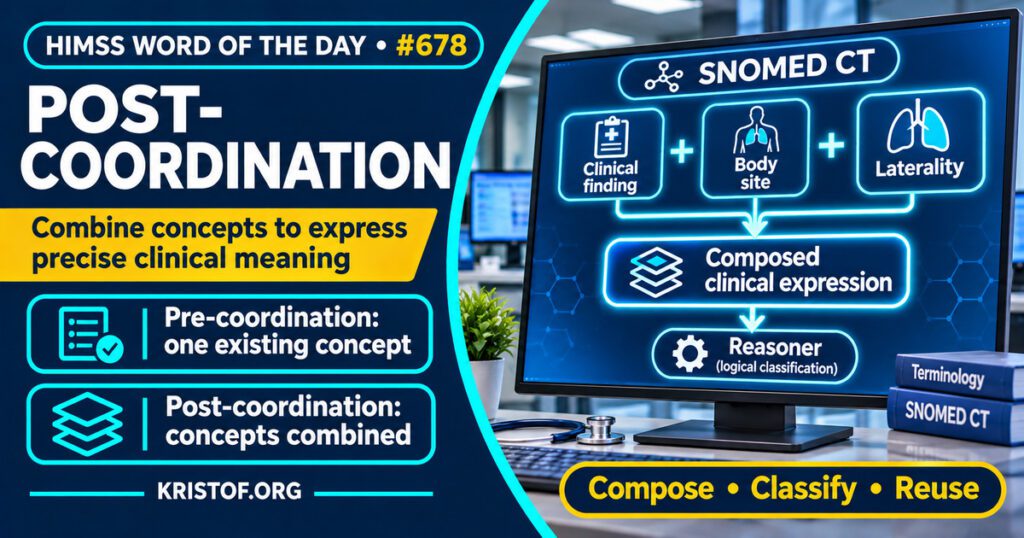
The HIMSS Dictionary gives post-coordination two senses. First, it is expressing a single concept by combining two or more codes, instead of finding one code that already covers it. Second, it is taking more than one concept from a single formal system or from several, and joining them with mechanisms that may sit inside those systems or outside them.
The studies in this post all use SNOMED CT, so that is the working example here. One study abstract calls SNOMED CT a compositional terminology and says that post-coordinated expressions let users specify new meaning by referencing existing SNOMED CT concepts. Another describes pre-coordinated expressions as those already in SNOMED CT, while post-coordinated expressions extend its content.
| Approach | How meaning is expressed | Example in the sources |
|---|---|---|
| Pre-coordination | A single concept that already exists in the terminology | Existing SNOMED CT concepts, such as “Acute disease” |
| Post-coordination | Existing concepts combined to specify a new meaning | 1,617 expressions generated from phenotype modifiers |
| Software support | A reasoner works out how expressions relate to existing content | Classification tested at scale in a 2014 study |
⚠️ Exam Alert: Do not confuse post-coordination with pre-coordination, in which a single existing code carries the whole meaning. Also do not assume post-coordination is the same as mapping between terminologies. Mapping links a code in one system to a code in another, while post-coordination builds a new expression from existing concepts.
🌐 Why It Matters: Real-World Healthcare IT Context
Why it exists. A terminology cannot easily hold a code for every combination a clinician might need, which is general reasoning and not a finding. Post-coordination fills gaps by letting users combine concepts. The studies below look at its performance, its pitfalls, and how much it adds. All five concern SNOMED CT, and I read abstracts only, so none of this describes any other terminology.
Performance at scale. Karlsson et al. (2014) tested reasoners, the software needed to relate post-coordinated expressions to existing SNOMED CT content. The best performing reasoner classified SNOMED CT plus 1 million post-coordinated expressions in 42 seconds, and classification time grew slightly less than quadratically with size. The authors conclude that classification time is not a problem with current reasoners and releases. That is a 2014 technical test, so it says nothing about usability, and current releases may differ.
A documented pitfall. Rector and Iannone (2012) examined how “acute” and “chronic” are used in SNOMED CT definitions, using the accuracy of authors writing pre-coordinated definitions as a proxy for how accurately users might write post-coordinated expressions. They found that 28% of candidate chronic concepts and 20% of candidate acute concepts were not classified as expected. Most of the cases arose because “acute” and “chronic” are sometimes specified as clinical course and sometimes as morphology, which the SNOMED User Guide mentions but does not fully detail. The authors call the proxy-based results preliminary and say anyone using post-coordination should be aware of significant pitfalls. It looked at two qualifiers in one module of the terminology.
Extending coverage. Dhombres et al. (2015) identified 176 modifiers in Human Phenotype Ontology terms, created 12 templates, and generated 1,617 post-coordinated expressions, which they say could increase the number of mappings by 50%. The abstract does not report any clinical validation of those expressions.
Filling gaps in laboratory mapping. Ryu et al. (2025) mapped 23 frequently requested panel tests from two referral laboratories to LOINC and SNOMED CT. Exact mapping was achieved for 87.0% of panels with LOINC and 78.2% with SNOMED CT, and 12 of the SNOMED CT mappings required post-coordination to represent the test. The authors attribute SNOMED CT failures to missing primitive concepts and limited pre-coordinated codes. Twenty-three tests is a small sample.
How much a hospital uses it. Zheng et al. (2026) analyzed 23,595 post-coordinated expressions from Geneva University Hospitals and compared each with concepts from 12 terminologies. Nearly one quarter (24.3%) aligned more closely with specialized terminologies such as LOINC and CPT, and a substantial subset had low similarity to any existing vocabulary, which the authors read as highly specific institutional practices. They conclude that post-coordination is essential for encoding fine-grained information. That is one institution, and the finding depends on an embedding-based similarity method.
What I could not confirm. I found no source on the dictionary’s mention of mechanisms outside the formal systems, and none of the studies is about a terminology other than SNOMED CT. I did not review SNOMED CT’s own documentation, its current release, or its licensing. I did not verify how many production systems use post-coordination or whether it improves patient care. Three of the five studies appear in Studies in Health Technology and Informatics, and I read abstracts only, not full texts.
Common post-coordination problems:
- Qualifiers specified inconsistently, as with “acute” and “chronic”
- Needing specialized software, a reasoner, to relate expressions to existing content
- Local expressions that mirror institution-specific practice and do not align with other vocabularies
- Gaps in pre-coordinated codes that push users toward combined expressions
- Weak documentation of how qualifiers should be used
What supports post-coordination:
- Reasoner performance that, in a 2014 test, scaled to a million expressions
- Templates built from frequent modifiers
- Quality assurance scripts, which the 2012 study shows can be modest in effort
- Flexibility to represent combinations a pre-coordinated set lacks
- Clear documentation of qualifier use
🏥 The Nurse’s Perspective: Clinical, Bedside, & Workflow
Post-coordination sits beneath the screen, so nurses meet its results more than its mechanics.
At the Bedside
In many systems, nurses choose terms from pick lists and flowsheet rows, and the coded expression behind a selection may or may not be post-coordinated, depending on how a system is built. None of the five studies examined nursing documentation or what bedside users see.
In Clinical Workflow
When a hospital’s expressions reflect local practice, as the Geneva analysis found for a subset of them, the same clinical idea may be coded differently across organizations. For nurses, that matters when data move between systems or are used for reporting. That is an inference from the study’s finding, not something the study measured.
In EHR Implementation (Go-Live Perspective)
During an Epic Go-Live, analysts and at-the-elbow support staff work with terminology content that is already built and mapped. Whether any of it is post-coordinated depends on the organization. None of the studies reviewed examines go-lives.
🎓 CAHIMS / CPHIMS & HIMSS Perspective
CAHIMS Exam Domain Mapping
Post-coordination appears in questions about terminologies, coding, and interoperability:
| CAHIMS Domain | How Post-Coordination Appears |
|---|---|
| Healthcare & Technology Environments | Terminology structure and standards |
| Clinical Informatics | Representing clinical meaning in coded data |
| Healthcare Information & Systems Management | Terminology mapping, quality assurance, and tooling |
| Management & Leadership | Governance of terminology use across the organization |
Key Terms to Know Alongside Post-Coordination
- Pre-coordination — a single existing code that carries a complete concept
- SNOMED CT — a compositional clinical terminology that supports post-coordination
- LOINC — a coding system compared with SNOMED CT for laboratory panel tests in one of the studies above
- Reasoner — software that works out the logical relations between expressions and existing content
- Ontology — a formal description of concepts and how they relate
- Terminology mapping — linking a code in one terminology to a code in another
HIMSS Organizational Position
HIMSS offers education and research on health information and technology topics through its Resource Center. Members can find related information on the HIMSS Resource Center page.
🧭 More HIMSS Word of The Day Terms
Related terms in the Interoperability and Standards series:
Browse all Interoperability and Standards terms or the A–Z glossary.
🔗 Explore Further: External References
- Karlsson et al. (2014), Studies in Health Technology and Informatics — Does SNOMED CT post-coordination scale? https://pubmed.ncbi.nlm.nih.gov/25160348/
- Rector and Iannone (2012), Journal of Biomedical Informatics — Lexically suggest, logically define: quality assurance of the use of qualifiers and expected results of post-coordination in SNOMED CT. https://pubmed.ncbi.nlm.nih.gov/22024315/
- Dhombres et al. (2015), Studies in Health Technology and Informatics — Extending the coverage of phenotypes in SNOMED CT through post-coordination. https://pubmed.ncbi.nlm.nih.gov/26262161/
- Ryu et al. (2025), International Journal of Medical Informatics — Comparative study of LOINC and SNOMED CT in panel mapping: enhancing interoperability in laboratory testing. https://pubmed.ncbi.nlm.nih.gov/40712447/
- Zheng et al. (2026), Studies in Health Technology and Informatics — Bridging Gaps in Unified Clinical Terminology: The Necessity of Post-Coordination in SNOMED CT. https://pubmed.ncbi.nlm.nih.gov/42175043/
- HIMSS — Resource Center https://www.himss.org/resource-center
Term source: HIMSS Dictionary of Health Information and Technology Terms, Acronyms, and Organizations, 6th Edition (2025). All definitions in this series are paraphrased for editorial purposes. Readers are encouraged to consult the primary source for exact language.
Eric Andrew Kristof, RN, CAHIMS is a Healthcare IT professional and HIMSS Arkansas Chapter member based in Hot Springs Village, AR, with hands-on Epic Go-Live experience and a diverse healthcare and IT background. He writes at kristof.org at the intersection of clinical care and healthcare technology.
Leave a Reply