By Eric Andrew Kristof, RN, CAHIMS | Healthcare IT Professional | HIMSS Arkansas Chapter Member
About This Series: The HIMSS Word of The Day is a running blog series drawing from the HIMSS Dictionary of Health Information and Technology Terms, Acronyms, and Organizations, 6th Edition (2025) — the authoritative reference for healthcare IT professionals and the primary study resource for CAHIMS and CPHIMS certification. Each post paraphrases the term in plain language, grounds it in real-world healthcare IT context, and adds a bedside nursing perspective you won’t find in a textbook.
📖 The Term: Electronic Waste (e-Waste)
Source: HIMSS Dictionary of Health Information and Technology Terms, Acronyms, and Organizations, 6th Edition (2025)
🔍 Plain-Language Definition
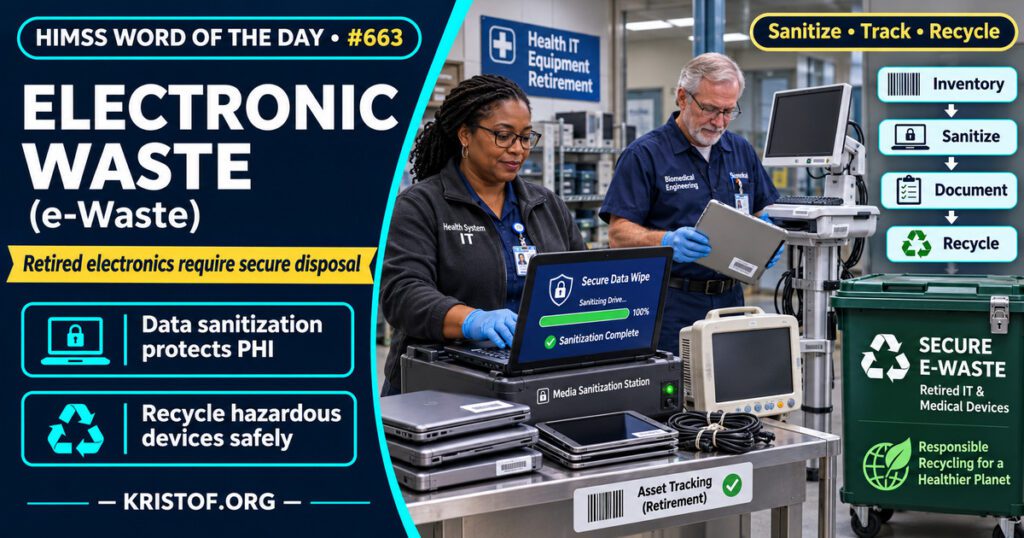
The HIMSS Dictionary describes electronic waste (e-waste) as the disposal of broken or outdated electronic components and materials. Some of that material has value and can be recycled or reused, and the dictionary gives memory modules and reusable laptops as examples. Other items, such as older cathode ray tube monitors, are hazardous and need special handling when they are discarded. It lists computers, televisions, stereos, copiers, and fax machines among the commonly discarded products.
In health IT, e-waste has two sides. One is information risk, because retired devices and storage media may still hold patient data. The other is environmental and health risk, because the materials inside electronics can harm people and the environment when handled or recycled poorly.
| Concern | What it means | Where it shows up |
|---|---|---|
| Data sanitization | Making data on retired media infeasible to recover | Laptops, workstations on wheels, tablets, servers, copiers |
| Hazardous materials | Substances that need special handling | Older monitors and electronic components |
| Recovery and reuse | Keeping working equipment and parts in use | Reusable laptops and memory |
| Worker and community health | Exposure during dismantling and recycling | Recycling sites |
⚠️ Exam Alert: E-waste is not only an environmental topic. For a health IT exam, the key link is that disposal of media that may hold protected health information is a security obligation. Keep data sanitization (protecting the information) separate from recycling (handling the materials), since an organization needs both.
🌐 Why It Matters: Real-World Healthcare IT Context
Data and disposal. Andersen (2011) wrote a primer for health care managers on the Health Insurance Portability and Accountability Act security regulations covering data sanitization and disposal of media that hold electronic protected health information. The article presents methods for effective sanitization and disposal, notes that disposing of electronic media produces e-waste that can harm human health and the environment, and gives examples of how organizations can meet the regulations while behaving responsibly toward the environment, using the stewardship ideas of reduce, reuse, reeducate, recover, and recycle. The article is from 2011, so regulations and technical guidance have been updated since, and I did not review the regulation text itself in this session.
Current guidance. The National Institute of Standards and Technology published NIST Special Publication 800-88 Revision 2, Guidelines for Media Sanitization, with a final version dated September 2025. According to the NIST page, it defines media sanitization as a process that makes access to target data on media infeasible for a given level of effort, and it is intended to help organizations and system owners build a sanitization program, with techniques and controls matched to the sensitivity of the information. I read the NIST summary page, not the full publication.
Worker exposure. Okeme and Arrandale (2019) reviewed research on occupational exposures in e-waste recycling. They report that workers may be exposed to chemical, physical, ergonomic, and psychosocial hazards, including metals, particulates, persistent organic compounds, and flame retardants. Exposure varies by job task, with higher exposures observed for dismantling and burning e-waste. Many studies have measured exposure, but fewer have looked at health effects.
Environment and public health. Alabi and colleagues (2021) reviewed the literature and describe e-waste as the fastest growing waste stream globally, with hazardous constituents such as heavy metals and persistent organic pollutants. They report that exposure can occur by ingestion, inhalation, and skin contact, that the most susceptible groups were children, pregnant women, and workers at primitive recycling sites, and that there is a large gap between exposure measurement and known health effects. Rene and colleagues (2021) review e-waste generation, handling procedures, and regulations in several countries and regions, and link rising generation rates in part to rapid technology change and increased use of IT for working and learning from home during COVID-19. Shrivastava and colleagues (2025) describe the health implications of e-waste and propose public health interventions, concluding that improper handling has harmed workers, nearby communities, and the environment.
What I could not confirm. The environmental and worker-health reviews mostly concern informal recycling and recycling industries, many outside the United States, not hospital IT departments, so applying them to a given health system is an inference. I did not find a source that measures how much e-waste hospitals produce or how often patient data are found on discarded hospital devices. I did not verify any national or state e-waste law for this post, and I read abstracts and one NIST summary page, not full texts.
Common e-waste problems:
- Retired devices stored unlabeled, with no record of who owns them
- Drives or media sent for recycling without verified data sanitization
- Disposal handled informally, outside the IT asset process
- Hazardous items such as older monitors treated like ordinary trash
- No record that sanitization and disposal took place
What supports responsible e-waste management:
- An asset inventory that tracks equipment through its whole life
- A written media sanitization procedure matched to data sensitivity
- Documented disposal and recycling through qualified vendors
- Reuse and recovery of working equipment where policy allows
- Training for staff who handle retired equipment
🏥 The Nurse’s Perspective: Clinical, Bedside, & Workflow
Nurses handle the same devices that later become e-waste, so their role is mostly about recognizing and routing equipment.
At the Bedside
Workstations on wheels, tablets, handheld scanners, and monitors all end their service lives. A nurse who finds a retired or broken device on a unit should treat it as a possible container of patient information and follow the organization’s process for reporting it, instead of leaving it in a supply closet or putting it in ordinary trash. This is a practical suggestion, not a finding from the sources above.
In Clinical Workflow
Units often hold equipment that nobody has formally retired. Clinical leaders can ask IT and biomedical engineering how a device is tracked, wiped, and removed from the unit. Andersen (2011) frames disposal as both a regulatory duty and an environmental one, which gives units two reasons to use the formal process.
In EHR Implementation (Go-Live Perspective)
During an Epic Go-Live, new computers, printers, and handhelds arrive while older equipment leaves. Analysts and at-the-elbow support staff see how fast hardware changes during a rollout. Planning for the old equipment, including who removes it and how data are cleared, belongs in the project plan, not after the project ends. This is a workflow observation, not a sourced finding.
🎓 CAHIMS / CPHIMS & HIMSS Perspective
CAHIMS Exam Domain Mapping
E-waste links infrastructure, security, and organizational stewardship:
| CAHIMS Domain | How E-Waste Appears |
|---|---|
| Healthcare & Technology Environments | Hardware life cycle, replacement, and environmental responsibility |
| Clinical Informatics | Retired clinical devices and the data they may hold |
| Healthcare Information & Systems Management | Asset management, media sanitization, and disposal procedures |
| Management & Leadership | Policy, vendor oversight, and sustainability decisions |
Key Terms to Know Alongside E-Waste
- Data sanitization — the process of making data on media infeasible to recover for a given level of effort
- Protected health information (PHI) — individually identifiable health information that is protected by privacy rules
- HIPAA Security Rule — the federal standard for safeguarding electronic protected health information
- Asset management — tracking equipment from purchase through retirement
- Life cycle — the stages a system or device goes through from acquisition to disposal
- Data security — measures that protect information from unauthorized access or loss
HIMSS Organizational Position
HIMSS offers education and research on health information and technology topics through its Resource Center. Members can find related information on the HIMSS Resource Center page.
🧭 More HIMSS Word of The Day Terms
Related terms in the IT Infrastructure series:
- WORM (Write Once, Read Many Times)
- Software as a Service (SaaS)
- TCP/IP (Transmission Control Protocol/Internet Protocol)
Browse all IT Infrastructure terms or the A–Z glossary.
🔗 Explore Further: External References
- Andersen (2011), The Health Care Manager — A primer for health care managers: data sanitization, equipment disposal, and electronic waste https://pubmed.ncbi.nlm.nih.gov/21808180/
- NIST — SP 800-88 Rev. 2, Guidelines for Media Sanitization https://csrc.nist.gov/pubs/sp/800/88/r2/final
- Okeme and Arrandale (2019), Current Environmental Health Reports — Electronic Waste Recycling: Occupational Exposures and Work-Related Health Effects https://pubmed.ncbi.nlm.nih.gov/31734812/
- Alabi et al. (2021), Journal of Environmental Health Science and Engineering — Environmental contamination and public health effects of electronic waste: an overview https://pubmed.ncbi.nlm.nih.gov/34150306/
- Rene et al. (2021), Journal of Hazardous Materials — Electronic waste generation, recycling and resource recovery: Technological perspectives and trends https://pubmed.ncbi.nlm.nih.gov/33838506/
- Shrivastava et al. (2025), Nigerian Postgraduate Medical Journal — Public Health Interventions to Optimise the Management of Electronic Waste https://pubmed.ncbi.nlm.nih.gov/40091475/
- HIMSS — Resource Center https://www.himss.org/resource-center
Term source: HIMSS Dictionary of Health Information and Technology Terms, Acronyms, and Organizations, 6th Edition (2025). All definitions in this series are paraphrased for editorial purposes. Readers are encouraged to consult the primary source for exact language.
Eric Andrew Kristof, RN, CAHIMS is a Healthcare IT professional and HIMSS Arkansas Chapter member based in Hot Springs Village, AR, with hands-on Epic Go-Live experience and a diverse healthcare and IT background. He writes at kristof.org at the intersection of clinical care and healthcare technology.
Leave a Reply