By Eric Andrew Kristof, RN, CAHIMS | Healthcare IT Professional | HIMSS Arkansas Chapter Member
About This Series: The HIMSS Word of the Day is a running blog series drawing from the HIMSS Dictionary of Health Information and Technology Terms, Acronyms, and Organizations, 6th Edition (2025) — the authoritative reference for healthcare IT professionals and the primary study resource for CAHIMS and CPHIMS certification. Each post paraphrases the term in plain language, grounds it in real-world healthcare IT context, and adds a bedside nursing perspective you won’t find in a textbook.
📖 The Term: LWBS (Left Without Being Seen)
Source: HIMSS Dictionary of Health Information and Technology Terms, Acronyms, and Organizations, 6th Edition (2025)
🔍 Plain-Language Definition
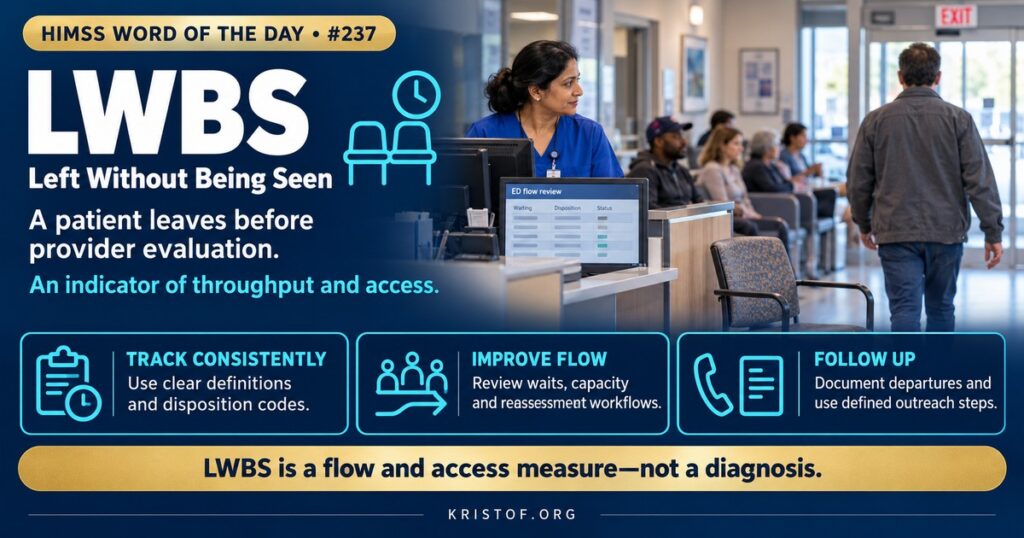
LWBS stands for left without being seen. The HIMSS Dictionary uses it for the status of a patient who departed a healthcare facility before receiving an examination or treatment. It is most often applied to emergency departments, where a person registers or is triaged, waits, and leaves before a clinician evaluates them. Organizations count these events as a rate: patients who left without being seen divided by total visits.
Terms vary. Some systems separate patients who leave after registration but before triage, those who leave after triage but before a provider evaluation, and those who leave after evaluation but before treatment is complete. Other names include did not wait, left before treatment complete, and left against medical advice, which are not the same thing. Local definitions matter when comparing rates.
| Term | Meaning | Key Distinction |
|---|---|---|
| LWBS | Left before being examined or treated | Never evaluated by a provider |
| Did not wait (DNW) | Common name outside the US | Left before assessment |
| Left before treatment complete (LBTC) | Left after evaluation, before treatment finished | Seen, not finished |
| AMA (against medical advice) | Left after being told to stay | Informed refusal documented |
| Elopement | Left unexpectedly, often a safety event | Often applies to inpatients or behavioral health |
⚠️ Exam Alert: LWBS is a throughput and access indicator, not a diagnosis. A patient who leaves AMA was seen and advised; an LWBS patient was not evaluated. LWBS is tracked alongside door-to-provider time and length of stay.
🌐 Why It Matters: Real-World Healthcare IT Context
LWBS matters for safety, equity, and finances. A patient who leaves unseen may have an unrecognized serious condition, and the department has no record of what happened next. Patients who leave also represent lost access to care and lost revenue. Because rates rise when emergency departments are crowded, many organizations treat LWBS as a marker of strain in the health care system.
Recent studies show how varied the picture is. A study in a Croatian tertiary center covered 110,547 emergency visits from July 2023 to July 2024. Of these, 1,420 patients, or 1.3 percent, left early, and only 5 percent of them left during treatment. Most were low-acuity, with 60 percent in triage category 4 and 29 percent in category 5. Self-referred patients accounted for 65 percent. Departures peaked in August and September and between 2 p.m. and 10 p.m. Within 48 hours, 20 percent returned to the emergency department and 12 percent required other hospital evaluations. An Australian study of patients who did not wait at a metropolitan tertiary emergency department in 2023 identified 813 patients, about 1 percent of triaged patients. Most arrived by private transport and were assigned low-priority triage categories. Only 4 percent had their complaint completely managed by triage nursing staff and 1.4 percent received nurse-initiated investigation or treatment. About 9 percent returned to a local health district emergency department within 48 hours. The authors suggested that earlier nurse-initiated treatments might reduce departures, while noting that more research is needed.
Equity is part of the story. A Canadian study of 7,221 visits assigned an LWBS disposition at a tertiary emergency department in 2025 linked 94.5 percent of them to neighborhood income data. The visits were highest in the lowest income category, at 32.9 percent, and lowest in the highest income category, at 12.5 percent. Such descriptive findings do not prove cause, but they suggest that waiting time alone does not explain who leaves, and that access, primary care connection, and circumstances matter.
Analytics are also being used to predict the problem. An Italian single-site study analyzed 80,614 emergency visits from 2019 to 2023 and tested four machine learning models. The best model, a random forest, reached an overall accuracy of 72 percent, and waiting time, triage score, and access mode were among the important predictors. Such models are exploratory, depend on local data, and should support staffing and flow decisions rather than label individual patients.
On the policy side, federal hospital outpatient quality reporting has included an LWBS measure, and measure lists change over time. Organizations should check the current program requirements through CMS resources rather than rely on an older list.
Reducing LWBS usually means improving flow rather than telling patients to wait. Common tactics include provider-in-triage models, nurse-initiated protocols, fast-track areas for low-acuity patients, real-time wait communication, bed management that frees inpatient capacity, and follow-up calls to patients who leave. EHR tracking boards and dashboards make the problem visible while it is happening, not weeks later.
Common LWBS problems:
- Long waits for low-acuity patients as sicker patients take priority
- No process to reassess patients waiting for a long time
- Unclear definitions that make rates hard to compare
- Patients who leave are not contacted or tracked
- Boarded inpatients blocking emergency department beds
- Dashboards that show averages and hide peak-hour problems
What supports lower LWBS rates:
- Provider-in-triage and nurse-initiated protocols
- Fast-track or split-flow areas for low acuity
- Hourly reassessment of waiting patients with documented triggers
- Real-time dashboards with alerts for long waits
- Hospital-wide actions to move admitted patients out of the department
- Follow-up outreach, with escalation for high-risk patients
🏥 The Nurse’s Perspective: Clinical, Bedside, & Workflow
Triage nurses are the first clinical contact for patients who may later leave, and their decisions shape the risk.
At the Bedside
A triage nurse who sees a crowded waiting room balances acuity, comfort, and communication. Telling patients how long the wait is likely to be, explaining warning signs that should prompt a return to the desk, and reassessing at regular intervals all reduce the chance that a patient leaves unnoticed. Documenting when a patient is observed leaving, and any attempt to reach them, supports follow-up and review.
Nurse-initiated orders, such as pain medication, imaging, or laboratory tests started at triage, can move care forward while a patient waits, where policy allows.
In Clinical Workflow
Emergency nurse leaders review LWBS cases to see whether the patients were low acuity, whether waits were long, and whether anyone was at high risk. They help set rules for who gets a callback and who needs urgent outreach. Charge nurses use tracking boards to spot long waiters and coordinate rooms, staffing, and inpatient transfers.
Nurse informaticists help design triage documentation, tracking board displays, and alerts for waiting-time thresholds. They also check that disposition options in the EHR are used consistently, since inconsistent coding makes LWBS data unreliable.
In EHR Implementation (Go-Live Perspective)
An Epic Go-Live in the emergency department changes triage, tracking, and documentation at the same time, and early weeks often show longer waits. At-the-elbow support analysts stay with triage nurses to speed registration and note entry, and they watch for patients who leave during the learning curve. Leaders track LWBS daily through go-live so that workflow fixes can be made quickly.
🎓 CAHIMS / CPHIMS & HIMSS Perspective
CAHIMS Exam Domain Mapping
LWBS appears in quality measurement and workflow questions:
| CAHIMS Domain | How LWBS Appears |
|---|---|
| Healthcare & Technology Environments | Quality reporting, patient flow, access to care |
| Clinical Informatics | Triage workflow, tracking boards, nurse-initiated protocols |
| Healthcare Information & Systems Management | Disposition coding, dashboards, data definitions |
| Management & Leadership | Throughput improvement, patient safety review, equity analysis |
Key Terms to Know Alongside LWBS
- Door-to-Provider Time — time from arrival to first provider contact
- Triage — process of sorting patients by urgency
- ED Boarding — admitted patients held in the emergency department
- Throughput — flow of patients through a care area
- Tracking Board — real-time display of patient status in the department
- Disposition — final status or outcome recorded for an encounter
HIMSS Organizational Position
HIMSS supports data-driven improvement of care delivery and patient safety through its research, education, and community work. Members can find related resources through the HIMSS Resource Center.
🔗 Explore Further: External References
- CMS — QualityNet Hospital Outpatient Quality Reporting Program https://qualitynet.cms.gov/outpatient
- Krnić et al. (2026), Croatian Medical Journal — Early Departures From the Emergency Department in a High-Volume Tertiary Center: The First Report From Croatia https://pubmed.ncbi.nlm.nih.gov/42669907/
- Partyka et al. (2026), Australasian Emergency Care — Exploring Patient Characteristics and Departmental Factors for Those Who Did Not Wait to Be Seen and Treated in the Emergency Department: The DNW Study https://pubmed.ncbi.nlm.nih.gov/42686480/
- O’Leary et al. (2026), Cureus — Beyond Wait Times: Neighborhood Income Distribution Among Emergency Department Visits Assigned a Leave-Without-Being-Seen Disposition https://pubmed.ncbi.nlm.nih.gov/42662781/
- Scala et al. (2025), BMC Emergency Medicine — Predicting Patient Risk of Leaving Without Being Seen Using Machine Learning: A Retrospective Study in a Single Overcrowded Emergency Department https://pubmed.ncbi.nlm.nih.gov/40660109/
Term source: HIMSS Dictionary of Health Information and Technology Terms, Acronyms, and Organizations, 6th Edition (2025). All definitions in this series are paraphrased for editorial purposes. Readers are encouraged to consult the primary source for exact language.
Eric Andrew Kristof, RN, CAHIMS is a Healthcare IT professional and HIMSS Arkansas Chapter member based in Hot Springs Village, AR, with hands-on Epic Go-Live experience and a diverse healthcare and IT background. He writes at kristof.org at the intersection of clinical care and healthcare technology.
Leave a Reply