By Eric Andrew Kristof, RN, CAHIMS | Healthcare IT Professional | HIMSS Arkansas Chapter Member
About This Series: The HIMSS Word of The Day is a running blog series drawing from the HIMSS Dictionary of Health Information and Technology Terms, Acronyms, and Organizations, 6th Edition (2025) — the authoritative reference for healthcare IT professionals and the primary study resource for CAHIMS and CPHIMS certification. Each post paraphrases the term in plain language, grounds it in real-world healthcare IT context, and adds a bedside nursing perspective you won’t find in a textbook.
📖 The Term: Feeder Systems
Source: HIMSS Dictionary of Health Information and Technology Terms, Acronyms, and Organizations, 6th Edition (2025)
🔍 Plain-Language Definition
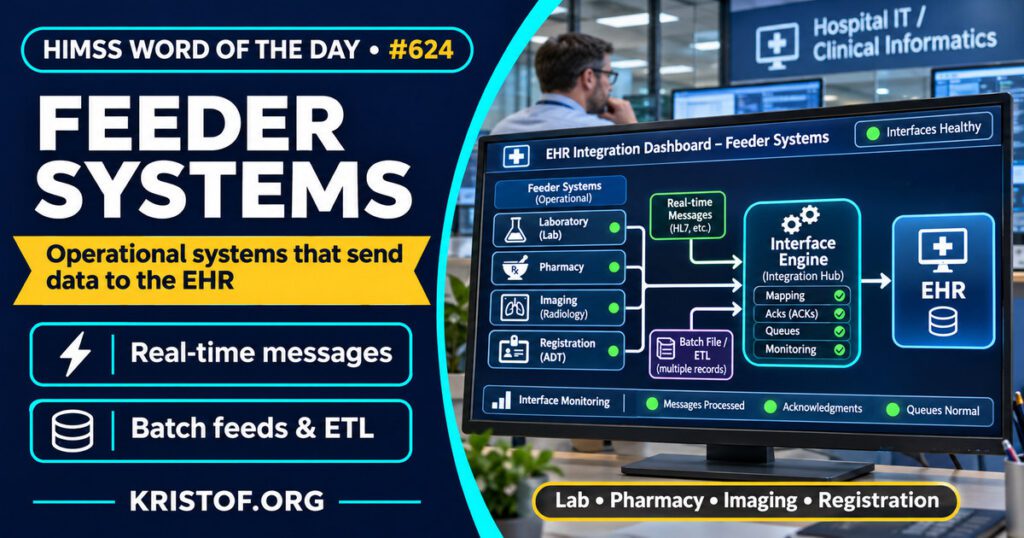
The HIMSS Dictionary describes feeder systems as operational systems that supply patient or person data to the EHR. Data can arrive as real-time single messages, as multiple messages, or as batch file uploads. The entry refers readers to source systems, adds that the same systems may be called legacy systems, and says they commonly take part in extract-transform-load (ETL) work.
In plain terms, the EHR is rarely the first place a fact is recorded. A lab analyzer, a pharmacy system, a registration system, or an older departmental application may create the data first and send it onward. The sender is a feeder system, and the connection between the two systems is an interface.
| Item | Detail |
|---|---|
| What it is | An operational system that sends data to the EHR |
| How data arrives | Real-time messages or batch file uploads |
| Common examples | Laboratory, pharmacy, imaging, and registration systems, and older legacy applications |
| Related processes | Interfaces, interface engines, and ETL |
| Where problems appear | Message mapping, acknowledgments, timing, and duplicate or missing records |
⚠️ Exam Alert: A feeder system sends data to another system, a source system is where data originates, and a legacy system is an older system still in use. One system can be all three. An interface engine routes and transforms messages between systems, and ETL is a process that extracts data, reshapes it, and loads it into a target, often in batches.
🌐 Why It Matters: Real-World Healthcare IT Context
Data that arrives from a feeder system is only as useful as the connection that carries it. The interface decides what is sent, when it is sent, how it is translated, and what happens when something goes wrong.
Messages and batches. Real-time interfaces typically send each event as it happens, which suits orders, results, and registration updates. HL7 Version 2 is the long-standing messaging standard that many of these interfaces use. Batch uploads move larger sets of data on a schedule, which suits history loads and reporting feeds. Neither approach is automatically better, and many organizations use both.
Three questions to ask about each feeder system. What does it send, and in what format? How often does it send, and what happens when it is down? Who owns it, on the vendor side and on the hospital side? Those questions sound basic, but they expose most of the surprises. A feeder system with no clear owner, no documented message specification, and no monitoring is a risk to the record even when it has run quietly for years. Mapping the feeder systems feeding an EHR is also a useful first step in any upgrade, consolidation, or replacement project, because each one represents a dependency that someone must test.
What studies show. Two papers show how interface and transformation details affect care and data.
- Schreiber and colleagues (2017) report two cases in which an EHR interfaced to an external clinical laboratory information system led to two patients not having laboratory tests drawn in a timely manner. The authors describe user actions combined with the lack of an acknowledgment message about the order cancellation from the external system as root causes. Testing had shown that the laboratory system would cancel duplicate orders, and duplicate alerting in the new order entry system was thought to prevent such events. This is a report of two cases, so it shows how a failure can happen and not how often it does.
- Tahar and colleagues (2023) studied the effect of ETL processes on the quality of rare disease data within the CORD-MI project, which connects university hospitals in Germany. They evaluated seven data quality indicators across three dimensions and report that ETL processes are challenging and influence the quality of the transformed data. This was one research network working on one type of data, so the details may not carry over to other settings.
How transformation is managed. The OHDSI Book describes ETL as restructuring raw source data into a target model, mapping codes to standard vocabularies, and rerunning when source data is refreshed. It recommends documenting the design in detail and testing through independent review, sample-level checks, count comparisons, and small unit-test datasets. These practices come from one community’s guidance and not from a universal standard, but the habits apply broadly.
Common feeder system problems:
- Missing acknowledgments, so a sender does not know a message was received or acted on
- Order or result messages mapped to the wrong field or code
- Duplicate or out-of-order messages
- Batch loads that overwrite newer data with older data
- Differences between what testing covered and what users actually do
- Legacy systems that no one on the current team fully understands
What supports good interface practice:
- Two-way messaging with acknowledgments for orders and cancellations
- End-to-end testing that includes unusual user sequences
- Documented field and code mappings
- Monitoring that alerts someone when messages stop or queue up
- Reconciliation reports that compare sender and receiver counts
🏥 The Nurse’s Perspective: Clinical, Bedside, & Workflow
Nurses see feeder system output as results, orders, and registration details in the chart, and they notice when something is missing or late.
At the Bedside
When a result, a medication status, or an order status does not match what happened at the bedside, an interface may be the cause. The Schreiber report is a reminder that the screen can show an order as active when the other system has acted differently.
In Clinical Workflow
Nurse informaticists help define what each feeder system must send and how the information should look at the point of care. They also help write downtime and workaround procedures for the times an interface stops.
In EHR Implementation (Go-Live Perspective)
During an Epic Go-Live, analysts at the elbow often sort tickets into those that are caused by training, those that are caused by build, and those that are caused by an interface or a feeder system. Knowing which one applies saves time. This post does not claim that any specific go-live had an interface failure like the one in the Schreiber report.
🎓 CAHIMS / CPHIMS & HIMSS Perspective
CAHIMS Exam Domain Mapping
Feeder systems appear in questions about integration and data flow:
| CAHIMS Domain | How Feeder Systems Appear |
|---|---|
| Healthcare & Technology Environments | Interfaces, messaging standards, and system landscapes |
| Clinical Informatics | Orders, results, and workflow across systems |
| Healthcare Information & Systems Management | Interface monitoring, testing, and data quality |
| Management & Leadership | Vendor coordination and downtime planning |
Key Terms to Know Alongside Feeder Systems
- Source systems — the systems where data originates before it is sent elsewhere
- Legacy systems — older systems that remain in use
- Interface engine — software that routes and transforms messages between systems
- HL7 V2 — a widely used messaging standard for exchanging clinical and administrative data
- ETL (Extract, Transform, Load) — a process that extracts data, reshapes it, and loads it into a target system
- Data quality — the fitness of data for its intended use
HIMSS Organizational Position
HIMSS offers education and research on health information and technology topics through its Resource Center. Members can find related information on the HIMSS Resource Center page.
🧭 More HIMSS Word of The Day Terms
Related terms in the Interoperability and Standards series:
- Fast Healthcare Interoperability Resources (FHIR)
- System Integration
- Admission, Discharge, and Transfer (ADT)
- hData
Browse all Interoperability and Standards terms or the A–Z glossary.
🔗 Explore Further: External References
- Schreiber et al. (2017), Journal of the American Medical Informatics Association : JAMIA — Orders on file but no labs drawn: investigation of machine and human errors caused by an interface idiosyncrasy https://pubmed.ncbi.nlm.nih.gov/28339629/
- Tahar et al. (2023), Studies in health technology and informatics — Local Data Quality Assessments on EHR-Based Real-World Data for Rare Diseases https://pubmed.ncbi.nlm.nih.gov/37203665/
- OHDSI — The Book of OHDSI: Extract Transform Load https://ohdsi.github.io/TheBookOfOhdsi/ExtractTransformLoad.html
- HL7 — HL7 Version 2 Product Brief https://www.hl7.org/implement/standards/product_brief.cfm?product_id=185
- HIMSS — Resource Center https://www.himss.org/resource-center
Term source: HIMSS Dictionary of Health Information and Technology Terms, Acronyms, and Organizations, 6th Edition (2025). All definitions in this series are paraphrased for editorial purposes. Readers are encouraged to consult the primary source for exact language.
Eric Andrew Kristof, RN, CAHIMS is a Healthcare IT professional and HIMSS Arkansas Chapter member based in Hot Springs Village, AR, with hands-on Epic Go-Live experience and a diverse healthcare and IT background. He writes at kristof.org at the intersection of clinical care and healthcare technology.
Leave a Reply