By Eric Andrew Kristof, RN, CAHIMS | Healthcare IT Professional | HIMSS Arkansas Chapter Member
About This Series: The HIMSS Word of The Day is a running blog series drawing from the HIMSS Dictionary of Health Information and Technology Terms, Acronyms, and Organizations, 6th Edition (2025) — the authoritative reference for healthcare IT professionals and the primary study resource for CAHIMS and CPHIMS certification. Each post paraphrases the term in plain language, grounds it in real-world healthcare IT context, and adds a bedside nursing perspective you won’t find in a textbook.
📖 The Term: AHA (American Hospital Association)
Source: HIMSS Dictionary of Health Information and Technology Terms, Acronyms, and Organizations, 6th Edition (2025)
🔍 Plain-Language Definition
The HIMSS Dictionary lists AHA (American Hospital Association) in its organizations appendix. It describes a membership organization whose members include hospitals, health care systems, care facilities that serve patients before or after acute care, and education programs tied to hospitals, such as a hospital-based nursing school or a health administration program.
AHA’s own About page says the organization was founded in 1898 and represents member views in national health policy, legislative and regulatory debates, and court matters. It also says AHA provides education for health care leaders and information on health care issues and trends. These are AHA’s statements about itself. The page carries no date, and I did not verify its member counts against an independent source.
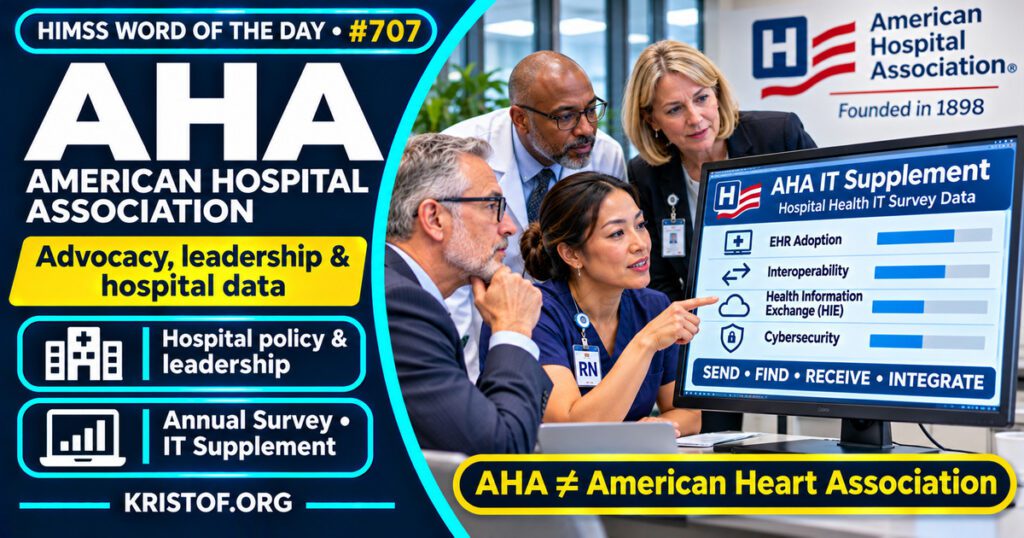
For health IT readers, AHA matters mostly through its surveys. The AHA Annual Survey covers hospitals broadly, and a separate AHA Information Technology Supplement asks about health IT. Federal data briefs and peer-reviewed studies use the supplement to describe how hospitals adopt and use technology.
| Item | Detail |
|---|---|
| Type | Membership and advocacy organization for hospitals and health systems |
| Founded | 1898 (AHA’s About page) |
| Members | Nearly 5,000 hospitals, health care systems, networks, and other care providers, plus 43,000 individual members (AHA’s figures, undated page) |
| Offices | Chicago and Washington, D.C. (AHA’s About page) |
| Health IT link | AHA Annual Survey and the AHA IT Supplement, which AHA says has run with ONC since 2008 |
| Relation to HIMSS | Separate organization; AHA does not issue CAHIMS or CPHIMS |
⚠️ Exam Alert: AHA in the HIMSS Dictionary is the American Hospital Association. The American Heart Association uses the same letters, so context decides which is meant. HIMSS is the society behind CAHIMS and CPHIMS, AHIMA is the health information management association, and ONC is a federal office that publishes data briefs using AHA survey data. The AHA Annual Survey and the IT Supplement are different instruments, and the second is the one most often cited in health IT research.
🌐 Why It Matters: Real-World Healthcare IT Context
Because AHA is an organization and not a research topic, this section draws on AHA’s own pages, the documentation for its Annual Survey Database, one ONC data brief, and two peer-reviewed papers that use the IT Supplement. AHA’s pages show what AHA says about itself and are not an independent evaluation.
Who it represents. AHA’s About page lists affiliated organizations: the Health Research & Educational Trust, AHA Physician Alliance, AHA Trustee Services, and the American Organization for Nursing Leadership. The last name points to nurse leaders, though I did not review that organization’s own pages.
The Annual Survey. Documentation for the fiscal year 2021 database, hosted by the National Bureau of Economic Research, says the AHA Annual Survey is voluntary and that hospitals need not be AHA members to take part. It says the database is produced by Health Forum LLC, an American Hospital Association company, and that missing values for non-responding hospitals are estimated with statistical methods. I read only the opening part of a very long document through a summarizing tool.
The IT Supplement. AHA says the IT Survey has been conducted since 2008 in partnership with ONC, now called ASTP, and that it began as a measure of EHR adoption before growing into a broader look at how technology supports hospital operations. AHA says the data inform federal policymakers and AHA’s responses to Congress, agencies, and the media, that ONC and ASTP publish data briefs, and that studies appear in peer-reviewed journals. AHA also says benchmarking reports are not available.
What the survey shows. ONC Data Brief No. 71 (May 2024), written by Gabriel and colleagues, used the 2018 through 2023 IT Supplement surveys of non-federal acute care hospitals. It reports that 70% of hospitals engaged in interoperable exchange at least sometimes as of 2023, and that the share routinely engaged in all four exchange domains (sending, finding, receiving, and integrating patient information) rose from 28% in 2018 to 43% in 2023. It says almost all hospitals electronically send patient information while about three-quarters integrate what they receive into their EHRs. It also reports that 71% of hospitals had routine access to outside clinical information at the point of care while 42% said clinicians often used it. The 2023 response rate was 58%, with weights from a propensity model based on hospital characteristics to adjust for non-response. Hospitals that answered rarely, no, do not know, or not applicable were coded as no, and the results cover non-federal acute care hospitals only. The survey is answered by the person most knowledgeable about the hospital’s health IT, typically the chief information officer, so the figures are self-reported.
Peer-reviewed work. Strawley et al. (2025) built three indices from the AHA health IT supplement: a Core Index, a Pathfinder Index, and a Friction Index. They report weighted means of 61 for Core (2023), 57 for Pathfinder (2022), and 30 for Friction (2023), with higher scores among large, non-critical-access, metropolitan hospitals using market-leading EHRs, and modest improvement over time. Anzalone et al. (2026) examined 41,838 hospital-years from the supplement’s survey years 2008 through 2018 and 2020 through 2023. They report that comprehensive EHR capability rose from 2% in 2008 to 75% in 2020, that certified EHR technology was nearly universal by 2023, and that rural hospitals stayed 4% to 15% behind urban hospitals in advanced functions such as interoperability, public health reporting, and social determinants of health data. Both studies share the survey’s limits, so the numbers describe what hospitals report, not how well a system works at the bedside. That reading is my inference.
What I could not confirm. I could not verify AHA’s membership counts independently, and I found no independent source on its finances, governance, or policy positions, which I did not review. I read the ONC brief through its web page and through a summarizing tool for the PDF. The two summaries disagreed on some domain-level figures, so I left those out and kept only figures both showed. The copy on the NCBI Bookshelf was blocked by a browser check, and I did not work around it. Check the figures in the brief itself before quoting them. AHA’s About page was live when retrieved and I saw no sign of a rename or merger, but it is undated.
Common AHA mix-ups:
- Confusing the American Hospital Association with the American Heart Association
- Treating the Annual Survey and the IT Supplement as one survey
- Reading self-reported survey figures as audited measures of hospital performance
- Assuming survey results cover every provider type when the briefs describe hospitals only
- Assuming AHA issues health IT certifications, which the pages reviewed do not describe
What AHA offers:
- Advocacy on national health policy for member hospitals and systems
- Education and information for health care leaders
- Data resources, including the Annual Survey and the IT Supplement
- Affiliated organizations for physicians, trustees, and nurse leaders
🏥 The Nurse’s Perspective: Clinical, Bedside, & Workflow
No study reviewed for this post measured nurses, so the points below are workflow context and not research findings.
At the Bedside
Nurses work in the hospitals the AHA survey describes. The gap in the ONC brief between routine access to outside clinical information (71%) and clinicians often using it (42%) is one nurses may recognize: a record from another organization can sit in the chart and still go unread when the screen is crowded or the path to it is unclear. The brief does not explain why use trails access, so that explanation is an inference.
In Clinical Workflow
Nurse informaticists reading policy debates and vendor materials will see AHA survey figures cited. Knowing that the figures rest on hospital self-report, a 58% response rate in 2023, and hospitals only helps in judging how far a number applies to a given unit or system. The survey’s four exchange domains of send, find, receive, and integrate also give a simple checklist for asking what a hospital’s interfaces actually do.
In EHR Implementation (Go-Live Perspective)
During an Epic Go-Live, analysts and at-the-elbow support staff hear the practical side of those four domains: where an outside result appears, whether a received summary lands in the chart or in a separate viewer, and who is expected to reconcile it. This is context from workflow experience, and the sources reviewed do not examine go-lives.
🎓 CAHIMS / CPHIMS & HIMSS Perspective
CAHIMS Exam Domain Mapping
AHA connects hospital policy, health IT data, and the leaders who manage both:
| CAHIMS Domain | How AHA Appears |
|---|---|
| Healthcare & Technology Environments | Hospital associations and the policy setting around them |
| Clinical Informatics | Survey measures of EHR capability, exchange, and social needs data |
| Healthcare Information & Systems Management | Using survey and benchmark data to judge hospital IT maturity |
| Management & Leadership | Advocacy, hospital governance, and leadership education |
Key Terms to Know Alongside AHA
- ONC — the federal health IT office that AHA says has partnered with it on the IT Survey since 2008
- Interoperability — the ability of systems to exchange and use data, the focus of the send, find, receive, and integrate measures
- EHR — the electronic health record, whose adoption the IT Survey first tracked
- HITECH — the federal law behind the EHR incentive programs that shaped hospital adoption
- Social Determinants of Health — non-clinical factors such as housing and food access, a topic the IT Supplement now asks about
HIMSS Organizational Position
HIMSS offers education and research on health information and technology topics through its Resource Center. Members can find related information on the HIMSS Resource Center page.
🧭 More HIMSS Word of The Day Terms
Related terms in the Healthcare Policy series:
- Payer
- OON (Out of Network)
- AHIMA (American Health Information Management Association)
- APG (Ambulatory Patient Group)
Browse all Healthcare Policy terms or the A–Z glossary.
🔗 Explore Further: External References
- AHA — About https://www.aha.org/about
- AHA — The American Hospital Association Information Technology Supplement Survey https://www.aha.org/american-hospital-association-information-technology-supplement-survey
- AHA Annual Survey Database, Fiscal Year 2021 documentation (hosted by NBER) https://data.nber.org/aha/docs/aha2021_docs/AnnualSurveyFY2021Doc.pdf
- ASTP/ONC — Interoperable Exchange of Patient Health Information Among U.S. Hospitals: 2023 (ONC Data Brief No. 71, May 2024) https://healthit.gov/data/data-briefs/interoperable-exchange-patient-health-information-among-us-hospitals-2023/
- Strawley et al. (2025), Journal of the American Medical Informatics Association — New indices to track interoperability among US hospitals. https://pubmed.ncbi.nlm.nih.gov/39724921/
- Anzalone et al. (2026), Journal of the American Medical Informatics Association — The digital divide in adoption and advanced use of electronic health records among US hospitals: rural versus urban disparities from 2008 to 2023. https://pubmed.ncbi.nlm.nih.gov/42043914/
- HIMSS — Resource Center https://www.himss.org/resource-center
Term source: HIMSS Dictionary of Health Information and Technology Terms, Acronyms, and Organizations, 6th Edition (2025). All definitions in this series are paraphrased for editorial purposes. Readers are encouraged to consult the primary source for exact language.
Eric Andrew Kristof, RN, CAHIMS is a Healthcare IT professional and HIMSS Arkansas Chapter member based in Hot Springs Village, AR, with hands-on Epic Go-Live experience and a diverse healthcare and IT background. He writes at kristof.org at the intersection of clinical care and healthcare technology.
Leave a Reply