By Eric Andrew Kristof, RN, CAHIMS | Healthcare IT Professional | HIMSS Arkansas Chapter Member
About This Series: The HIMSS Word of The Day is a running blog series drawing from the HIMSS Dictionary of Health Information and Technology Terms, Acronyms, and Organizations, 6th Edition (2025) — the authoritative reference for healthcare IT professionals and the primary study resource for CAHIMS and CPHIMS certification. Each post paraphrases the term in plain language, grounds it in real-world healthcare IT context, and adds a bedside nursing perspective you won’t find in a textbook.
📖 The Term: CRM (Customer Relationship Management)
Source: HIMSS Dictionary of Health Information and Technology Terms, Acronyms, and Organizations, 6th Edition (2025)
🔍 Plain-Language Definition
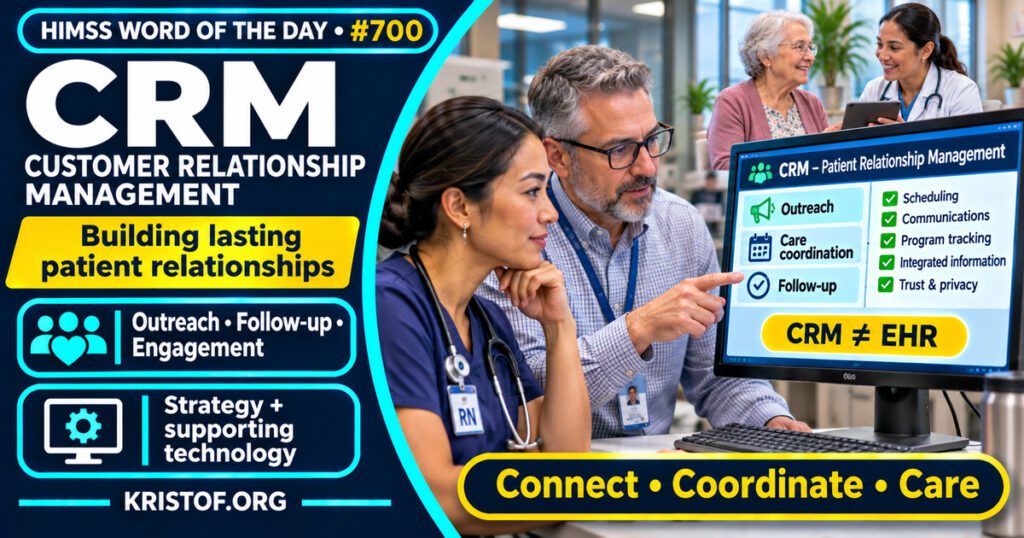
The HIMSS Dictionary gives two meanings for customer relationship management (CRM). The first is a computerized system for finding, targeting, winning, and keeping the right mix of customers, which is the business meaning. The second is the healthcare meaning, an organization-wide strategy for managing interactions with patients and their support networks, suppliers, providers, or employees using CRM technology. The dictionary says the aim is meaningful, lasting relationships that improve patient experience, population health, cost, and the working life of providers, and that lead to more trust and loyalty.
The studies below use CRM in four ways: as a tracking tool, as an analysis method, as a platform, and as a model for hospital management.
| Piece | What it describes | Where it appears in this post |
|---|---|---|
| CRM as a strategy | An organization-wide approach to interactions with patients and partners | Dictionary; Meskarpour-Amiri et al. |
| CRM system (CRMS) | Software that records and manages those interactions | Baashar et al.; Pham-Singer et al. |
| Segmentation | Grouping patients by visit recency, frequency, and spending | Li et al. |
| AI-enabled platforms | CRM platforms with artificial intelligence features | Gupta |
| CRM data as an input | CRM platform records used as a data source in an evaluation | Vashi et al. |
⚠️ Exam Alert: CRM is not an electronic health record, which holds the clinical record, and it is not a patient portal, which is the patient-facing access point. CRM manages relationships and interactions, and the dictionary frames it as a strategy as well as a system. “Customer” is a term borrowed from business, and the literature also uses patient relationship management (PRM) for the same idea in health care.
🌐 Why It Matters: Real-World Healthcare IT Context
Where it shows up. CRM tools support scheduling follow-up, outreach, program tracking, and communication, and they also support marketing and retention. The five health care research sources below plus one access evaluation were read as abstracts only.
What reviews say. Baashar et al. (2020) conducted a systematic review of CRM in the health care environment, including hospitals, clinics, medical centers, and nursing homes. They analyzed 19 studies that fell into three categories: social or electronic CRM, implementing CRM systems, and adopting CRM systems. The authors report positive outcomes in patient relationship and communication, satisfaction, treatment outcomes, empowerment, and hospital operations, productivity, cost, and service quality. They also conclude that substantial knowledge gaps exist and recommend research on factors such as patient characteristics, culture, trust, security, and privacy, as well as mobile CRM and data-mining CRM. The abstract says research specific to health care is very limited.
CRM as a quality improvement tool. Pham-Singer et al. (2021) describe HealthyHearts New York City, one of seven cooperatives funded through AHRQ‘s EvidenceNOW initiative, which evaluated practice facilitation for implementing cardiovascular prevention guidelines. A customizable CRM system was implemented to support the intervention with 257 small independent practices, with features customized for program management, facilitation tracking, supervision, and data collection for performance feedback. The authors call it a valuable tool for tracking and managing the intervention and add that implementation required an articulated plan and an adoption process. The abstract reports no outcome data for the CRM system itself.
What matters to hospitals adopting it. Meskarpour-Amiri et al. (2021) designed a patient relationship management model for general hospitals using a systematic review, pair-wise comparisons, and interpretive structural modeling. The top three priorities were an integrated information system, registration of the patient’s essential information, and the right data at the right time. The authors say the strategy depends on an electronic CRM system, the choice of technology, integrated information systems, and a technology culture. It is a cross-sectional modeling study from 2020 and not an outcome evaluation.
Segmenting patients with CRM methods. Li et al. (2021) used CRM theory to analyze outpatients at an infectious disease hospital in Shanghai, China. From 2,271,020 extracted data elements between August 2009 and December 2019, they kept 171,107 valid elements, one per person. The main diseases were viral hepatitis B and AIDS, and drug expenditure averaged 80.39% of spending. Their expanded recency-frequency-monetary model, which adds the share spent on drugs, grouped patients into potential patients (24.2%), high-value patients (24.5%), and basal patients (51.3%), and a decision tree verified the model with 99.97% accuracy. The authors say the approach provides an objective basis for hospital management. The accuracy figure appears to show how well a decision tree reproduces the clusters, not whether the groups predict anything about care, and the paper does not say whether any service decisions followed.
AI-enabled platforms and a CRM data source. Gupta (2026) published a research letter summarizing early lessons from four enterprise implementations of AI-enabled CRM platforms and describing governance practices associated with improvements in affordability, adherence, and access at program level. The abstract gives no figures, so I cannot report effect sizes. Vashi et al. (2026) evaluated the Veterans Administration Health Connect modernization, which centralized appointment scheduling and added same-day virtual evaluation after nurse triage, using data from sources that included CRM platforms. The study examined the program, not CRM itself. Same-day scheduling rose by 14.3 percentage points, time to a completed appointment increased by 2.9 days, and emergency department use and costs did not change meaningfully.
What I could not confirm. I read abstracts only, and one search result, a 2026 letter on CRM in hemodialysis care, had no abstract, so I did not use it. The review’s reported positive outcomes come from the authors’ synthesis of studies of varied design, and I did not check the underlying studies. The research letter’s abstract has no data. None of the sources compares CRM with a non-CRM approach on patient outcomes. Using CRM to rank patients by economic value, as in the Shanghai analysis, raises a fairness question about the equity of care, and the abstract does not address it.
Common CRM problems:
- Borrowing a business model that treats patients as customers of differing value
- Very limited health care research, as the review notes
- Adopting a system without an implementation plan and an adoption process
- Data that are not integrated or not recorded at the right time
- Reporting outcomes for a program without isolating the effect of the CRM tool
What supports CRM:
- A systematic review that reports positive outcomes across communication, satisfaction, and operations
- A documented use as a tracking and feedback tool across 257 small practices
- Priorities for adoption that hospital managers can act on, such as integrated information and essential data registration
- Analytic methods that can describe patient groups using existing data
- Early governance practices described for AI-enabled platforms
🏥 The Nurse’s Perspective: Clinical, Bedside, & Workflow
None of the abstracts examines nurses as participants, although one program evaluation involved nurse triage calls, so this section is workflow context and not evidence.
At the Bedside
At the bedside a relationship is built through small things: a call light answered, an explanation given, a follow-up promised. A CRM tool does not do that work. Its role in nursing is closer to the follow-up that happens after the visit, such as a reminder, a message, or a list of patients who have not been contacted.
In Clinical Workflow
Nurses who run care management or triage lines work with lists of patients to contact and notes on what was said. The VA study evaluated a program in which nurse triage was followed by centralized scheduling and virtual evaluation, and it used CRM platform data among its sources. The Meskarpour-Amiri model highlights the same practical point, that having the right data at the right time is a first-order need.
In EHR Implementation (Go-Live Perspective)
During an Epic Go-Live, analysts and at-the-elbow support staff see how a separate tool that holds contact lists or outreach notes can duplicate or conflict with what is in the record. Deciding which system holds which information, and how they connect, is an integration question like the ones the hospital model study ranks highly. That is context only, and none of the studies reviewed examines go-lives.
🎓 CAHIMS / CPHIMS & HIMSS Perspective
CAHIMS Exam Domain Mapping
CRM appears in questions about patient engagement, data use, and organizational strategy:
| CAHIMS Domain | How CRM Appears |
|---|---|
| Healthcare & Technology Environments | Patient engagement strategies and supporting systems |
| Clinical Informatics | Outreach, follow-up, and communication workflows |
| Healthcare Information & Systems Management | System selection, integration, and data quality |
| Management & Leadership | Strategy, trust, and measuring program results |
Key Terms to Know Alongside CRM
- Care management — coordinated work to help patients with complex needs get appropriate care
- Care coordination — organizing care activities and sharing information among everyone involved
- Patient portal — a secure online tool that lets patients see and use parts of their health information
- Data analytics — examining data to find patterns that support decisions
- Dashboard — a visual display of key measures for monitoring performance
- Patient-centric — organized around the needs and preferences of the patient
HIMSS Organizational Position
HIMSS offers education and research on health information and technology topics through its Resource Center. Members can find related information on the HIMSS Resource Center page.
🧭 More HIMSS Word of The Day Terms
Related terms in the Data and Analytics series:
Browse all Data and Analytics terms or the A–Z glossary.
🔗 Explore Further: External References
- Baashar et al. (2020), Computer Standards and Interfaces — Customer relationship management systems (CRMS) in the healthcare environment: A systematic literature review. https://pubmed.ncbi.nlm.nih.gov/34170994/
- Pham-Singer et al. (2021), American Journal of Medical Quality — Using a Customer Relationship Management System to Manage a Quality Improvement Intervention. https://pubmed.ncbi.nlm.nih.gov/32924529/
- Meskarpour-Amiri et al. (2021), Journal of Education and Health Promotion — Designing a model for patient relationship management in the general hospitals using the combination of analytic hierarchy process and interpretive structural modeling. https://pubmed.ncbi.nlm.nih.gov/34761019/
- Li et al. (2021), International Journal of Medical Informatics — Customer relationship management analysis of outpatients in a Chinese infectious disease hospital using drug-proportion recency-frequency-monetary model. https://pubmed.ncbi.nlm.nih.gov/33418439/
- Gupta (2026), JMIR Medical Informatics — AI-Enabled Customer Relationship Management Platforms for Patient Services in Health Care, Early Lessons From Governance, and Program-Level Outcomes. https://pubmed.ncbi.nlm.nih.gov/41481793/
- Vashi et al. (2026), Health Services Research — Modernizing the Front Door to Care: Evaluation of Veterans Administration Health Connect’s Impact on Access, Utilization, and Patient Experience. https://pubmed.ncbi.nlm.nih.gov/42470152/
- HIMSS — Resource Center https://www.himss.org/resource-center
Term source: HIMSS Dictionary of Health Information and Technology Terms, Acronyms, and Organizations, 6th Edition (2025). All definitions in this series are paraphrased for editorial purposes. Readers are encouraged to consult the primary source for exact language.
Eric Andrew Kristof, RN, CAHIMS is a Healthcare IT professional and HIMSS Arkansas Chapter member based in Hot Springs Village, AR, with hands-on Epic Go-Live experience and a diverse healthcare and IT background. He writes at kristof.org at the intersection of clinical care and healthcare technology.
Leave a Reply