By Eric Andrew Kristof, RN, CAHIMS | Healthcare IT Professional | HIMSS Arkansas Chapter Member
About This Series: The HIMSS Word of The Day is a running blog series drawing from the HIMSS Dictionary of Health Information and Technology Terms, Acronyms, and Organizations, 6th Edition (2025) — the authoritative reference for healthcare IT professionals and the primary study resource for CAHIMS and CPHIMS certification. Each post paraphrases the term in plain language, grounds it in real-world healthcare IT context, and adds a bedside nursing perspective you won’t find in a textbook.
📖 The Term: ICIDH (International Classification of Impairments, Disabilities, and Handicaps)
Source: HIMSS Dictionary of Health Information and Technology Terms, Acronyms, and Organizations, 6th Edition (2025)
🔍 Plain-Language Definition
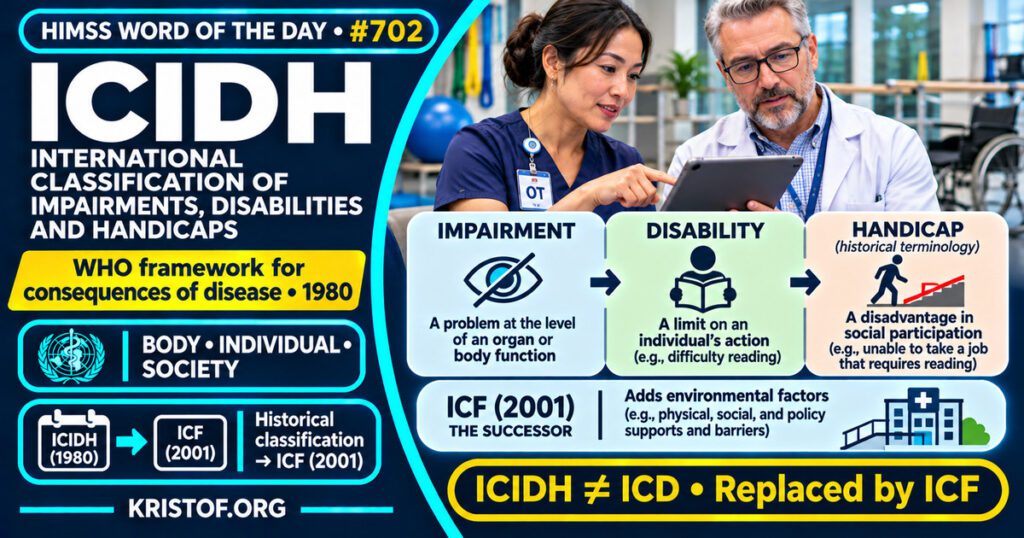
The HIMSS Dictionary describes the ICIDH as a World Health Organization classification, published in Geneva in 1980, that gives a common framework and shared definitions for disability-related questions. It separates three dimensions: impairment at the level of the organ or body, disability at the level of the individual, and handicap at the level of society.
A note on the name: the dictionary expands the acronym as “International Classification of Improvements, Disability, and Health.” The papers read for this post, from the journal Disability and Rehabilitation, use the title “International Classification of Impairments, Disabilities and Handicaps.” I use the literature’s title and flag the difference so that a reader who meets either wording is not confused.
| Level | What it describes | My illustration, not from the sources |
|---|---|---|
| Impairment | A problem at the level of an organ or body function | A loss of vision in one eye |
| Disability | A limit on an individual’s action | Difficulty reading print |
| Handicap | A disadvantage in social interaction | Being unable to take a job that requires reading forms |
The examples are mine and are meant only to show the three levels.
⚠️ Exam Alert: The ICIDH classifies the consequences of disease at three levels, and the ICF replaced it with a framework for functioning, disability, and health that also includes environmental factors. ICD classifies diseases and diagnoses, so it answers what condition a person has while the ICF and ICIDH describe what the condition does to function. Do not treat the three as interchangeable. Questions may ask which classification describes functioning and disability.
🌐 Why It Matters: Real-World Healthcare IT Context
Because the ICIDH is a classification that was later replaced, this section draws on WHO’s ICF page and five papers from PubMed, four of them from a 2003 special issue of one journal and one from 1995. I read them as abstracts, and one has no abstract.
The original scheme. Thuriaux (1995) wrote that WHO introduced the scheme in the mid-1970s for measuring the long-term, non-fatal consequences of disease. It uses three axes: impairment with 1,009 items, disability with 338 items, and handicap, called disadvantage, with 72 items. The paper describes how the ICIDH had been used since 1980 to estimate how common disability is in populations, to inform policy decisions, to manage institutions, and to care for individuals. It also lists problems: the role of environmental factors was unclear, and impairments, disabilities, and handicaps overlapped. The author anticipated a revised proposal for 1998, formally issued in 1999.
The move to the ICF. WHO says its 54th World Health Assembly endorsed the ICF on 22 May 2001 and that all 191 member states endorsed it. WHO describes the ICF as its framework for measuring health and disability at the level of individuals and populations, and notes it includes a list of environmental factors. WHO’s page does not mention the ICIDH, so the link between the two comes from the papers. de Kleijn-de Vrankrijker (2003) titled a paper on “the long way” from the ICIDH to the ICF, though PubMed shows no abstract, so I cannot say more about its content. Kennedy (2003) described how the International Mental Health Task Force helped revise the ICIDH and develop the ICF, including a chapter on mental functioning, and analyzed the mental disorder aspects of impairments and disabilities in the ICIDH.
Use by nurses and other professions. Heerkens et al. (2003) described how nurses and allied health professionals in the Netherlands used the ICIDH as a shared terminology to document patient descriptors, and reviewed possible uses of the ICIDH and its successor, the ICF. They concluded that neither had the level of detail needed for a richer description of a patient’s functioning, and they argued for a clinical modification of the ICF. This is a description from one country, not a test of outcomes.
Use in measurement. Mbogoni (2003) reviewed the use of the ICIDH and ICF in developing countries through the United Nations Disability Statistics Database. For most countries, the questions used to identify people with disabilities were not based on either classification, and disability was mostly identified with screens for a few severe impairments. Some recent studies did use the ICIDH or ICF framework, which the author attributes largely to United Nations census guidelines.
What I could not confirm. WHO’s ICF page does not describe the ICF’s components or its relation to the ICIDH, so I did not verify those from WHO. I did not read the 1980 WHO publication, so the publication date comes from the dictionary and from a 1995 paper’s description of use since 1980. I found no current health system documentation using the ICIDH, and the papers call the ICF its successor. I found no study of whether either classification improves care or outcomes. The dictionary’s expansion of the acronym does not match the literature’s title, and I have not found a source for the dictionary’s version.
Common ICIDH problems:
- Confusing the ICIDH with the ICF, or with the ICD
- Using the dictionary’s expansion without checking the literature’s title
- Treating impairment, disability, and handicap as the same idea
- Overlooking that the ICIDH did not give environmental factors a clear role
- Assuming a superseded classification is still in use
What supports the ICIDH’s ideas:
- A shared vocabulary that separates body, individual, and social levels
- Use in surveys and policy to describe disability in populations
- A starting point for the ICF, which added environmental factors
- Adoption as a shared terminology by some nurses and allied professions in one country
- A framework that has been revised in response to criticism
🏥 The Nurse’s Perspective: Clinical, Bedside, & Workflow
Only one of the papers describes nurses directly, and it is a description of practice in the Netherlands, so the rest of this section is workflow context and not evidence.
At the Bedside
Nurses document function every day: how far a patient walked, what help was needed to bathe, whether a patient could swallow safely. Those observations describe the person’s activity, which is the idea the ICIDH tried to give a name. A shared way to describe function lets a nurse’s note be understood by a therapist or case manager.
In Clinical Workflow
Heerkens et al. found that the Dutch professions could use the classification as a shared terminology, and that it lacked the detail for a rich clinical picture. That is a reminder that a classification built for population statistics may not fit bedside documentation. Nurse informaticists weighing how to represent function in flowsheets face the same trade-off between detail and standardization.
In EHR Implementation (Go-Live Perspective)
During an Epic Go-Live, analysts and at-the-elbow support staff see functional status documentation in flowsheets, assessments, and discharge planning. The sources reviewed do not examine go-lives, and none says the ICIDH or ICF is built into any EHR, so this is context only.
🎓 CAHIMS / CPHIMS & HIMSS Perspective
CAHIMS Exam Domain Mapping
The ICIDH connects classification systems, function, and how health data are described:
| CAHIMS Domain | How ICIDH Appears |
|---|---|
| Healthcare & Technology Environments | WHO classifications and international standards |
| Clinical Informatics | Documenting function and disability |
| Healthcare Information & Systems Management | Choosing classifications and code sets |
| Management & Leadership | Reporting, policy, and population measurement |
Key Terms to Know Alongside ICIDH
- ICD — the International Classification of Diseases, which classifies diseases and diagnoses
- Healthcare terminology — the vocabulary used to describe health and care
- Code set — a set of codes used to represent data elements
- Nursing Minimum Data Set — a standard set of nursing data elements
- Minimum Data Set — a standardized assessment used in long-term care
- SNOMED CT — a clinical terminology used to represent health information
HIMSS Organizational Position
HIMSS offers education and research on health information and technology topics through its Resource Center. Members can find related information on the HIMSS Resource Center page.
🧭 More HIMSS Word of The Day Terms
Related terms in the Clinical Informatics series:
- Quality Improvement (QI)
- VistA (Veterans Health Information Systems and Technology Architecture)
- SOP (Standard Operating Procedure)
- CMIO (Chief Medical Information Officer)
Browse all Clinical Informatics terms or the A–Z glossary.
🔗 Explore Further: External References
- WHO — International Classification of Functioning, Disability and Health (ICF). https://www.who.int/standards/classifications/international-classification-of-functioning-disability-and-health
- Thuriaux (1995), Disability and Rehabilitation — The ICIDH: evolution, status, and prospects. https://pubmed.ncbi.nlm.nih.gov/7787193/
- de Kleijn-de Vrankrijker (2003), Disability and Rehabilitation — The long way from the International Classification of Impairments, Disabilities and Handicaps (ICIDH) to the International Classification of Functioning, Disability and Health (ICF). https://pubmed.ncbi.nlm.nih.gov/12959328/
- Heerkens et al. (2003), Disability and Rehabilitation — Past and future use of the ICF (former ICIDH) by nursing and allied health professionals. https://pubmed.ncbi.nlm.nih.gov/12959336/
- Kennedy (2003), Disability and Rehabilitation — Functioning and disability associated with mental disorders: the evolution since ICIDH. https://pubmed.ncbi.nlm.nih.gov/12959335/
- Mbogoni (2003), Disability and Rehabilitation — On the application of the ICIDH and ICF in developing countries: evidence from the United Nations Disability Statistics Database (DISTAT). https://pubmed.ncbi.nlm.nih.gov/12959339/
- HIMSS — Resource Center https://www.himss.org/resource-center
Term source: HIMSS Dictionary of Health Information and Technology Terms, Acronyms, and Organizations, 6th Edition (2025). All definitions in this series are paraphrased for editorial purposes. Readers are encouraged to consult the primary source for exact language.
Eric Andrew Kristof, RN, CAHIMS is a Healthcare IT professional and HIMSS Arkansas Chapter member based in Hot Springs Village, AR, with hands-on Epic Go-Live experience and a diverse healthcare and IT background. He writes at kristof.org at the intersection of clinical care and healthcare technology.
Leave a Reply