By Eric Andrew Kristof, RN, CAHIMS | Healthcare IT Professional | HIMSS Arkansas Chapter Member
About This Series: The HIMSS Word of the Day is a running blog series drawing from the HIMSS Dictionary of Health Information and Technology Terms, Acronyms, and Organizations, 6th Edition (2025) — the authoritative reference for healthcare IT professionals and the primary study resource for CAHIMS and CPHIMS certification. Each post paraphrases the term in plain language, grounds it in real-world healthcare IT context, and adds a bedside nursing perspective you won’t find in a textbook.
📖 The Term: CMIO (Chief Medical Information Officer)
Source: HIMSS Dictionary of Health Information and Technology Terms, Acronyms, and Organizations, 6th Edition (2025)
🔍 Plain-Language Definition
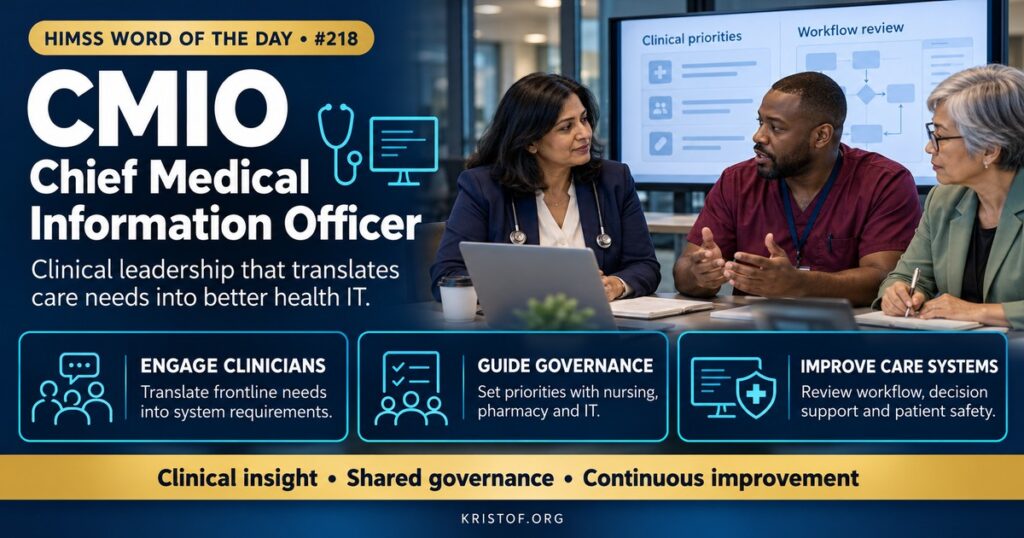
The chief medical information officer (CMIO), sometimes written chief medical informatics officer, is a leader who guides the ongoing development, rollout, advancement, and improvement of electronic information systems that affect patient care. The HIMSS Dictionary stresses a partnership with the organization’s IT leadership, in which the CMIO helps turn what clinicians need into specifications that IT teams can build for clinical and research systems.
The role is usually filled by a physician, which explains the word medical in the title, but the broader family of titles reflects different clinical backgrounds. The AMIA task force on this subject uses chief clinical informatics officer (CCIO) as an umbrella term that includes CMIO and chief nursing informatics officer (CNIO), as well as the rarely used chief pharmacy and chief dental informatics officer titles.
| Role | Primary Focus | Typical Partnership |
|---|---|---|
| CMIO | Physician and clinical workflow leadership for health IT | Works with the CIO, CNIO, medical staff, and quality leaders |
| CNIO | Nursing practice and documentation in health IT | Works with the chief nursing officer, CMIO, and IT |
| CCIO | Umbrella title for clinical informatics leaders | Varies by organization |
| CIO | Overall IT strategy, operations, and infrastructure | Partners with clinical informatics leaders |
| CISO | Information security and risk | Works with the CIO and compliance |
⚠️ Exam Alert: The CMIO is a clinical leader, not the head of IT operations; that is the CIO. CCIO is the umbrella title, and CNIO is the nursing counterpart. The dictionary entry covers both medical information officer and medical informatics officer, which are used interchangeably.
🌐 Why It Matters: Real-World Healthcare IT Context
Electronic health records and related systems shape how clinicians work every minute of the day. Decisions about order sets, alerts, documentation templates, and interfaces are clinical decisions as well as technical ones. Someone needs authority and credibility with clinicians to make those decisions and to explain them. The CMIO fills that gap.
Typical responsibilities include chairing or co-chairing clinical informatics governance, setting priorities with the CIO, leading clinician engagement for projects such as an EHR go-live, overseeing clinical decision support design and review, supporting patient safety review of technology-related events, guiding optimization after go-live, and representing clinicians in vendor and executive discussions. Some CMIOs also supervise or collaborate with teams of physician, nurse, pharmacy, and analyst informaticists, and some continue to practice part time to stay close to care.
The role is not uniform. The AMIA task force report, published in 2016, observed that the emerging CCIO role remained heterogeneous, with people coming from a variety of clinical settings and backgrounds, and that the title, responsibilities, and scope are defined locally by each organization. That makes it difficult for candidates and employers to know what a given title means. The task force developed recommendations for knowledge, education, and operational skills, focusing on a common core with differences based on a person’s clinical informatics focus. It concluded that a growing body of clinical informatics knowledge and increasing certification were leading to greater consistency, and it advised that reaching a predictable skill set requires clearly defined clinical informatics education and training, and that future education should reflect changes in the field’s knowledge and in day-to-day practice.
Formal pathways have since matured. Physicians can pursue board certification in clinical informatics as a subspecialty through the American Board of Preventive Medicine. Attention to the role predates that: an article from 2003 in the Journal of Healthcare Information Management already discussed the essential skills for the chief medical information officer. The theme across the years is consistent: strong CMIOs combine clinical credibility, technical understanding, change leadership, and communication.
Governance is where the CMIO has the greatest influence. Without a structured way to decide which requests to build, which alerts to retire, and which workflows to standardize, organizations drift toward customization that is hard to support and unsafe to maintain. A clinical informatics governance body chaired by clinical leaders, with nursing, pharmacy, and IT at the table, gives decisions legitimacy. The ONC SAFER Guides offer a practical set of self-assessment tools that CMIOs and their teams can use to review safety-related practices.
Common CMIO role problems:
- Unclear scope, with responsibility but not authority
- Reporting lines that separate the role from clinical or IT leadership
- Little protected time for the role
- Physician-only perspective when nursing and pharmacy input is needed
- Constant demand to fix individual complaints rather than shape priorities
- Insufficient informatics team capacity to deliver on the agenda
What supports an effective CMIO:
- Defined scope, decision rights, and executive sponsorship
- A partnership model with the CIO, CNIO, and CISO
- Clinical informatics governance with nursing and pharmacy members
- Data on use, burden, and safety to guide priorities
- Formal informatics training and continued learning
- Visible presence with frontline clinicians
🏥 The Nurse’s Perspective: Clinical, Bedside, & Workflow
Nurses and CMIOs share the same goal, usable and safe systems, yet they often see different parts of the problem.
At the Bedside
Many requests that nurses make, such as fewer clicks, better handoff reports, or clearer alerts, end up in front of the CMIO and the governance group. Specific examples with the workflow context, the patient safety concern, and how often the problem occurs carry weight. Nurses also help by sharing what works, since good practices on one unit can become standards for others.
In Clinical Workflow
Nurse leaders collaborate with the CMIO through governance committees, order set and alert review, and patient safety investigations. A nurse perspective prevents designs that are workable for physicians but burdensome for nursing documentation or medication administration. Where the organization has a CNIO, the CMIO and CNIO often act as a paired leadership team.
Nurse informaticists serve as translators between bedside practice and the CMIO’s agenda. They gather data from units, run pilots, and bring recommendations forward with evidence.
In EHR Implementation (Go-Live Perspective)
During an Epic Go-Live, the CMIO is a visible clinical sponsor, helping to resolve disputes about workflow and to communicate decisions to physicians. At-the-elbow support analysts report patterns of problems to the command center, and those reports often reach the CMIO’s desk. When the issue is a policy or practice question rather than a build question, the CMIO and clinical leaders make the call.
🎓 CAHIMS / CPHIMS & HIMSS Perspective
CAHIMS Exam Domain Mapping
The CMIO appears in leadership, governance, and clinical informatics questions:
| CAHIMS Domain | How the CMIO Appears |
|---|---|
| Healthcare & Technology Environments | Roles in the health IT leadership team, professional certification |
| Clinical Informatics | Clinical workflow design, decision support governance, safety |
| Healthcare Information & Systems Management | Partnership with IT operations, prioritization of requests |
| Management & Leadership | Governance, change leadership, stakeholder engagement |
Key Terms to Know Alongside the CMIO
- CCIO — umbrella title for chief clinical informatics officers
- CNIO — chief nursing informatics officer
- CIO — chief information officer responsible for IT strategy and operations
- Clinical Informatics Governance — structure for deciding clinical system priorities and standards
- Clinical Decision Support Governance — oversight of alerts, order sets, and rules
- Clinical Informatics Subspecialty — board-certified subspecialty for physicians
HIMSS Organizational Position
HIMSS supports clinical informatics leaders through its Physician Community and Nursing Informatics Community, education, and certification programs including CAHIMS and CPHIMS. Members can find related resources through the HIMSS Resource Center and community pages.
🔗 Explore Further: External References
- Kannry et al. (2016), Applied Clinical Informatics — The Chief Clinical Informatics Officer (CCIO): AMIA Task Force Report on CCIO Knowledge, Education, and Skillset Requirements https://pubmed.ncbi.nlm.nih.gov/27081413/
- Hersher (2003), Journal of Healthcare Information Management — The Essential Skills for the Chief Medical Information Officer https://pubmed.ncbi.nlm.nih.gov/12553210/
- ABPM — Clinical Informatics Subspecialty https://www.theabpm.org/become-certified/subspecialties/clinical-informatics/
- ONC — SAFER Guides https://healthit.gov/clinical-quality-and-safety/safer-guides/
- HIMSS — Physician Community https://www.himss.org/networking/communities/physician/
- HIMSS — Nursing Informatics Community https://www.himss.org/networking/communities/nursing-informatics/
Term source: HIMSS Dictionary of Health Information and Technology Terms, Acronyms, and Organizations, 6th Edition (2025). All definitions in this series are paraphrased for editorial purposes. Readers are encouraged to consult the primary source for exact language.
Eric Andrew Kristof, RN, CAHIMS is a Healthcare IT professional and HIMSS Arkansas Chapter member based in Hot Springs Village, AR, with hands-on Epic Go-Live experience and a diverse healthcare and IT background. He writes at kristof.org at the intersection of clinical care and healthcare technology.
Leave a Reply