By Eric Andrew Kristof, RN, CAHIMS | Healthcare IT Professional | HIMSS Arkansas Chapter Member
About This Series: The HIMSS Word of the Day is a running blog series drawing from the HIMSS Dictionary of Health Information and Technology Terms, Acronyms, and Organizations, 6th Edition (2025) — the authoritative reference for healthcare IT professionals and the primary study resource for CAHIMS and CPHIMS certification. Each post paraphrases the term in plain language, grounds it in real-world healthcare IT context, and adds a bedside nursing perspective you won’t find in a textbook.
📖 The Term: Code Set
Source: HIMSS Dictionary of Health Information and Technology Terms, Acronyms, and Organizations, 6th Edition (2025)
🔍 Plain-Language Definition
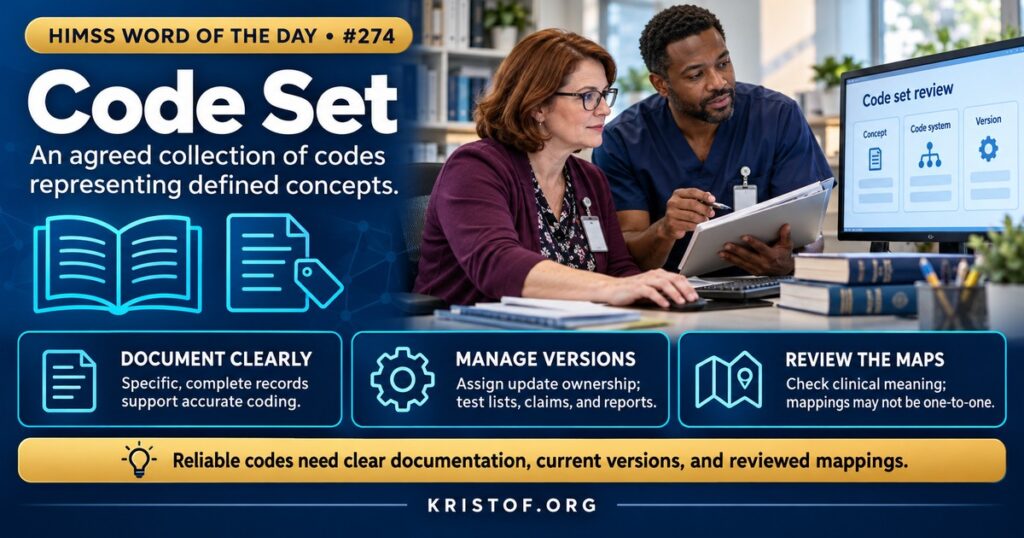
A code set is a group of elements mapped to another group according to a coding scheme. In plain terms, it is an agreed list that pairs a concept, such as a diagnosis, with a code that computers can store, exchange, and count. The HIMSS Dictionary separates two kinds. Clinical or medical code sets label health conditions along with the procedures, services, and items, such as equipment and supplies, used in care. Nonclinical or administrative code sets describe the parties and events that an administrative process needs to recognize, for example, the type of facility where a service was provided.
Code sets matter because health care runs on shared meaning. A claim, a quality measure, a public health report, and a research query all assume that a code means the same thing to sender and receiver. Code sets are maintained by organizations that publish rules and updates, and the version in use matters.
| Code Set | Used For | Maintained By |
|---|---|---|
| ICD-10-CM | Diagnoses and health conditions | HHS (U.S. clinical modification) |
| ICD-10-PCS | Inpatient hospital procedures | HHS |
| CPT-4 | Physician and other health care services | American Medical Association |
| HCPCS | Supplies, equipment, and other items and services | HHS |
| NDC | Drugs and biologics | HHS with drug manufacturers |
| SNOMED CT | Detailed clinical concepts in the record | SNOMED International |
⚠️ Exam Alert: HIPAA adopts medical data code sets for standard transactions, including ICD-10-CM, ICD-10-PCS, CPT-4 with HCPCS, and NDC. SNOMED CT and LOINC are clinical terminologies used for exchange within the record and are not the HIPAA transaction code sets. A map links one code set to another but may not match one-to-one.
🌐 Why It Matters: Real-World Healthcare IT Context
HIPAA’s administrative simplification rules require standard code sets for electronic transactions. The regulation at 45 CFR 162.1002 lists the standard medical data code sets and the periods in which each applies. For dates on and after October 1, 2015, it names the International Classification of Diseases, 10th Revision, Clinical Modification (ICD-10-CM) for diagnoses and the ICD-10 Procedure Coding System (ICD-10-PCS) for inpatient hospital procedures, along with National Drug Codes for retail pharmacy drug reporting, the Code on Dental Procedures and Nomenclature for dental services, and the combination of the Healthcare Common Procedure Coding System (HCPCS) and Current Procedural Terminology, Fourth Edition (CPT-4) for physician and other health care services. Which code set applies to a drug or supply depends on the setting and the period, so organizations consult the regulation and current guidance. Using the required code set in a standard transaction is a compliance matter as well as a technical one.
Code sets are only as good as the process that assigns codes. A 2026 study in the journal Infection analyzed 10,334 hospital cases from ten German hospitals and compared sepsis identified by structured chart review with sepsis in administrative coded data. Among 1,310 cases that met the severe sepsis criteria used in the study, only 30.7 percent were correctly coded. The strongest predictor of correct coding was explicit mention of sepsis in the medical chart, with an odds ratio of 19.58. ICU treatment, organ dysfunction severity, and mechanical ventilation were also associated with higher coding rates, while pneumonia as the infection source was linked to a lower chance that sepsis was named and coded. The study took place in Germany under a different coding system and data from 2015 to 2017, so its numbers do not transfer directly to U.S. practice. The lesson does: codes follow documentation, and documentation that does not name a condition clearly leaves coders and algorithms to guess.
Technology can help with coding but does not remove the need for clinical clarity. A randomized controlled experiment published in 2019 in the International Journal of Medical Informatics tested map-assisted ICD-10-CM coding. Clinical problems encoded in SNOMED CT in the problem list were translated through the National Library of Medicine’s SNOMED CT to ICD-10-CM map, and the suggested codes were offered to professional coders. Compared with usual coding, map-assisted coding reduced average coding time per note by 1.5 minutes. Gains in reliability and accuracy were small and not statistically significant, and benefits were larger for more experienced coders. When the map failed to find the correct codes, most failures came from problems missing from the problem list and from suboptimal mapping. The finding supports using maps as aids, not replacements, and shows the dependence on a complete and well-maintained problem list.
Interoperability depends on code sets in other ways. Clinical systems often store data in one terminology, such as SNOMED CT for problems, LOINC for laboratory tests, and RxNorm for medications, while billing uses ICD-10-CM, CPT, and HCPCS. Maps connect them, but a map is a judgment about equivalence, and fine-grained clinical concepts often collapse into broader billing codes. Annual updates add, retire, and revise codes, so organizations need processes to load new versions, update order sets and pick lists, retire obsolete entries, and test claims. A code that is valid in one year may be invalid in the next.
Common code set problems:
- Documentation too vague to support specific codes
- Out-of-date code sets in pick lists or charge masters
- Maps treated as exact when they are approximate
- Local codes that do not map to standard sets
- Annual updates applied late or without testing
- Different code sets used in different systems for the same concept
What supports sound code set management:
- Clinician education on documentation that supports specific coding
- A named owner and calendar for annual code set updates
- Mapping governance with clinical review
- Testing of claims and reports after each update
- Problem lists maintained in standard terminology
- Feedback loops between coders, clinicians, and analysts
🏥 The Nurse’s Perspective: Clinical, Bedside, & Workflow
Nurses influence code sets through the clarity and completeness of what they document.
At the Bedside
A nurse who documents a pressure injury stage, a fall with injury, a wound’s characteristics, or a patient’s functional status in structured fields gives coders and quality teams something to work with. A vague note such as “skin issue” cannot support a precise code. When a condition changes, updating the problem list and assessments keeps the record, and the codes drawn from it, aligned with reality.
In Clinical Workflow
Nurse managers see code-driven reports on quality measures, hospital-acquired conditions, and risk adjustment. When numbers look wrong, they ask whether the cause is care, documentation, or coding. Clinical documentation improvement nurses query clinicians to clarify documentation so that it reflects the patient’s true condition and severity.
Nurse informaticists work with HIM and coding teams on pick lists, flowsheet rows, and order sets that carry the right codes, and on mappings between nursing content and standard terminologies. They help test code set updates before they go live.
In EHR Implementation (Go-Live Perspective)
An Epic Go-Live loads code sets for diagnoses, procedures, and charges, and analysts verify that clinician-friendly terms map to the correct codes. At-the-elbow support analysts hear when a pick list lacks a term clinicians expect, and note when workarounds appear, such as free-text entries used in place of searching. These reports help improve the lists and reduce downstream coding queries.
🎓 CAHIMS / CPHIMS & HIMSS Perspective
CAHIMS Exam Domain Mapping
Code sets appear in standards, coding, and data management questions:
| CAHIMS Domain | How Code Sets Appear |
|---|---|
| Healthcare & Technology Environments | HIPAA code set requirements, standards organizations |
| Clinical Informatics | Documentation, clinical terminologies, decision support |
| Healthcare Information & Systems Management | Mapping, version control, interfaces, claims systems |
| Management & Leadership | Compliance, revenue cycle, change management for updates |
Key Terms to Know Alongside Code Set
- ICD-10-CM — U.S. diagnosis code set used in HIPAA transactions
- CPT — procedural terminology for physician and other services
- HCPCS — coding system for supplies, equipment, and other services
- Terminology Mapping — linking concepts in one code set to another
- Clinical Documentation Improvement — review process that clarifies documentation to support accurate coding
- Administrative Code Set — codes that identify entities or events for administrative processes
HIMSS Organizational Position
HIMSS supports standards-based data exchange and accurate health data through its public policy work, research, and education. Members can find related resources through the HIMSS Resource Center and Public Policy and Advocacy pages.
🔗 Explore Further: External References
- eCFR — 45 CFR 162.1002, Medical Data Code Sets https://www.ecfr.gov/current/title-45/subtitle-A/subchapter-C/part-162/subpart-J/section-162.1002
- Thomas-Rüddel et al. (2026), Infection — Think Sepsis, Write Sepsis, Code Sepsis: Patient Characteristics Associated With Sepsis (Under-)Coding in Administrative Health Data https://pubmed.ncbi.nlm.nih.gov/41359203/
- Fung et al. (2019), International Journal of Medical Informatics — Using SNOMED CT-Encoded Problems to Improve ICD-10-CM Coding: A Randomized Controlled Experiment https://pubmed.ncbi.nlm.nih.gov/31029260/
- CMS — Administrative Simplification: Transactions and Code Sets https://www.cms.gov/priorities/key-initiatives/burden-reduction/administrative-simplification/transactions
- NLM — SNOMED CT to ICD-10-CM Map https://www.nlm.nih.gov/research/umls/mapping_projects/snomedct_to_icd10cm.html
Term source: HIMSS Dictionary of Health Information and Technology Terms, Acronyms, and Organizations, 6th Edition (2025). All definitions in this series are paraphrased for editorial purposes. Readers are encouraged to consult the primary source for exact language.
Eric Andrew Kristof, RN, CAHIMS is a Healthcare IT professional and HIMSS Arkansas Chapter member based in Hot Springs Village, AR, with hands-on Epic Go-Live experience and a diverse healthcare and IT background. He writes at kristof.org at the intersection of clinical care and healthcare technology.
Leave a Reply