By Eric Andrew Kristof, RN, CAHIMS | Healthcare IT Professional | HIMSS Arkansas Chapter Member
About This Series: The HIMSS Word of the Day is a running blog series drawing from the HIMSS Dictionary of Health Information and Technology Terms, Acronyms, and Organizations, 6th Edition (2025) — the authoritative reference for healthcare IT professionals and the primary study resource for CAHIMS and CPHIMS certification. Each post paraphrases the term in plain language, grounds it in real-world healthcare IT context, and adds a bedside nursing perspective you won’t find in a textbook.
📖 The Term: MDS (Minimum Data Set)
Source: HIMSS Dictionary of Health Information and Technology Terms, Acronyms, and Organizations, 6th Edition (2025)
🔍 Plain-Language Definition
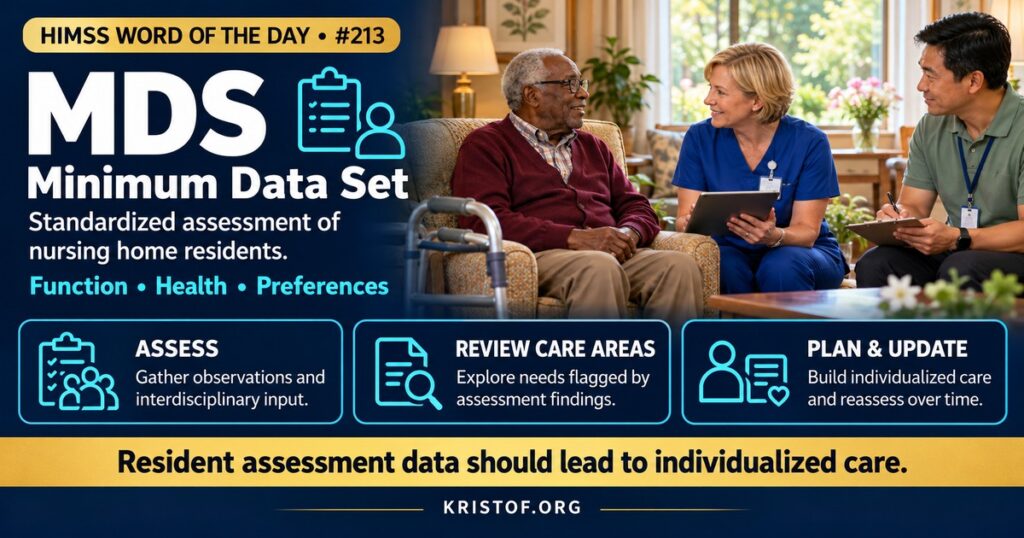
The Minimum Data Set (MDS) is the standardized clinical assessment that federal rules require for every resident of a Medicare- or Medicaid-certified nursing home. According to the HIMSS Dictionary, it gives a comprehensive picture of a resident’s functional capabilities and helps staff identify health problems. It applies regardless of who pays for the resident’s care.
The MDS is one part of a larger process called the Resident Assessment Instrument (RAI). Items on the MDS can trigger care area assessments (CAAs), which direct staff to look more closely at specific problems such as falls, nutrition, or pressure injuries. The results of that closer look become the foundation for the resident’s individual care plan. Facilities encode MDS information electronically and submit it to the national MDS database at CMS.
| Component | What It Is | Why It Matters |
|---|---|---|
| MDS | Standardized resident assessment items | Common data across all certified facilities |
| Care Area Assessment (CAA) | Structured review triggered by MDS responses | Links findings to care planning |
| Care Plan | Individualized plan of care | Built from assessment findings |
| RAI Manual | CMS instructions for completing the RAI | Defines items, timing, and coding rules |
| National MDS Database | CMS repository of submitted assessments | Supports payment, oversight, and quality measures |
⚠️ Exam Alert: The MDS discussed here is the nursing home resident assessment required by CMS. It is not the Nursing Minimum Data Set (NMDS), which is a standard set of core nursing data elements for describing nursing care. Both use “Minimum Data Set” in the name, so check the context.
🌐 Why It Matters: Real-World Healthcare IT Context
The federal rule at 42 CFR 483.20 asks facilities to conduct initially and periodically a comprehensive, accurate, standardized, and reproducible assessment of each resident’s functional capacity. The assessment uses the RAI specified by CMS and must cover a defined list of areas, including cognitive patterns, communication, vision, mood and behavior, physical functioning, continence, disease diagnoses and health conditions, nutritional status, skin condition, medications, special treatments, and discharge planning. The process must include direct observation of and communication with the resident, as well as input from licensed and nonlicensed direct care staff on all shifts.
The schedule is specific. A comprehensive assessment is due within 14 calendar days after admission, within 14 calendar days after the facility determines, or should have determined, that the resident has had a significant change in physical or mental condition, and at least once every 12 months. A quarterly review assessment is required at least every three months. Facilities must keep assessments completed within the previous 15 months in the active record and use them to develop, review, and revise the comprehensive care plan. Within 7 days after completing an assessment, the facility must encode the required information, and that information is then transmitted to the national database.
Because every certified facility collects the same items, MDS data support much more than care planning. CMS and states use them for payment and oversight, and quality measures for nursing homes draw on MDS items. Researchers use the data to study outcomes across large populations. For informatics teams, the MDS is a model of how a mandated data set turns clinical observations into computable information.
Data quality is the persistent challenge, and recent studies show it. A 2026 study in the Journal of the American Medical Directors Association compared the MDS 3.0 kidney impairment item with estimated glomerular filtration rate values in more than 454,000 assessments from over 225,000 residents in eight nursing home chains. Agreement was fair at best, with kappa of 0.19 and sensitivity of 25.8 percent at an eGFR threshold below 60, though specificity was high at 92.3 percent. The authors concluded the item has low sensitivity for identifying kidney impairment compared with laboratory values. A separate 2026 study in Medical Care looked at missing race and ethnicity data in MDS 3.0 across about 18.1 million residents between 2014 and 2018 and found that missingness ranged by state from 1.2 percent to 14.7 percent, along with notable misclassification differences between data sources. Both studies point to the same lesson: a required field is not automatically an accurate one.
For informatics, interoperability adds another layer. Many facilities keep clinical notes in an EHR and then abstract or map data into MDS items. Poorly mapped fields, free-text documentation that does not feed structured items, and delays between care and coding can all create mismatches between what happened and what the assessment says.
Common MDS problems:
- Items coded from memory or old notes rather than current observation
- Late or missed assessment windows
- Disconnect between EHR documentation and MDS item definitions
- Missing demographic fields that limit equity analysis
- Care plans that do not reflect triggered care areas
- Staff unfamiliar with the current RAI Manual instructions
What supports reliable MDS data:
- Interdisciplinary input from nursing, therapy, social work, and dietary staff
- Assessment calendars with alerts ahead of due dates
- Structured EHR fields mapped to MDS items
- Regular audits comparing assessments with source documentation
- Training tied to each RAI Manual update
- Review of submission error reports and quality measure trends
🏥 The Nurse’s Perspective: Clinical, Bedside, & Workflow
The MDS is deeply nursing work. Licensed nurses, often registered nurses serving as MDS coordinators, lead the process, and nursing assistants supply much of the day-to-day observation.
At the Bedside
Direct care staff notice mood changes, appetite, mobility, continence, and behavior across all shifts. The regulation explicitly expects the assessment to draw on communication with staff on every shift, so accurate documentation by nursing assistants and nurses matters. Observations recorded clearly during care are easier to turn into correct items later.
Talking with residents directly is part of the process. Their preferences, goals, and life history inform both the assessment and the care plan.
In Clinical Workflow
MDS coordinators track assessment windows, gather input from therapy, social services, dietary, and nursing, and complete CAAs for triggered areas. Care plan meetings turn findings into goals and interventions. A missed window or an item coded without enough evidence affects the plan and can affect payment and quality reporting.
Nurse informaticists help by mapping EHR fields to MDS items, building reminders for due assessments, and designing documentation so that evidence is captured during care instead of reconstructed at the deadline.
In EHR Implementation (Go-Live Perspective)
When a long-term or post-acute setting goes live on a new EHR, assessment workflows are among the first to test. Analysts confirm that the MDS item sets, scheduling logic, and submission files work with the current RAI Manual. At-the-elbow support analysts help coordinators find the right structured fields and flag any item definition mismatches for correction.
🎓 CAHIMS / CPHIMS & HIMSS Perspective
CAHIMS Exam Domain Mapping
The MDS appears in policy, data standards, and post-acute care questions:
| CAHIMS Domain | How the MDS Appears |
|---|---|
| Healthcare & Technology Environments | CMS requirements, long-term care regulation, mandated data sets |
| Clinical Informatics | Assessment design, care planning, structured documentation |
| Healthcare Information & Systems Management | Data submission, mapping, data quality audits |
| Management & Leadership | Compliance, reimbursement, quality reporting |
Key Terms to Know Alongside the MDS
- Resident Assessment Instrument (RAI) — CMS process that includes the MDS, CAAs, and care planning
- Care Area Assessment (CAA) — structured review triggered by MDS findings
- RAI Manual — CMS instructions for completing assessments
- Significant Change in Status — major change that triggers a new comprehensive assessment
- Quality Measures — indicators calculated from assessment data
- Nursing Minimum Data Set (NMDS) — separate standard of core nursing data elements
HIMSS Organizational Position
HIMSS supports interoperable, quality-focused information exchange across care settings, including post-acute and long-term care, through its education, research, and communities. Members can find related resources through the HIMSS Resource Center.
🔗 Explore Further: External References
- CMS — Resident Assessment Instrument (RAI) Manual https://www.cms.gov/medicare/quality/nursing-home-improvement/resident-assessment-instrument-manual
- eCFR — 42 CFR 483.20, Resident Assessment https://www.ecfr.gov/current/title-42/chapter-IV/subchapter-G/part-483/subpart-B/section-483.20
- CMS — Nursing Home Improvement https://www.cms.gov/medicare/quality/nursing-home-improvement
- Radjabova et al. (2026), Journal of the American Medical Directors Association — Concordance Between the Minimum Data Set Kidney Impairment I1500 Item and eGFR Records in Nursing Homes https://pubmed.ncbi.nlm.nih.gov/41871835/
- Tjia et al. (2026), Medical Care — Geographic Variation in Missing Race and Ethnicity Data in Minimum Data Set 3.0 https://pubmed.ncbi.nlm.nih.gov/42100939/
Term source: HIMSS Dictionary of Health Information and Technology Terms, Acronyms, and Organizations, 6th Edition (2025). All definitions in this series are paraphrased for editorial purposes. Readers are encouraged to consult the primary source for exact language.
Eric Andrew Kristof, RN, CAHIMS is a Healthcare IT professional and HIMSS Arkansas Chapter member based in Hot Springs Village, AR, with hands-on Epic Go-Live experience and a diverse healthcare and IT background. He writes at kristof.org at the intersection of clinical care and healthcare technology.
Leave a Reply