By Eric Andrew Kristof, RN, CAHIMS | Healthcare IT Professional | HIMSS Arkansas Chapter Member
About This Series: The HIMSS Word of the Day is a running blog series drawing from the HIMSS Dictionary of Health Information and Technology Terms, Acronyms, and Organizations, 6th Edition (2025) — the authoritative reference for healthcare IT professionals and the primary study resource for CAHIMS and CPHIMS certification. Each post paraphrases the term in plain language, grounds it in real-world healthcare IT context, and adds a bedside nursing perspective you won’t find in a textbook.
📖 The Term: International Classification of Diseases (ICD)
Source: HIMSS Dictionary of Health Information and Technology Terms, Acronyms, and Organizations, 6th Edition (2025)
🔍 Plain-Language Definition
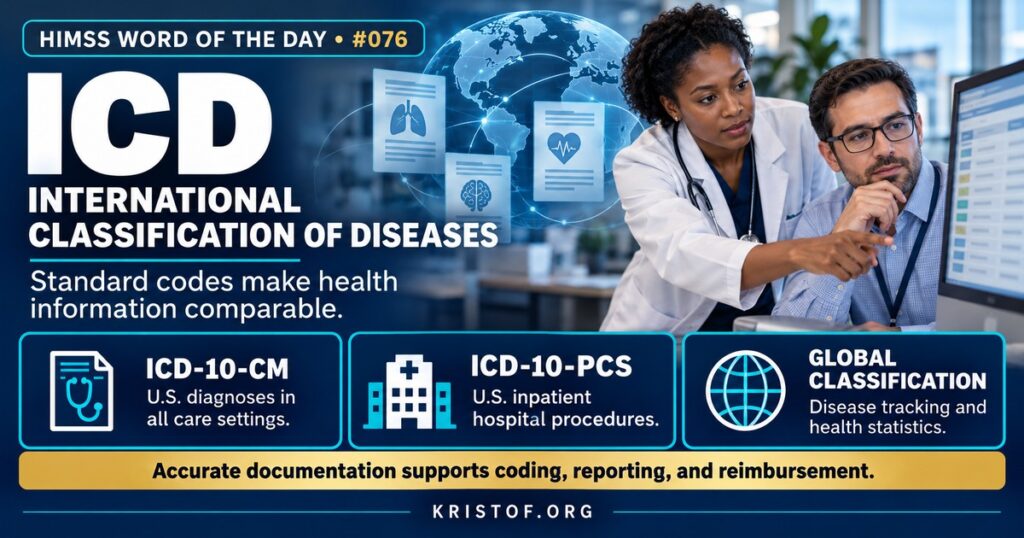
The International Classification of Diseases (ICD) is the global system for classifying diseases, injuries, symptoms, causes of death, and other health conditions into standard codes. It allows health information to be counted and compared across hospitals, states, and countries.
The HIMSS Dictionary calls ICD the standard diagnostic reference used in epidemiology, in managing health services, and in clinical practice, including studying the overall health of population groups. It notes that ICD is used to monitor how often diseases occur, to code conditions on health records and vital records such as death certificates, and, in some countries, to support reimbursement and resource decisions. The World Health Organization publishes ICD. The Dictionary adds that ICD-10 was endorsed by the World Health Assembly in 1990 but was not implemented in the U.S. healthcare system until 2015.
The United States uses national modifications of ICD-10:
| Code Set | Used For | Maintained By |
|---|---|---|
| ICD-10-CM | Diagnoses in all care settings | National Center for Health Statistics (NCHS) |
| ICD-10-PCS | Inpatient hospital procedures | Centers for Medicare & Medicaid Services (CMS) |
| ICD-10 (WHO version) | Coding causes of death on U.S. death certificates and international reporting | World Health Organization, with NCHS for U.S. mortality |
| ICD-11 | The current WHO edition, in effect internationally since 2022 | World Health Organization |
⚠️ Exam Alert: ICD is a classification: it groups conditions into categories for counting, statistics, and billing. SNOMED CT is a clinical terminology: it captures detailed clinical meaning at the point of care. The two are linked by maps. CPT and HCPCS codes describe outpatient and professional procedures and services, while ICD-10-PCS covers inpatient hospital procedures. In the United States, the ICD-10 transition took effect on October 1, 2015.
🌐 Why It Matters: Real-World Healthcare IT Context
ICD codes connect clinical care to almost every downstream use of health data. Diagnosis codes determine DRG assignment and payment for hospital stays, support medical necessity for outpatient services, feed quality measures and risk adjustment, populate disease registries, and drive public health surveillance and death statistics.
The U.S. move from ICD-9-CM to ICD-10-CM and ICD-10-PCS on October 1, 2015, was one of the largest coding changes in the country’s healthcare history. ICD-10 added far more detail, including laterality, episode of care, and specific complications, which improved the precision of data but required more specific documentation.
ICD-10-CM also includes codes that capture factors beyond disease. Z codes, for example, record social and economic circumstances that influence health, such as housing instability or food insecurity, which helps organizations measure social determinants of health.
Code sets are updated regularly. ICD-10-CM and ICD-10-PCS receive annual updates that take effect each October 1, adding, revising, and deleting codes to reflect new conditions, technologies, and reporting needs. Health systems must load those updates into EHRs, coding software, groupers, and billing systems on time, and test that order entry, problem lists, and claims still work correctly. Missing an update can cause claim denials or reporting errors.
Internationally, the World Health Organization’s ICD-11 was adopted by the World Health Assembly in 2019 and came into effect in 2022. It is fully digital, uses a different code structure, and includes updated content. The United States has not yet adopted ICD-11 for morbidity coding, and any transition would require extensive preparation.
ICD also underpins public health. Death certificates are coded with ICD to produce national mortality statistics, and conditions reported to public health agencies are often identified and tracked using ICD codes. Accurate cause-of-death documentation by clinicians therefore affects the statistics that shape research priorities and policy.
Common ICD-related challenges:
- Documentation that lacks the specificity ICD-10 codes require
- Unspecified codes used when more specific information exists
- Mismatches between problem list entries and billed diagnoses
- Coding backlogs that delay billing and reporting
- Confusion between clinical terminology and billing codes
- Future transition planning for ICD-11
Characteristics of strong ICD practice:
- Problem lists built on clinical terminology mapped to ICD codes
- Documentation templates that prompt for clinically meaningful specificity
- Coding professionals and CDI specialists working with clinicians
- Regular code set updates applied to systems on schedule
- Use of Z codes to capture social needs
- Audits that check accuracy in both directions
🏥 The Nurse’s Perspective: Clinical, Bedside, & Workflow
Nurses rarely assign ICD codes, but much of the information that supports accurate coding comes from nursing assessment and documentation.
At the Bedside
Nurses document details that give diagnoses their specificity: the stage and location of a pressure injury, the side of a fracture, the presence of a fall, or the type of a device complication. Those details help providers document precisely and help coders assign accurate codes.
Admission screenings also matter. Social needs identified during nursing screening, such as homelessness or food insecurity, can be captured with Z codes when documented appropriately, which helps organizations understand and address the needs of their patients.
Nurses also contribute to death certificate accuracy indirectly. Clear documentation of the sequence of events leading to a patient’s death helps the certifying clinician record the underlying cause, which is then coded with ICD for national statistics.
In Clinical Workflow
Problem lists connect clinical documentation to coding. When nurses and providers keep problem lists accurate and current, the EHR can map clinical terms to ICD codes, supporting both care coordination and accurate billing. Outdated or duplicate problems create confusion for everyone who reads the chart.
Nurses working in case management, utilization review, or clinical documentation integrity use ICD knowledge daily, translating between clinical reality and the codes that represent it.
In EHR Implementation (Go-Live Perspective)
During an Epic Go-Live, diagnosis search and problem list tools change how clinicians find and record conditions. Most clinicians search using clinical terms, and the system maps those terms to ICD codes behind the scenes. Training should emphasize selecting the most specific clinically appropriate term.
At-the-elbow support analysts often help providers and nurses search for diagnoses, add problems correctly, and understand why the system may prompt for more detail, such as laterality or episode of care.
🎓 CAHIMS / CPHIMS & HIMSS Perspective
CAHIMS Exam Domain Mapping
ICD is a core classification topic on the CAHIMS exam:
| CAHIMS Domain | How ICD Appears |
|---|---|
| Healthcare & Technology Environments | WHO and NCHS roles; HIPAA code set standards; ICD-10 transition; ICD-11 |
| Clinical Informatics | Documentation specificity; problem lists; social needs coding |
| Healthcare Information & Systems Management | Code set maintenance, terminology mapping, groupers, coding software |
| Management & Leadership | Revenue cycle, quality reporting, transition planning, coding compliance |
Key Terms to Know Alongside ICD
- ICD-10-CM — the U.S. clinical modification of ICD-10 used for diagnosis coding in all settings
- ICD-10-PCS — the U.S. procedure coding system used for inpatient hospital procedures
- ICD-11 — the current World Health Organization edition of the classification
- Classification — a system that groups concepts into categories for statistics and reporting
- SNOMED CT — a comprehensive clinical terminology used to record detailed clinical meaning
- Z Codes — ICD-10-CM codes describing factors influencing health status, including social determinants
HIMSS Organizational Position
HIMSS addresses ICD and other code sets through its work on interoperability, data standards, and revenue cycle, and has engaged on code set transitions through its public policy work. Members can find related education and research through the HIMSS Resource Center.
🔗 Explore Further: External References
- World Health Organization — International Classification of Diseases https://www.who.int/standards/classifications/classification-of-diseases
- World Health Organization — ICD-11 https://icd.who.int/en/
- CMS — ICD-10 https://www.cms.gov/medicare/coding-billing/icd-10-codes
- CMS — Using Z Codes for Social Determinants of Health https://www.cms.gov/files/document/zcodes-infographic.pdf
- NLM — SNOMED CT (United States) https://www.nlm.nih.gov/healthit/snomedct/index.html
- AHIMA — American Health Information Management Association https://www.ahima.org/
Term source: HIMSS Dictionary of Health Information and Technology Terms, Acronyms, and Organizations, 6th Edition (2025). All definitions in this series are paraphrased for editorial purposes. Readers are encouraged to consult the primary source for exact language.
Eric Andrew Kristof, RN, CAHIMS is a Healthcare IT professional and HIMSS Arkansas Chapter member based in Hot Springs Village, AR, with hands-on Epic Go-Live experience and a diverse healthcare and IT background. He writes at kristof.org at the intersection of clinical care and healthcare technology.
Leave a Reply