By Eric Andrew Kristof, RN, CAHIMS | Healthcare IT Professional | HIMSS Arkansas Chapter Member
About This Series: The HIMSS Word of the Day is a running blog series drawing from the HIMSS Dictionary of Health Information and Technology Terms, Acronyms, and Organizations, 6th Edition (2025) — the authoritative reference for healthcare IT professionals and the primary study resource for CAHIMS and CPHIMS certification. Each post paraphrases the term in plain language, grounds it in real-world healthcare IT context, and adds a bedside nursing perspective you won’t find in a textbook.
📖 The Term: Terminology (Clinical Terminology)
Source: HIMSS Dictionary of Health Information and Technology Terms, Acronyms, and Organizations, 6th Edition (2025)
🔍 Plain-Language Definition
A terminology is an organized set of terms or concepts used to name things within a particular field. In health IT, a clinical terminology assigns each clinical concept, such as a diagnosis, finding, procedure, or lab test, a unique code and defines how concepts relate to one another, so computers can recognize when different words mean the same thing.
The HIMSS Dictionary keeps its definition short: a terminology is the set of words a discipline uses to name the things it deals with. In health IT, that idea becomes the foundation of semantic interoperability: shared, coded vocabularies that let systems exchange data without losing meaning.
Several related terms are often confused:
| Term | What It Is | Example |
|---|---|---|
| Terminology | A coded set of concepts with relationships, used to record detailed clinical meaning | SNOMED CT for clinical findings and problems |
| Classification | A system that groups concepts into categories for counting and reporting | ICD-10-CM for diagnosis statistics and billing |
| Code Set | Any set of codes used in data elements, including those named in HIPAA transactions | CPT, HCPCS, ICD-10-CM, NDC |
| Value Set | A defined list of codes selected for a specific purpose | Codes representing diabetes in a quality measure |
| Metathesaurus | A resource linking terms and codes across many vocabularies | NLM’s UMLS Metathesaurus |
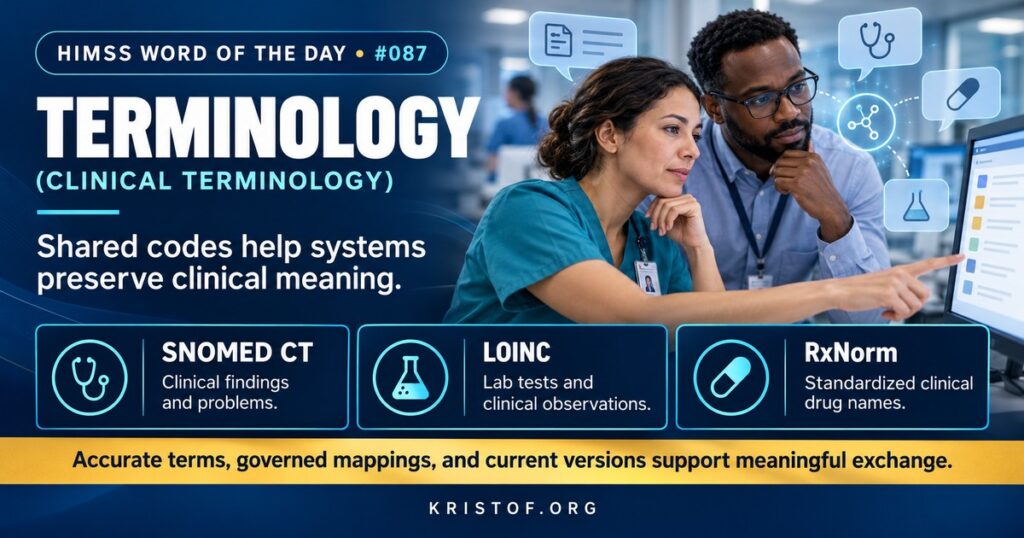
⚠️ Exam Alert: A terminology captures clinical detail at the point of care. A classification groups concepts for statistics and payment. Clinicians typically document using terminology-based terms, and systems map them to classifications for billing. Know which standard covers which domain: SNOMED CT for clinical findings and problems, LOINC for lab tests and observations, RxNorm for clinical drugs, ICD-10-CM for diagnosis classification, and CPT and HCPCS for procedures and services billed by clinicians and outpatient settings.
🌐 Why It Matters: Real-World Healthcare IT Context
Computers cannot interpret meaning the way people do. Without shared terminologies, an allergy recorded as “PCN” in one system and “penicillin” in another might not trigger the same drug-allergy alert, and a lab test called “Glucose, fasting” in one hospital might not match “FBG” in another. Standard terminologies solve that problem by giving each concept a code that every system can recognize.
U.S. health IT policy relies on them. USCDI specifies vocabulary standards for its data elements, such as SNOMED CT for problems, LOINC for lab tests, and RxNorm for medications, and certified EHRs must support them. The National Library of Medicine distributes SNOMED CT for U.S. use and maintains RxNorm and the UMLS, which links many terminologies together. HL7 FHIR includes a terminology module defining how code systems, value sets, and concept maps are represented.
Mapping connects terminologies to each other and to classifications. A SNOMED CT problem can map to an ICD-10-CM code for billing, and a local lab code can map to LOINC for exchange. Mapping is never perfect, because different systems divide concepts differently, so maps require expert review and maintenance.
Nursing has its own terminologies, including NANDA-I nursing diagnoses, the Nursing Interventions Classification, the Nursing Outcomes Classification, the Omaha System, and the Clinical Care Classification. Encoding nursing assessments and interventions with standard terminologies helps make nursing’s contribution to outcomes visible in research and quality data.
Terminologies also support decision support and analytics. A rule that checks for diabetes or a quality measure that counts patients with heart failure relies on value sets, lists of codes that represent each condition. If local data is not coded or is mapped incorrectly, the rule may miss patients or flag the wrong ones. Terminology services, which manage code systems, value sets, and maps in one place, help organizations keep these definitions consistent across applications.
Common terminology problems:
- Local codes and free-text entries with no standard mapping
- Outdated terminology versions loaded in systems
- Maps that lose meaning between terminologies and classifications
- Multiple picklist entries for the same concept
- Value sets that miss codes used locally
- Limited staff expertise in terminology management
Characteristics of strong terminology management:
- Standard terminologies behind every clinical picklist
- Regular updates to the latest terminology releases
- Governed mapping with clinical and coding review
- Single, well-named entries for each concept users choose
- Terminology services that support decision support and exchange
- Dedicated terminology or data standards expertise
🏥 The Nurse’s Perspective: Clinical, Bedside, & Workflow
Nurses use terminologies every shift, often without seeing the codes behind the words they choose.
At the Bedside
When a nurse selects an allergy, documents a wound type, or records a pain location from a picklist, that choice usually maps to a standard code. Choosing the most accurate option, rather than the first one that looks close, keeps the coded meaning correct for alerts, handoff reports, and exchange with other providers.
Free-text “other” entries are sometimes necessary, but they lose coded meaning. If nurses frequently type the same item as “other,” that is a signal for informatics teams to add a proper coded option.
Problem lists are where terminology choices are most visible. Selecting a specific, accurate problem, such as a particular type of heart failure rather than a vague symptom, carries detailed meaning to every clinician and system that reads the chart.
In Clinical Workflow
Nursing terminologies support care planning and outcomes measurement. When problems, interventions, and outcomes are coded consistently, organizations can compare what works across units and patient populations and demonstrate the value of nursing care.
Terminology also matters in medication work. Medications are typically represented using RxNorm and related drug databases, which allow systems to check interactions, allergies, and doses. Selecting the correct medication form and strength during reconciliation keeps those checks reliable.
In EHR Implementation (Go-Live Perspective)
During an Epic implementation, terminology decisions shape picklists, problem lists, allergy lists, and flowsheet choices. Teams map legacy local codes to standard terminologies so historical data remains meaningful, and they review picklists to avoid duplicate or confusing entries.
At-the-elbow support analysts often help clinicians search for the right problem, allergy, or order term. When a common term cannot be found, documenting the search words used helps terminology teams add synonyms so the next clinician finds it faster.
🎓 CAHIMS / CPHIMS & HIMSS Perspective
CAHIMS Exam Domain Mapping
Terminologies are a core interoperability topic:
| CAHIMS Domain | How Terminology Appears |
|---|---|
| Healthcare & Technology Environments | National standards, USCDI vocabulary requirements, HIPAA code sets |
| Clinical Informatics | Picklist design, problem lists, nursing terminologies, documentation accuracy |
| Healthcare Information & Systems Management | Code systems, value sets, mapping, terminology services, version updates |
| Management & Leadership | Data governance for standards, terminology resources, interoperability strategy |
Key Terms to Know Alongside Terminology
- SNOMED CT — a comprehensive clinical terminology for findings, diagnoses, procedures, and more
- LOINC — a standard terminology for identifying laboratory tests and clinical observations
- RxNorm — a normalized naming system for clinical drugs maintained by the National Library of Medicine
- Classification — a system that groups concepts into categories for statistics and reporting, such as ICD-10-CM
- Value Set — a specific list of codes chosen to represent a concept for a defined purpose
- Mapping — linking concepts in one terminology or classification to equivalent concepts in another
HIMSS Organizational Position
HIMSS treats standard terminologies as a foundation of semantic interoperability and supports their adoption through its interoperability and nursing informatics work. Members can find related education and research through the HIMSS Resource Center.
🔗 Explore Further: External References
- NLM — Unified Medical Language System (UMLS) https://www.nlm.nih.gov/research/umls/index.html
- NLM — SNOMED CT (United States) https://www.nlm.nih.gov/healthit/snomedct/index.html
- NLM — RxNorm https://www.nlm.nih.gov/research/umls/rxnorm/index.html
- Regenstrief Institute — LOINC https://www.regenstrief.org/real-world-solutions/loinc/
- HL7 — FHIR Terminologies https://hl7.org/fhir/terminologies.html
- ONC — United States Core Data for Interoperability (USCDI) https://isp.healthit.gov/united-states-core-data-interoperability-uscdi
Term source: HIMSS Dictionary of Health Information and Technology Terms, Acronyms, and Organizations, 6th Edition (2025). All definitions in this series are paraphrased for editorial purposes. Readers are encouraged to consult the primary source for exact language.
Eric Andrew Kristof, RN, CAHIMS is a Healthcare IT professional and HIMSS Arkansas Chapter member based in Hot Springs Village, AR, with hands-on Epic Go-Live experience and a diverse healthcare and IT background. He writes at kristof.org at the intersection of clinical care and healthcare technology.
Leave a Reply