By Eric Andrew Kristof, RN, CAHIMS | Healthcare IT Professional | HIMSS Arkansas Chapter Member
About This Series: The HIMSS Word of the Day is a running blog series drawing from the HIMSS Dictionary of Health Information and Technology Terms, Acronyms, and Organizations, 6th Edition (2025) — the authoritative reference for healthcare IT professionals and the primary study resource for CAHIMS and CPHIMS certification. Each post paraphrases the term in plain language, grounds it in real-world healthcare IT context, and adds a bedside nursing perspective you won’t find in a textbook.
📖 The Term: Quality Improvement (QI)
Source: HIMSS Dictionary of Health Information and Technology Terms, Acronyms, and Organizations, 6th Edition (2025)
🔍 Plain-Language Definition
Quality improvement (QI) is the disciplined work of making care better: measuring how a process performs, identifying where it falls short, testing changes, and keeping the changes that work. It focuses on systems and processes rather than blaming individuals.
The HIMSS Dictionary describes QI as a systematic, formal approach to analyzing practice performance and to efforts aimed at improving it.
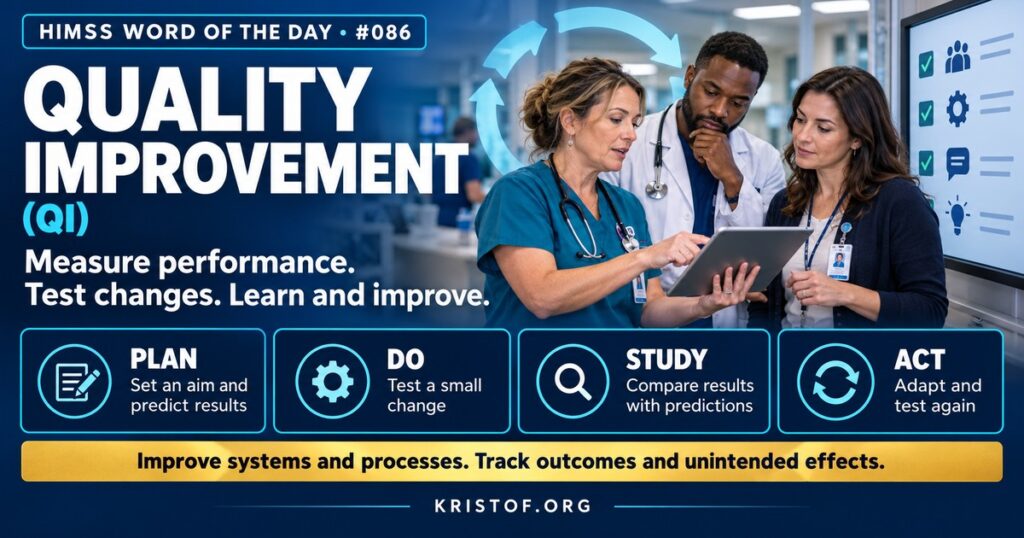
One of the most widely used frameworks is the Model for Improvement, promoted by the Institute for Healthcare Improvement (IHI). It begins with three questions, What are we trying to accomplish? How will we know that a change is an improvement? What change can we make that will result in improvement?, and then uses repeated Plan-Do-Study-Act (PDSA) cycles to test changes on a small scale.
| QI Method | Core Idea | Healthcare Example |
|---|---|---|
| Model for Improvement and PDSA | Set an aim, measure, and test small changes in rapid cycles | Testing a new handoff checklist on one unit for one week |
| Lean | Remove waste and improve flow | Reorganizing a medication room to reduce walking and searching |
| Six Sigma | Reduce variation and defects using statistical methods | Reducing variation in time to antibiotics for sepsis |
| Root Cause Analysis | Identify underlying causes of an adverse event | Investigating a wrong-patient medication error |
| Run and Control Charts | Track performance over time to see real change | Weekly fall rates plotted before and after an intervention |
⚠️ Exam Alert: Quality improvement aims to improve local processes using rapid testing and data over time. Research aims to generate generalizable knowledge and typically requires institutional review. Quality assurance focuses on checking that standards are met. In PDSA, the Study step compares results with predictions. Questions often ask which tool shows change over time; the answer is usually a run chart.
🌐 Why It Matters: Real-World Healthcare IT Context
Healthcare has many gaps between what is known to work and what actually happens. QI provides a practical way to close those gaps in real settings, often with the people who do the work leading the change.
Methods matter. A 2014 systematic review in BMJ Quality & Safety by Taylor and colleagues examined published applications of the PDSA method. Of 73 articles that met inclusion criteria, fewer than 20% fully documented a sequence of iterative cycles, and only a small share reported using frequent quantitative data to guide each cycle. The authors concluded that many projects described as PDSA did not follow the method’s core features, such as small-scale, iterative testing. The lesson is that QI works best when teams actually test, measure, and learn in repeated cycles rather than making one large change and calling it a PDSA.
Health IT is a powerful QI tool. EHR data can produce timely measures, dashboards can show performance by unit and shift, and clinical decision support, order sets, and documentation tools can embed improvements into workflow. Changes to the EHR can make the right action the easy action, such as a default order or a prompt at the right moment.
Technology changes also need QI discipline. A new alert or form is itself a change to test, with measures for both the intended benefit and possible side effects, such as added documentation time or alert fatigue.
Spread and sustainability are often harder than the initial improvement. A change that works on one unit may fail on another with different staffing, patients, or culture. Successful organizations adapt changes for each setting, assign owners for ongoing monitoring, and build improvements into standard work, policies, and system design so that gains do not depend on the enthusiasm of a single champion.
Common QI pitfalls:
- Vague aims without measurable targets or timelines
- Measuring only at the beginning and end instead of over time
- Making large changes all at once rather than testing small ones
- Relying on education alone instead of system changes
- Ignoring balancing measures that reveal unintended consequences
- Losing gains when attention shifts to the next project
Characteristics of successful QI work:
- A clear, specific aim agreed on by the team
- Outcome, process, and balancing measures tracked over time
- Rapid, small-scale tests of change
- Frontline staff involved in designing and testing changes
- Use of health IT to make improvements easier to sustain
- Plans for spreading and sustaining successful changes
🏥 The Nurse’s Perspective: Clinical, Bedside, & Workflow
Nurses lead and participate in a large share of hospital quality improvement, from falls prevention to infection reduction.
At the Bedside
Nurses see process problems first: supplies that are never where they should be, steps that are repeated, handoffs that lose information, and alarms that interrupt care. Those observations are the starting point for QI. A nurse who notices that patients often fall on the way to the bathroom at night has identified a target for improvement.
Many nursing-sensitive quality measures, such as falls with injury, hospital-acquired pressure injuries, and catheter-associated infections, are the focus of unit-based QI projects. Nurses often design and test interventions such as hourly rounding, bundle checklists, or new documentation prompts.
In Clinical Workflow
Unit practice councils and shared governance structures give nurses a formal way to lead QI. Teams set aims, choose measures, and run PDSA cycles, often with support from quality and informatics departments. Posting run charts on the unit keeps everyone aware of progress.
Data access helps. When nurses can see timely data on their own unit’s performance, rather than waiting months for reports, they can test changes and see results quickly. Informatics teams can build dashboards that support this kind of rapid learning.
In EHR Implementation (Go-Live Perspective)
An Epic Go-Live is a major change that affects many quality measures at once. Workflows, documentation, and reports change together, so organizations often see temporary shifts in quality data. Treating stabilization as a QI effort, with clear measures and rapid adjustments, helps recover and improve performance.
At-the-elbow support analysts contribute by noting where new workflows create friction that could affect quality, such as missed reassessments or delayed documentation. Those observations can become the first targets for post-Go-Live improvement cycles.
🎓 CAHIMS / CPHIMS & HIMSS Perspective
CAHIMS Exam Domain Mapping
QI appears in quality, safety, and management questions:
| CAHIMS Domain | How QI Appears |
|---|---|
| Healthcare & Technology Environments | Quality programs, accreditation, public reporting, value-based care |
| Clinical Informatics | Using EHR tools and data to support improvement; nursing-sensitive measures |
| Healthcare Information & Systems Management | Dashboards, measure calculation, run charts, data timeliness |
| Management & Leadership | QI methods, governance, change management, sustaining and spreading improvement |
Key Terms to Know Alongside Quality Improvement
- PDSA Cycle — Plan-Do-Study-Act, a method for testing changes on a small scale
- Model for Improvement — a framework of three questions combined with PDSA cycles
- Run Chart — a graph of data over time used to detect change
- Balancing Measure — a measure that checks for unintended consequences of a change
- Lean — an improvement approach focused on eliminating waste and improving flow
- Root Cause Analysis — a structured method for identifying the underlying causes of an event
HIMSS Organizational Position
HIMSS connects quality improvement to the use of health IT and data, highlighting organizations that use technology to improve outcomes through its awards and education, and encouraging analytics maturity that supports continuous improvement. Members can find related education and research through the HIMSS Resource Center.
🔗 Explore Further: External References
- Institute for Healthcare Improvement — Model for Improvement https://www.ihi.org/library/model-for-improvement
- Taylor et al. (2014), BMJ Quality & Safety — Systematic Review of the Application of the PDSA Method https://pubmed.ncbi.nlm.nih.gov/24025320/
- AHRQ — Patient Safety and Quality Improvement https://www.ahrq.gov/patient-safety/index.html
- eCQI Resource Center https://ecqi.healthit.gov/
- HIMSS — Changemaker in Health Awards https://www.himss.org/initiatives/awards
- HIMSS — Analytics Maturity Assessment Model (AMAM) https://www.himss.org/maturity-models/amam
Term source: HIMSS Dictionary of Health Information and Technology Terms, Acronyms, and Organizations, 6th Edition (2025). All definitions in this series are paraphrased for editorial purposes. Readers are encouraged to consult the primary source for exact language.
Eric Andrew Kristof, RN, CAHIMS is a Healthcare IT professional and HIMSS Arkansas Chapter member based in Hot Springs Village, AR, with hands-on Epic Go-Live experience and a diverse healthcare and IT background. He writes at kristof.org at the intersection of clinical care and healthcare technology.
Leave a Reply