By Eric Andrew Kristof, RN, CAHIMS | Healthcare IT Professional | HIMSS Arkansas Chapter Member
About This Series: The HIMSS Word of the Day is a running blog series drawing from the HIMSS Dictionary of Health Information and Technology Terms, Acronyms, and Organizations, 6th Edition (2025) — the authoritative reference for healthcare IT professionals and the primary study resource for CAHIMS and CPHIMS certification. Each post paraphrases the term in plain language, grounds it in real-world healthcare IT context, and adds a bedside nursing perspective you won’t find in a textbook.
📖 The Term: Care Coordination
Source: HIMSS Dictionary of Health Information and Technology Terms, Acronyms, and Organizations, 6th Edition (2025)
🔍 Plain-Language Definition
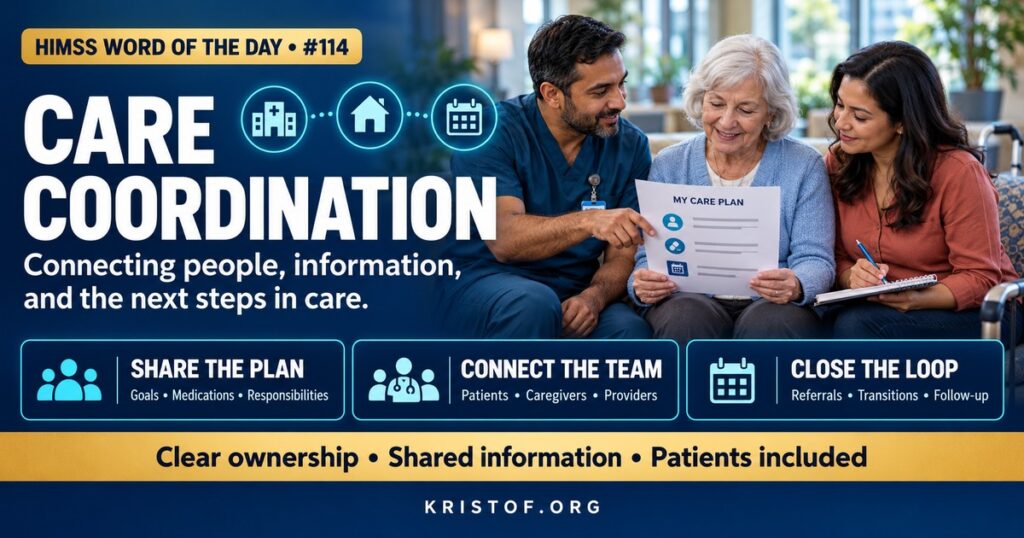
Care coordination means intentionally organizing a patient’s care across the people and organizations involved, and sharing the information they need, so that care is safe, timely, and not duplicated or missed.
The HIMSS Dictionary describes care coordination as the deliberate organization of patient care activities among two or more participants, including the patient, to make appropriate care easier to deliver. It explains that organizing care means marshaling the personnel and other resources needed for all required activities, and that it is often managed by exchanging information among the participants responsible for different parts of the care.
| Care Coordination Activity | What It Involves | Example |
|---|---|---|
| Assessing Needs | Understanding clinical, functional, and social needs | Identifying that a patient cannot afford medications |
| Creating a Shared Plan | Agreeing on goals and responsibilities | A care plan visible to primary care, specialists, and home health |
| Communicating | Exchanging information among team members | Sending a discharge summary and medication list |
| Facilitating Transitions | Supporting moves between settings | Scheduling follow-up before hospital discharge |
| Linking to Resources | Connecting to community services | Referral to meal delivery or transportation |
| Monitoring and Following Up | Checking that the plan is working | Calling after discharge to review medications |
⚠️ Exam Alert: Care coordination is the organizing of care and information across participants. Care management is a set of services, often delivered by nurses, to help patients manage conditions. Case management focuses on individual patients’ needs and resources, often within a facility or plan. Care transitions are moves between settings, which coordination supports. These terms overlap, so read scenarios carefully.
🌐 Why It Matters: Real-World Healthcare IT Context
Fragmented care is a well-known source of harm and waste. When information does not follow patients, tests are repeated, medications conflict, follow-up is missed, and patients and families are left to manage the gaps themselves. Patients with multiple chronic conditions are especially vulnerable, because they see more clinicians and move between more settings.
AHRQ has long promoted care coordination as a priority and publishes the Care Coordination Measures Atlas, which catalogs ways to measure coordination activities and patient experiences.
Payment models reward coordination. Accountable Care Organizations and patient-centered medical homes depend on coordinated care to improve quality and reduce avoidable costs. Medicare pays for care management services, including chronic care management for patients with multiple chronic conditions and transitional care management after discharge, which often fund nurse-led coordination.
Health IT is central. Shared care plans, problem lists, and medication lists in the EHR give the team common information. Health information exchange and event notifications tell primary care teams when patients are admitted or discharged elsewhere. Secure messaging and care team lists help clinicians know who else is involved. Registries and analytics identify patients who need outreach. Referral management tools track whether referrals are completed.
Patients and families are part of the team. Care coordination works best when patients understand their plan, know whom to call, and can share information with each provider. Patient portals, shared care plans, and after-visit summaries support that role, while caregivers often serve as informal coordinators who need information and support of their own.
Gaps remain. Many community providers, behavioral health programs, and social service agencies are not connected to the same systems, and information may arrive in formats that are hard to use. Clear ownership of each task matters as much as technology.
Measurement helps programs improve. Organizations can track follow-up appointment completion after discharge, referral completion rates, time to notification of admissions, and patient-reported experience of coordination to see where gaps remain.
Common care coordination failures:
- No clear owner for follow-up tasks
- Incomplete or missing information at transitions
- Multiple, conflicting care plans across organizations
- Referrals sent but never completed
- Patients and caregivers not included in planning
- Social needs identified but not addressed
Characteristics of effective care coordination:
- A designated coordinator or care manager for high-need patients
- Shared, current care plans and medication lists
- Event notifications routed to the right team members
- Closed-loop referral tracking
- Patient and caregiver engagement in goals and plans
- Data to identify patients who need coordination most
🏥 The Nurse’s Perspective: Clinical, Bedside, & Workflow
Nurses are natural coordinators and often fill formal care coordination roles.
At the Bedside
In the hospital, nurses coordinate constantly: with providers, therapists, pharmacists, case managers, transport, and families. Making sure the plan for the day is shared, tests are scheduled, and the patient understands what is happening is care coordination at the unit level.
At discharge, nurses coordinate with case management to ensure follow-up appointments, equipment, home services, and medication access are in place. Teaching the patient and caregiver the plan, and confirming understanding, is the final step before the handoff to the next setting.
Behavioral health coordination deserves special attention. Patients with both physical and mental health conditions often receive care from separate systems, and nurses who connect those teams help prevent medication conflicts and missed follow-up.
In Clinical Workflow
Nurse care managers in primary care, ACOs, and health plans manage panels of high-risk patients. They make outreach calls after hospital discharges, review medication adherence, coordinate specialist visits, connect patients to community resources, and track goals over time. Registries and care management tools help them prioritize who needs attention.
Communication across organizations is often the hardest part. Nurses frequently bridge gaps by calling other offices, sending records, and confirming that information arrived, especially when systems are not connected.
In EHR Implementation (Go-Live Perspective)
During an Epic implementation, care coordination tools, including care team lists, shared care plans, referral tracking, event notifications, and care management work queues, are configured and tested. Clear ownership rules for tasks and notifications should be defined before Go-Live.
At-the-elbow support analysts help care managers and nurses find patient lists, notifications, and documentation tools. After Go-Live, monitoring of follow-up completion and readmissions helps confirm that coordination workflows are working.
🎓 CAHIMS / CPHIMS & HIMSS Perspective
CAHIMS Exam Domain Mapping
Care coordination appears in value-based care and workflow questions:
| CAHIMS Domain | How Care Coordination Appears |
|---|---|
| Healthcare & Technology Environments | Value-based payment; ACOs and medical homes; Medicare care management services |
| Clinical Informatics | Shared care plans, care team communication, transitions, patient engagement |
| Healthcare Information & Systems Management | Health information exchange, event notifications, referral tracking, registries |
| Management & Leadership | Care management programs, staffing, measurement, community partnerships |
Key Terms to Know Alongside Care Coordination
- Care Management — services that help patients manage conditions and navigate care
- Chronic Care Management (CCM) — Medicare-paid non-face-to-face care management for patients with multiple chronic conditions
- Transitional Care Management (TCM) — services supporting patients in the period after discharge
- Care Transitions — moves between providers or care settings
- Event Notification — an alert that a patient has been admitted, discharged, or transferred
- Closed-Loop Referral — a referral process that confirms the service was completed
HIMSS Organizational Position
HIMSS treats care coordination as a central goal of interoperability and value-based care, supporting the data exchange and tools that let care teams share information across settings. Members can find related education and research through the HIMSS Resource Center.
🔗 Explore Further: External References
- AHRQ — Care Coordination https://www.ahrq.gov/ncepcr/care/coordination.html
- AHRQ — Care Coordination Measures Atlas https://www.ahrq.gov/ncepcr/care/coordination/atlas.html
- CMS — Care Management Services https://www.cms.gov/medicare/payment/fee-schedules/physician/care-management
- CMS — Medicare Shared Savings Program https://www.cms.gov/medicare/payment/shared-savings-program
- ONC — What Is HIE? https://healthit.gov/health-it-basics/hie/
- HIMSS — Nursing Informatics Community https://www.himss.org/networking/communities/nursing-informatics/
Term source: HIMSS Dictionary of Health Information and Technology Terms, Acronyms, and Organizations, 6th Edition (2025). All definitions in this series are paraphrased for editorial purposes. Readers are encouraged to consult the primary source for exact language.
Eric Andrew Kristof, RN, CAHIMS is a Healthcare IT professional and HIMSS Arkansas Chapter member based in Hot Springs Village, AR, with hands-on Epic Go-Live experience and a diverse healthcare and IT background. He writes at kristof.org at the intersection of clinical care and healthcare technology.
Leave a Reply