By Eric Andrew Kristof, RN, CAHIMS | Healthcare IT Professional | HIMSS Arkansas Chapter Member
About This Series: The HIMSS Word of the Day is a running blog series drawing from the HIMSS Dictionary of Health Information and Technology Terms, Acronyms, and Organizations, 6th Edition (2025) — the authoritative reference for healthcare IT professionals and the primary study resource for CAHIMS and CPHIMS certification. Each post paraphrases the term in plain language, grounds it in real-world healthcare IT context, and adds a bedside nursing perspective you won’t find in a textbook.
📖 The Term: Electronic Clinical Quality Measure (eCQM)
Source: HIMSS Dictionary of Health Information and Technology Terms, Acronyms, and Organizations, 6th Edition (2025)
🔍 Plain-Language Definition
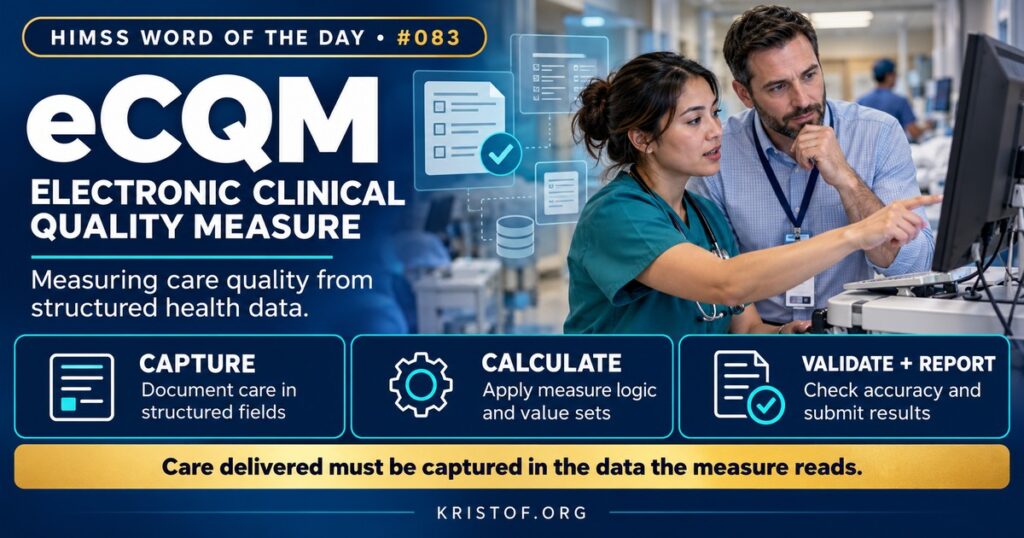
An electronic clinical quality measure (eCQM) is a quality measure calculated from data in electronic health records and other health IT systems. Instead of staff reading charts by hand, the measure logic runs against structured data to count how many eligible patients received recommended care.
The HIMSS Dictionary describes eCQMs as using data from EHRs and other health IT systems to measure healthcare quality. It notes that CMS uses eCQMs in many quality reporting and incentive programs, and that eCQMs are considered an improvement over traditional measurement, because gathering data by abstracting it from charts by hand is labor intensive and prone to human error.
Most quality measures share a common structure:
| Measure Component | What It Defines | Example |
|---|---|---|
| Initial Population | Patients the measure could apply to | Adult inpatients discharged during the reporting period |
| Denominator | Patients eligible for the measure | Patients with a specific condition or event |
| Denominator Exclusions and Exceptions | Patients removed for clinical or other reasons | Patients receiving comfort care only |
| Numerator | Patients who met the quality action | Patients who received the recommended treatment within the time window |
| Measure Logic | Rules expressed in a standard language | Clinical Quality Language (CQL) using defined value sets |
| Reporting Format | How results are submitted | QRDA files with patient-level or aggregate data |
⚠️ Exam Alert: An eCQM is calculated from structured EHR data. A chart-abstracted measure relies on people reviewing records. A claims-based measure uses billing data. CQL (Clinical Quality Language) expresses measure logic, and QRDA (Quality Reporting Document Architecture) is the format for submitting results. Value sets define the lists of codes that represent concepts such as a diagnosis or medication.
🌐 Why It Matters: Real-World Healthcare IT Context
Quality measurement drives payment, public reporting, and improvement. CMS uses eCQMs in programs for hospitals and clinicians, including hospital quality reporting, Promoting Interoperability, and the Merit-based Incentive Payment System. Results can affect payment, appear on public comparison websites, and guide internal improvement work.
eCQMs promise efficiency and timeliness. Once measure logic is built and validated, results can be calculated continuously rather than months after care is delivered, and organizations can see performance in near real time on dashboards.
They also depend completely on data capture. An eCQM can only count what is documented in the structured fields and codes its logic expects. If a nurse documents a screening in a free-text note instead of the designated field, or a medication is recorded with a code outside the value set, the patient may appear to have missed recommended care.
The eCQI Resource Center, a collaboration of CMS and ONC, publishes measure specifications, value sets, CQL resources, and implementation guidance, and measures are updated annually. CMS has also signaled a long-term move toward digital quality measures that use FHIR-based data, aiming to reduce the custom work needed to extract data from each EHR.
Organizations also face a choice between building and buying measure tools. Certified EHRs must be able to record, calculate, and report specified eCQMs, but many organizations add third-party tools for validation, dashboards, and submission. Whatever the tools, someone must own the annual cycle of loading new specifications, testing logic, validating results, and submitting data on time. Newer measures that track harms, such as severe hypoglycemia, show how eCQMs are expanding from process measures toward outcomes.
Common eCQM challenges:
- Care delivered but documented outside the structured fields the measure reads
- Local codes not mapped to required value sets
- Annual specification updates that require rebuild and retesting
- Results that differ from chart review, undermining clinician trust
- Workflow changes made to satisfy measures rather than improve care
- Limited analyst capacity to validate measure logic
Practices that improve eCQM accuracy:
- Designing documentation so measure data is captured in normal workflow
- Mapping local terminology to standard value sets
- Validating eCQM results against chart review samples
- Monitoring measure performance throughout the year
- Sharing results with clinicians alongside explanations
- Coordinating quality, informatics, and analytics teams
🏥 The Nurse’s Perspective: Clinical, Bedside, & Workflow
Many eCQM data elements come from nursing documentation, so nurses influence quality results directly.
At the Bedside
Measures related to medication timing, screenings, venous thromboembolism prevention, falls, pressure injuries, and patient education often depend on what nurses document and where. Recording an intervention in the structured flowsheet row or activity designed for it, at the time it happens, gives the measure logic what it needs.
When a measure requires an exception, such as a medical reason for not giving a medication, documenting that reason clearly in the expected place prevents the patient from counting as a failure when the care was appropriate.
Medication and vital sign timing is especially important. Many measures depend on exact times, such as when an antibiotic was administered relative to arrival, so documenting administration at the bedside in real time protects both the patient and the measure result.
In Clinical Workflow
Nurses often see quality measures as scorecards on their units. Understanding how a measure is calculated helps nurses interpret results. A sudden drop may reflect a documentation change, a new order set, or a mapping problem rather than worse care, and nurses’ feedback helps quality teams find the cause.
Nurse quality specialists and abstractors have also seen their work change. As more measures become electronic, their expertise shifts toward validating eCQM results, investigating discrepancies, and guiding documentation improvements.
In EHR Implementation (Go-Live Perspective)
During an Epic Go-Live, quality measures depend on new documentation tools mapping correctly to measure logic. Teams test eCQMs with sample patients and compare early results with legacy reporting to catch gaps before reporting periods close.
At-the-elbow support analysts can help nurses find the structured fields that matter most for quality, such as screening tools, education documentation, and medication administration details, and explain why documenting there rather than in comments makes a difference.
🎓 CAHIMS / CPHIMS & HIMSS Perspective
CAHIMS Exam Domain Mapping
eCQMs appear in quality, data, and policy questions:
| CAHIMS Domain | How eCQMs Appear |
|---|---|
| Healthcare & Technology Environments | CMS quality programs; public reporting; value-based payment |
| Clinical Informatics | Documentation design for measure capture; clinician feedback on results |
| Healthcare Information & Systems Management | CQL, value sets, QRDA, certification requirements, data validation |
| Management & Leadership | Quality strategy, reporting governance, performance improvement |
Key Terms to Know Alongside eCQM
- Clinical Quality Language (CQL) — a standard language for expressing clinical knowledge and measure logic
- QRDA (Quality Reporting Document Architecture) — an HL7 standard format for reporting quality measure data
- Value Set — a defined list of codes representing a clinical concept for use in measures
- Numerator and Denominator — the patients meeting the quality action and the patients eligible for the measure
- Chart Abstraction — manually reviewing medical records to collect measure data
- Digital Quality Measure (dQM) — a quality measure using standardized digital data, often based on FHIR
HIMSS Organizational Position
HIMSS supports electronic and digital quality measurement as a way to reduce reporting burden and improve data-driven care, and engages with CMS and ONC on quality reporting policy through its public policy work. Members can find related education and research through the HIMSS Resource Center.
🔗 Explore Further: External References
- eCQI Resource Center — About eCQMs https://ecqi.healthit.gov/ecqms/about-ecqms
- eCQI Resource Center — Clinical Quality Language (CQL) https://ecqi.healthit.gov/cql/versions
- eCQI Resource Center https://ecqi.healthit.gov/
- CMS — Promoting Interoperability Programs https://www.cms.gov/medicare/regulations-guidance/promoting-interoperability-programs
- CMS — Hospital Inpatient Quality Reporting Program https://www.cms.gov/medicare/quality/initiatives/hospital-quality-initiative/inpatient-reporting-program
- CMS — About the Quality Payment Program https://qpp.cms.gov/get-started/what-is-qpp/about-qpp
Term source: HIMSS Dictionary of Health Information and Technology Terms, Acronyms, and Organizations, 6th Edition (2025). All definitions in this series are paraphrased for editorial purposes. Readers are encouraged to consult the primary source for exact language.
Eric Andrew Kristof, RN, CAHIMS is a Healthcare IT professional and HIMSS Arkansas Chapter member based in Hot Springs Village, AR, with hands-on Epic Go-Live experience and a diverse healthcare and IT background. He writes at kristof.org at the intersection of clinical care and healthcare technology.
Leave a Reply