By Eric Andrew Kristof, RN, CAHIMS | Healthcare IT Professional | HIMSS Arkansas Chapter Member
About This Series: The HIMSS Word of the Day is a running blog series drawing from the HIMSS Dictionary of Health Information and Technology Terms, Acronyms, and Organizations, 6th Edition (2025) — the authoritative reference for healthcare IT professionals and the primary study resource for CAHIMS and CPHIMS certification. Each post paraphrases the term in plain language, grounds it in real-world healthcare IT context, and adds a bedside nursing perspective you won’t find in a textbook.
📖 The Term: Clinical Decision Support System (CDSS)
Source: HIMSS Dictionary of Health Information and Technology Terms, Acronyms, and Organizations, 6th Edition (2025)
🔍 Plain-Language Definition
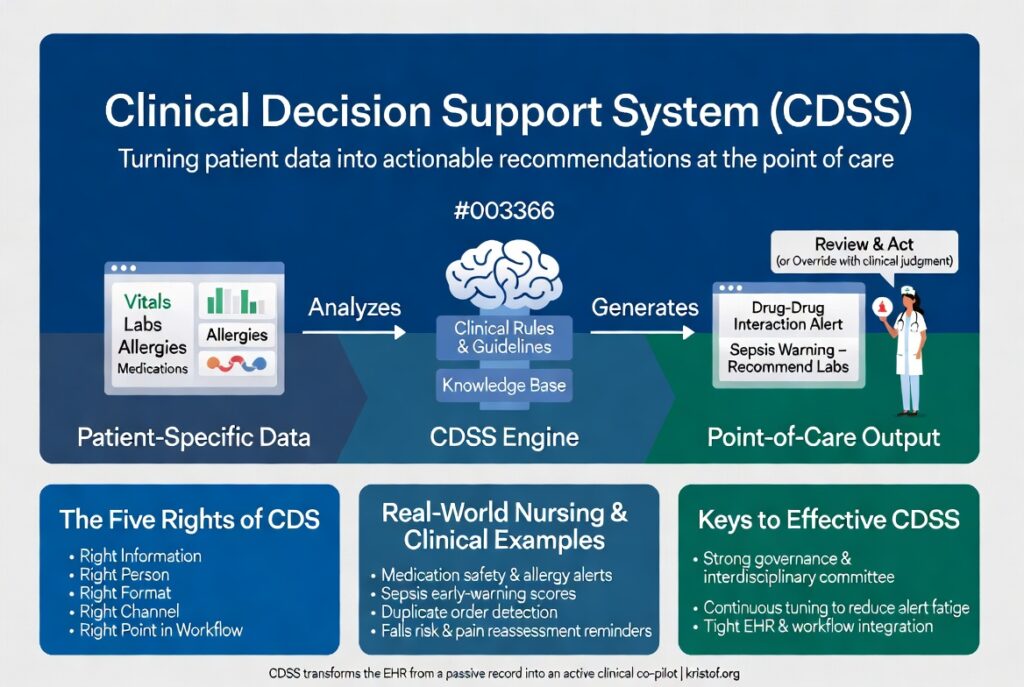
A Clinical Decision Support System (CDSS) is software that combines patient-specific data from multiple sources with pre-established rules and clinical guidelines — which the healthcare organization itself can build, edit, and maintain — to generate alerts, reminders, and treatment recommendations at the point of care.
CDSS is where the EHR stops being a passive filing cabinet and starts behaving like a clinical colleague. It is the informatics layer that takes raw patient data and turns it into a recommendation a clinician can act on — or, just as often, choose to override with clinical judgment.
CDSS implementations vary along several axes:
| Dimension | Types |
|---|---|
| Trigger Mechanism | Active (system pushes an alert) vs. Passive (system surfaces guidance only when the clinician asks) |
| Knowledge Base | Rule-based (explicit logic authored by clinicians) vs. Machine-learning-based (algorithmic recommendations from training data) |
| Workflow Integration | Order-entry CDS, documentation CDS, diagnostic CDS, and post-visit / registry-based CDS |
| Specificity | Population-level (broad guideline reminders) vs. Patient-specific (alerts triggered by individual data) |
⚠️ Exam Alert: Don’t confuse CDSS with CPOE (Computerized Provider Order Entry). CPOE is the entry mechanism for electronic orders; CDSS is the intelligence layered on top that evaluates those orders against patient data, rules, and guidelines. The two are usually integrated, but they are distinct concepts and CAHIMS questions will test the distinction. Also remember: CDSS supports clinical decisions — it never makes them autonomously. Answer choices implying autonomous decision-making are traps.
🌐 Why It Matters: Real-World Healthcare IT Context
CDSS is one of the most consequential — and most contested — categories of health IT.
When it works, CDSS demonstrably improves patient safety. Drug–drug interaction checking, allergy alerts, dose-range checking, duplicate order detection, and clinical guideline reminders catch errors before they reach the patient. Sepsis early-warning scores, VTE prophylaxis alerts, and pneumococcal vaccine reminders have measurably improved outcomes when properly tuned.
When it fails, CDSS demonstrably causes harm. The most documented failure mode is alert fatigue: when too many low-value alerts fire, clinicians develop reflexive override behaviors that desensitize them to the important alerts buried among the noise. Override rates above 90% are not unusual in poorly governed CDSS implementations.
The Five Rights of Clinical Decision Support — a framework popularized by ONC and AHRQ — define what makes CDS effective: the right information, to the right person, in the right format, through the right channel, and at the right point in workflow.
Failure modes of poorly governed CDSS:
- Excessive low-specificity alerts that fire on every chart open
- Alerts that fire too late in workflow to influence the decision
- Rules that conflict with organizational policy or local clinical practice
- Hard stops in situations where clinical judgment should override
- Drift over time as guidelines update but rules don’t
Strengths of mature CDSS:
- Tightly governed by an interdisciplinary clinical informatics committee
- Rules tied to measurable outcome metrics and reviewed quarterly
- Active monitoring of override rates as a quality indicator
- Integration with order sets, documentation templates, and workflow tools
- Continuous tuning based on clinician feedback and outcome data
CDSS is the technical layer where clinical informatics most visibly earns or loses its credibility with the clinical workforce.
🏥 The Nurse’s Perspective: Clinical, Bedside, & Workflow
CDSS is intimately familiar to every practicing nurse, even those who have never heard the acronym.
At the Bedside
Nurses encounter CDSS constantly during medication administration. The barcode scanner that flags an allergy match, the high-alert medication hard stop, the dose-range warning, and the duplicate order check are all CDSS. Sepsis early-warning banners triggered by vitals, lab values, and clinical observations are CDSS. Falls-risk score recalculations triggered by Morse scale updates are CDSS.
When CDSS works well, it is nearly invisible — a quiet co-pilot that catches the rare but consequential error. When CDSS works poorly, it is the dominant aggravation of a shift: the same pop-up firing dozens of times on every chart open, training the muscle memory of click-through.
In Clinical Workflow
Nursing CDSS spans the full shift. Admission assessments trigger flowsheet completion reminders. Restraint orders surface re-evaluation alerts. Pain reassessment timing fires reminders. Insulin sliding-scale recommendations surface in documentation. Pressure injury risk scores update with each Braden score entry.
The line between “decision support” and “documentation burden” is thin and contested. Nurses are typically the largest user group for CDSS interactions, which means nurse-led informatics involvement in CDSS governance is essential — not optional.
In EHR Implementation (Go-Live Perspective)
During Epic Go-Lives, CDSS build is among the most clinician-sensitive decisions of the entire project. Best Practice Advisory (BPA) build, alert thresholds, and hard-stop versus soft-alert decisions are battleground issues in build sessions.
End-user support analysts during Go-Live become the front line on CDSS feedback. When an alert fires too often, fires at the wrong time, or fires on inappropriate patient populations, nurses voice it immediately. Capturing that feedback in a structured way — and routing it to the CDSS governance committee for tuning — is one of the most valuable functions of the Go-Live support role.
Knowing how to discuss alert specificity, sensitivity, override rate, and workflow integration with both clinicians and analysts is a high-value skill for anyone in clinical informatics.
🎓 CAHIMS / CPHIMS & HIMSS Perspective
CAHIMS Exam Domain Mapping
CDSS is one of the most frequently tested concepts on the CAHIMS exam:
| CAHIMS Domain | How CDSS Appears |
|---|---|
| Clinical Informatics | The Five Rights of CDS; alert fatigue; CDSS governance; rule-based vs. machine learning CDS; CDSS integration with CPOE and EHR documentation |
| Healthcare & Technology Environments | CMS Promoting Interoperability CDS requirements; ONC Certified EHR Technology criteria; CDS standards (Arden Syntax, CDS Hooks) |
| Healthcare Information & Systems Management | CDSS implementation lifecycle; rule authoring and version control; CDS knowledge bases |
| Management & Leadership | Change management for clinician adoption; managing alert override behaviors; CDSS governance committee structure |
Key Terms to Know Alongside CDSS
- CPOE (Computerized Provider Order Entry) — the order entry system CDSS most commonly integrates with; distinct from CDSS but frequently confused on exams
- Five Rights of Clinical Decision Support — the framework defining what makes CDS effective: right information, right person, right format, right channel, and right point in workflow
- Alert Fatigue — the desensitization clinicians develop to low-value alerts; the dominant failure mode of poorly governed CDSS
- Best Practice Advisory (BPA) — Epic’s vendor-specific term for a CDSS alert or recommendation; commonly seen in implementation contexts
- CDS Hooks — the HL7-developed, FHIR-based standard for delivering CDS from external sources into the EHR workflow
- Arden Syntax — an older HL7 standard for encoding medical knowledge in a vendor-neutral, computable form
HIMSS Organizational Position
HIMSS actively supports CDSS governance and effectiveness through its Clinical Informatics community, the HIMSS Innovation Committee, and annual HIMSS Global Health Conference programming. The HIMSS Davies Award program frequently recognizes organizations for outstanding CDSS implementation and governance.
🔗 Explore Further: External References
- HealthIT.gov — Clinical Decision Support https://www.healthit.gov/topic/safety/clinical-decision-support
- AHRQ — Clinical Decision Support Resources https://digital.ahrq.gov/health-it-tools-and-resources/evaluation-resources/clinical-decision-support
- HL7 — CDS Hooks Specification https://cds-hooks.hl7.org
- HIMSS — Clinical Decision Support Resource Hub https://www.himss.org/resources/clinical-decision-support
- AMIA — Clinical Decision Support Working Group https://amia.org/community/working-groups/clinical-decision-support
- The Joint Commission — Sentinel Event Alerts on Alert Fatigue https://www.jointcommission.org/resources/sentinel-event/sentinel-event-alert-newsletters/
Term source: HIMSS Dictionary of Health Information and Technology Terms, Acronyms, and Organizations, 6th Edition (2025). All definitions in this series are paraphrased for editorial purposes. Readers are encouraged to consult the primary source for exact language.
Eric Andrew Kristof, RN, CAHIMS is a Healthcare IT professional and HIMSS Arkansas Chapter member based in Hot Springs Village, AR, with hands-on Epic Go-Live experience and a diverse healthcare and IT background. He writes at kristof.org at the intersection of clinical care and healthcare technology.
Leave a Reply