By Eric Andrew Kristof, RN, CAHIMS | Healthcare IT Professional | HIMSS Arkansas Chapter Member
About This Series: The HIMSS Word of The Day is a running blog series drawing from the HIMSS Dictionary of Health Information and Technology Terms, Acronyms, and Organizations, 6th Edition (2025) — the authoritative reference for healthcare IT professionals and the primary study resource for CAHIMS and CPHIMS certification. Each post paraphrases the term in plain language, grounds it in real-world healthcare IT context, and adds a bedside nursing perspective you won’t find in a textbook.
📖 The Term: FFP (Federal Financial Participation)
Source: HIMSS Dictionary of Health Information and Technology Terms, Acronyms, and Organizations, 6th Edition (2025)
🔍 Plain-Language Definition
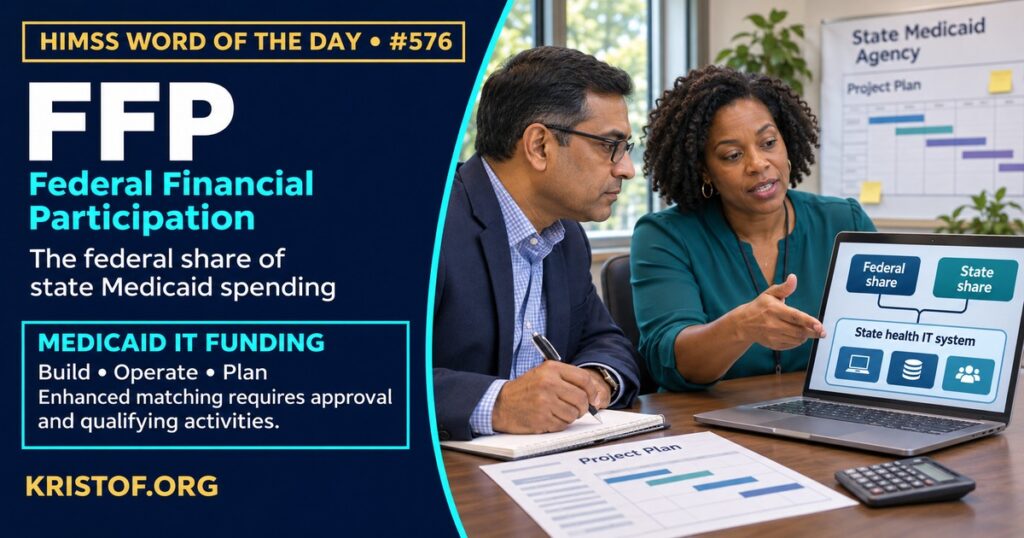
The HIMSS Dictionary describes federal financial participation (FFP) as the amount the federal government pays toward what a state spends on Medicaid, and it lists 90/10, 75/25, and 50/50 as examples of how that funding can be split. In each pair, the first number is the federal percentage and the second is the state’s.
The Medicaid and CHIP Payment and Access Commission (MACPAC), in a July 2026 brief, explains that FFP is also called the federal match. It says Medicaid administrative spending is generally matched at 50 percent, and that Congress authorized enhanced rates for state claims processing and information systems in 1972: 90 percent for design, development, or installation (DDI) and 75 percent for operations and maintenance (O&M). Other Medicaid Enterprise Systems (MES) spending can be claimed at the regular 50 percent rate. Enhanced rates require approval from CMS.
| Related term | How it relates to FFP |
|---|---|
| Federal match | Another name for the federal share of Medicaid spending |
| DDI (design, development, and installation) | System build activity that can qualify for the 90 percent enhanced rate |
| M&O or O&M (maintenance and operations) | Ongoing system operation that can qualify for the 75 percent enhanced rate |
| Advance Planning Document (APD) | The plan a state submits to CMS to request approval for enhanced funding |
| Medicaid Enterprise Systems (MES) | The state systems that support Medicaid functions such as eligibility, claims, and quality measurement |
The table is a teaching sketch and not an official taxonomy.
⚠️ Exam Alert: FFP is the federal share, not a grant to a hospital and not a payment to a provider. The 90/10, 75/25, and 50/50 figures apply to different activities (build, run, and other administrative spending), not to different states. Enhanced rates also depend on CMS approval and on meeting regulatory conditions. This post covers administrative IT matching only. The separate formula for matching Medicaid spending on medical services is outside its scope, so verify it in CMS or MACPAC materials before relying on it.
🌐 Why It Matters: Real-World Healthcare IT Context
Peer-reviewed research that studies FFP itself is sparse. The PubMed searches run for this post found no study evaluating the effect of enhanced matching on state health IT, and one 2026 policy paper that discusses it. The sources below are therefore mostly regulations, CMS guidance, and a MACPAC brief, which are the primary documents for how the rates work. Each source is labeled by type.
How the rates work. MACPAC’s July 2026 brief describes the 50, 75, and 90 percent rates above and ties the enhanced rates to Section 1903(a)(3) of the Social Security Act. It also reports that HITECH administrative funding for state systems generally ended in 2021, and that CMS has worked with states to keep pursuing health information exchange goals through other MES funding. This is a congressional advisory body’s description, not a regulation.
What a state must do first. According to the MACPAC brief, states need CMS approval before claiming enhanced rates, which they seek through an Advance Planning Document under 45 CFR 95.610. CMS has 60 days to review an APD, and a request for more information resets that clock. MACPAC adds that an APD is deemed approved if CMS gives no response in the 60-day period, and that states need prior approval to acquire IT equipment or services when expected total acquisition costs reach $5 million or more in federal and state funds. The regulation text for enhanced funding is in 42 CFR 433.112 for DDI and 42 CFR 433.116 for operations.
A 2015 rule. A CMS final rule published in the Federal Register on December 4, 2015, titled “Mechanized Claims Processing and Information Retrieval Systems (90/10),” describes enhanced federal match for DDI at 90 percent and for maintenance and operations at 75 percent, and projects a shift over time from mostly 90 percent funding to 75 percent funding as systems move from build to operation.
What the enhanced rates do not cover. In a June 14, 2024 CMS informational bulletin on enhanced matching for behavioral health IT, CMS says the funding applies only to systems operated by the state Medicaid agency and is not authorized for provider-owned systems or for work on a provider’s system. The bulletin says the enhanced rates do not cover EHR implementation in individual provider practices, requires states to show the system benefits Medicaid, and calls for a cost allocation plan when a system also benefits non-Medicaid programs. It names conditions in the regulations that include modular design with open interfaces and compliance with HIPAA. Because the bulletin is CMS guidance on one use of the rates, it does not describe every possible application.
A policy proposal. Jain and Jain, in the Milbank Quarterly (2026), argue that state health data utilities could serve as shared public infrastructure and proposes a financing model that includes Medicaid enhanced matching. The authors call for federal action to confirm enhanced matching for shared infrastructure. This is a policy analysis and proposal, not an evaluation of results, and the recommendations are the authors’ own.
Common FFP problems:
- Assuming enhanced matching can pay for a hospital’s or clinic’s own EHR, which CMS guidance says it does not
- Mixing up the 90/10, 75/25, and 50/50 splits, which apply to different kinds of spending
- Treating enhanced funding as automatic, when approval and regulatory conditions apply
- Citing HITECH-era Medicaid administrative funding as ongoing, since MACPAC says it generally ended in 2021
- Overlooking cost allocation when a system also serves non-Medicaid programs
- Missing the procurement approval step for large state contracts
What supports sound FFP planning:
- An APD that sets out the project plan, budget, and expected outcomes, as MACPAC describes
- A defined CMS review window of 60 days
- Regulatory conditions that favor modular systems with open interfaces
- A higher federal share for build work than for ongoing operation, as the 2015 rule describes
- Clear documentation of cost allocation across programs
- Ongoing engagement between CMS staff and states during development and operation, as MACPAC describes
🏥 The Nurse’s Perspective: Clinical, Bedside, & Workflow
For nurses, FFP matters most in state Medicaid agencies, in managed care and community organizations that depend on state systems, and in health systems that sell or connect to them.
At the Bedside
FFP never appears on a bedside screen, but the systems it helps fund can touch patients indirectly. State Medicaid systems handle eligibility, enrollment, and claims, and a bedside nurse or case manager may see the results as coverage status or prior authorization. Staff who work with Medicaid patients benefit from knowing that these are state systems with separate funding and timelines from the hospital EHR.
In Clinical Workflow
Nurses working as clinical subject matter experts at a state agency or a contractor may help define requirements for utilization review, care management, or quality reporting modules. In a provider organization, a nurse informaticist should not assume that Medicaid IT funding will pay for the organization’s own EHR build, because the 2024 CMS bulletin says the enhanced rates do not cover EHR implementation in individual provider practices. Questions about funding belong with finance and compliance leaders, and the practical check is to confirm which entity owns and operates the system.
In EHR Implementation (Go-Live Perspective)
During an Epic Go-Live, analysts at the elbow handle the clinical system, while state Medicaid systems have their own testing and go-live cycles. The CMS conditions that call for modular design and open interfaces suggest why interface testing between state systems and provider systems deserves early planning. Nurses who join user acceptance testing for a state module can verify clinical rules, such as authorization logic or care management workflows, against real scenarios before release.
🎓 CAHIMS / CPHIMS & HIMSS Perspective
CAHIMS Exam Domain Mapping
FFP links healthcare financing to system funding and governance:
| CAHIMS Domain | How FFP Appears |
|---|---|
| Healthcare & Technology Environments | Medicaid structure, federal and state roles, and public funding for health IT |
| Clinical Informatics | Clinical input into Medicaid system requirements and quality reporting |
| Healthcare Information & Systems Management | Procurement, approval documents, interfaces, and system conditions |
| Management & Leadership | Budgeting, cost allocation, and working with funders and regulators |
Key Terms to Know Alongside FFP
- MMIS (Medicaid Management Information System) — state system for Medicaid claims processing and related functions
- HITECH Act — 2009 law that created federal incentives for health IT adoption
- Meaningful Use — federal program that tied incentives to use of certified EHR technology
- HIE (Health Information Exchange) — organization or process that moves health information among providers
- Interoperability — ability of systems to exchange and use information
- HIPAA — federal law that sets privacy and security rules for health information
HIMSS Organizational Position
HIMSS offers education and research on health information and technology topics through its Resource Center. Members can find related information on the HIMSS Resource Center page.
🧭 More HIMSS Word of The Day Terms
Related terms in the Healthcare Policy series:
- Payer
- Prescription Drug Monitoring Program (PDMP)
- AUC (Appropriate Use Criteria)
- GUDID (Global Unique Device Identification Database)
Browse all Healthcare Policy terms or the A–Z glossary.
🔗 Explore Further: External References
- MACPAC (July 2026) — State Medicaid Enterprise Systems (Issue Brief) https://www.macpac.gov/wp-content/uploads/2026/07/Issue-Brief-State-Medicaid-Enterprise-Systems-FINAL.pdf
- CMS (June 14, 2024) — Accessing Enhanced Federal Medicaid Matching Rates for State Information Technology Expenditures to Improve Access to Mental Health and Substance Use Disorder Treatment and Care Coordination https://www.medicaid.gov/federal-policy-guidance/downloads/cib06142024.pdf
- 42 CFR § 433.112 — FFP for design, development, installation or enhancement of mechanized claims processing and information retrieval systems https://www.law.cornell.edu/cfr/text/42/433.112
- 42 CFR § 433.116 — FFP for operation of mechanized claims processing and information retrieval systems https://www.ecfr.gov/current/title-42/chapter-IV/subchapter-C/part-433/subpart-C/section-433.116
- CMS (2015), Federal Register — Medicaid Program; Mechanized Claims Processing and Information Retrieval Systems (90/10), Final Rule https://www.govinfo.gov/content/pkg/FR-2015-12-04/pdf/2015-30591.pdf
- Jain and Jain (2026), The Milbank quarterly — Health Data Utilities as Essential Public Infrastructure: A Cooperative Federalism Architecture https://pubmed.ncbi.nlm.nih.gov/42905117/
- HIMSS — Resource Center https://www.himss.org/resource-center
Term source: HIMSS Dictionary of Health Information and Technology Terms, Acronyms, and Organizations, 6th Edition (2025). All definitions in this series are paraphrased for editorial purposes. Readers are encouraged to consult the primary source for exact language.
Eric Andrew Kristof, RN, CAHIMS is a Healthcare IT professional and HIMSS Arkansas Chapter member based in Hot Springs Village, AR, with hands-on Epic Go-Live experience and a diverse healthcare and IT background. He writes at kristof.org at the intersection of clinical care and healthcare technology.
Leave a Reply