By Eric Andrew Kristof, RN, CAHIMS | Healthcare IT Professional | HIMSS Arkansas Chapter Member
About This Series: The HIMSS Word of the Day is a running blog series drawing from the HIMSS Dictionary of Health Information and Technology Terms, Acronyms, and Organizations, 6th Edition (2025) — the authoritative reference for healthcare IT professionals and the primary study resource for CAHIMS and CPHIMS certification. Each post paraphrases the term in plain language, grounds it in real-world healthcare IT context, and adds a bedside nursing perspective you won’t find in a textbook.
📖 The Term: MMIS (Medicaid Management Information System)
Source: HIMSS Dictionary of Health Information and Technology Terms, Acronyms, and Organizations, 6th Edition (2025)
🔍 Plain-Language Definition
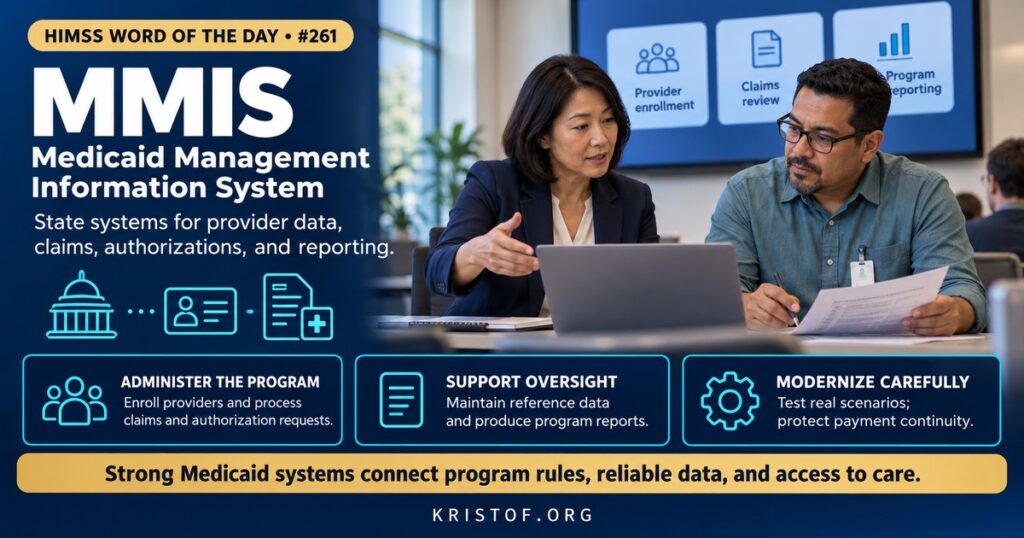
A Medicaid Management Information System (MMIS) is a coordinated set of manual procedures and computer operations, grouped into subsystems, built to support the main objectives of a state-run program. In practice, it is the system a state Medicaid agency uses to manage provider enrollment, process and pay claims, support prior authorization and utilization review, keep reference data, and produce management and federal reports.
Medicaid is jointly financed by the federal government and the states, and each state runs its own program within federal rules. That means there is not one MMIS but many, each built or purchased by a state and often operated with contractor support.
| Typical Function | What It Does | Why It Matters |
|---|---|---|
| Provider enrollment | Registers and screens providers | Only eligible providers are paid |
| Claims processing | Edits, adjudicates, and prices claims | Accurate and timely payment |
| Prior authorization and utilization review | Applies program rules to requests | Controls cost and supports appropriateness |
| Reference files | Holds codes, fee schedules, and policy tables | Keeps payment rules current |
| Management reporting | Produces program and federal reports | Oversight and planning |
| Data to CMS | Sends program data to federal systems | Federal monitoring and research |
⚠️ Exam Alert: The MMIS processes Medicaid claims and provider data for the state. Federal financial participation (FFP) is the federal government’s share of state spending. Systems seeking enhanced federal funding need advance approval of an advance planning document (APD). T-MSIS is the federal data submission and research file set derived from state data.
🌐 Why It Matters: Real-World Healthcare IT Context
Medicaid covers a large and diverse population, including children, pregnant people, older adults, and people with disabilities. Its systems must pay claims accurately, enroll providers, and produce data that federal and state leaders rely on. Because these systems are complex and expensive, federal rules govern how they are funded and what they must do.
The regulations are in 42 CFR Part 433, Subpart C, on mechanized claims processing and information retrieval systems. Section 433.112 states that federal funding is available at the 90 percent rate for the design, development, installation, or enhancement of such a system, but only if CMS approves the state’s advance planning document before the state spends the money. CMS approves a system if it determines the system is likely to provide more efficient, economical, and effective administration of the state plan, meets requirements in the State Medicaid Manual, is compatible with the claims processing and information retrieval systems used for Medicare so eligibility can be verified and claims processed for people eligible for both programs, and supports the data needs of quality improvement organizations. The rule also says the state owns software developed with enhanced funding and that the federal government has a royalty-free license to use it. Section 433.116 provides federal funding at 75 percent of expenditures for operating an approved system. For states, these rules shape procurement, project timelines, and vendor contracts, and they encourage reusable, modular approaches.
Modernization is a constant theme. Many MMIS platforms are old, built around batch processing and custom code. States have moved toward modular approaches in which functions such as provider management, claims, and analytics can be replaced separately, but transitions are large projects with significant risk for payment continuity. Informatics professionals who work with state agencies or managed care organizations encounter these projects in vendor selection, requirements, testing, and data migration.
The data matter beyond payment. CMS released the T-MSIS Analytic Files, or TAF, in 2019 as a new-generation federal Medicaid claims dataset that has driven policy-relevant research. A 2025 article in JAMA Health Forum introduced a reporting checklist for TAF-based research, noting that Medicaid is the largest single source of health coverage in the United States, that research had lagged Medicare research because high-quality claims data across states were limited, and that TAF data are highly complex, with meaningful differences in quality across states, years, and data elements. The checklist was developed by a subcommittee of the Medicaid Data Learning Network through iterative feedback from members, an advisory group, and journal editors. For anyone interpreting Medicaid-based findings, the lesson is the same as for any claims data: understand how the data were generated before trusting the result. The MMIS and state submission processes are where those data originate.
Connections to clinical systems are growing. Prior authorization, electronic visit verification, immunization registry links, prescription drug monitoring checks, and health information exchange participation all touch Medicaid systems. Federal interoperability rules for Medicaid and CHIP programs push state systems toward standardized APIs. Clinicians and health systems feel the effects when claims edits deny payment, enrollment status is wrong, or prior authorization takes too long.
Common MMIS-related problems:
- Aging platforms that are costly to change
- Large modernization projects with payment continuity risks
- Data that differ in quality across states and years
- Claims edits that do not match clinical practice
- Provider enrollment delays that interrupt access to care
- Weak links between Medicaid data and clinical records
What supports successful Medicaid system work:
- Clear requirements shaped by clinicians, providers, and members
- Modular architecture and reusable components
- Early planning with CMS and approved advance planning documents
- Strong data governance and documentation of data limits
- Testing with real claim scenarios and payer rules
- Transparent communication with providers about changes
🏥 The Nurse’s Perspective: Clinical, Bedside, & Workflow
Nurses interact with the MMIS indirectly, through eligibility checks, authorizations, and payment rules that shape what care patients can get.
At the Bedside
When a patient’s Medicaid coverage lapses, a service is denied, or a medication needs authorization, the effects reach the unit. Nurses who understand that these decisions come from state systems and rules can help patients navigate: connecting them with social work, financial counseling, and enrollment help, and documenting clinical details that support authorization.
In Clinical Workflow
Case managers and utilization review nurses work daily with Medicaid authorization processes. They know which documentation speeds approval and where claims commonly fail. Nurse leaders in community health centers, home health agencies, and long-term care also depend on timely enrollment and payment.
Nurse informaticists who work with state agencies or managed care plans help translate clinical needs into system requirements, test claims edits against real clinical scenarios, and advise on documentation that supports program rules.
In EHR Implementation (Go-Live Perspective)
An Epic Go-Live in a health system with a large Medicaid population depends on correct registration, eligibility checks, and claims transmission. Revenue cycle and clinical analysts test Medicaid scenarios before go-live. At-the-elbow support analysts hear when registration or authorization steps do not fit the clinic’s workflow, and help adjust them so that eligibility problems are caught at the front door and not after the visit.
🎓 CAHIMS / CPHIMS & HIMSS Perspective
CAHIMS Exam Domain Mapping
MMIS appears in public program, payer, and policy questions:
| CAHIMS Domain | How MMIS Appears |
|---|---|
| Healthcare & Technology Environments | Medicaid program structure, federal and state roles, regulation |
| Clinical Informatics | Eligibility, authorization, documentation for coverage |
| Healthcare Information & Systems Management | Claims processing, system modernization, data quality, interfaces |
| Management & Leadership | Procurement, federal funding approval, vendor management, project risk |
Key Terms to Know Alongside MMIS
- Federal Financial Participation (FFP) — federal share of allowable state Medicaid spending
- Advance Planning Document (APD) — state plan for a system project that requires CMS approval for enhanced funding
- T-MSIS — federal system through which states submit Medicaid data
- TAF (T-MSIS Analytic Files) — research-ready Medicaid datasets produced from T-MSIS data
- Adjudication — process of deciding whether and how much to pay on a claim
- Provider Enrollment — process of approving providers to participate in Medicaid
HIMSS Organizational Position
HIMSS supports public health information systems and policy through its public policy work, research, and education. Members can find related resources through the HIMSS Resource Center and Public Policy and Advocacy pages.
🔗 Explore Further: External References
- eCFR — 42 CFR Part 433, Subpart C: Mechanized Claims Processing and Information Retrieval Systems https://www.ecfr.gov/current/title-42/chapter-IV/subchapter-C/part-433/subpart-C
- eCFR — 42 CFR 433.112, FFP for Design, Development, Installation or Enhancement https://www.ecfr.gov/current/title-42/chapter-IV/subchapter-C/part-433/subpart-C/section-433.112
- eCFR — 42 CFR 433.116, FFP for Operation of Mechanized Claims Processing Systems https://www.ecfr.gov/current/title-42/chapter-IV/subchapter-C/part-433/subpart-C/section-433.116
- Schpero et al. (2025), JAMA Health Forum — The T-MSIS Analytic Files (TAF) Analysis Reporting Checklist: A Guide for Research Using Medicaid Claims Data https://pubmed.ncbi.nlm.nih.gov/41134558/
- CMS — Administrative Simplification https://www.cms.gov/priorities/key-initiatives/burden-reduction/administrative-simplification
Term source: HIMSS Dictionary of Health Information and Technology Terms, Acronyms, and Organizations, 6th Edition (2025). All definitions in this series are paraphrased for editorial purposes. Readers are encouraged to consult the primary source for exact language.
Eric Andrew Kristof, RN, CAHIMS is a Healthcare IT professional and HIMSS Arkansas Chapter member based in Hot Springs Village, AR, with hands-on Epic Go-Live experience and a diverse healthcare and IT background. He writes at kristof.org at the intersection of clinical care and healthcare technology.
Leave a Reply