By Eric Andrew Kristof, RN, CAHIMS | Healthcare IT Professional | HIMSS Arkansas Chapter Member
About This Series: The HIMSS Word of the Day is a running blog series drawing from the HIMSS Dictionary of Health Information and Technology Terms, Acronyms, and Organizations, 6th Edition (2025) — the authoritative reference for healthcare IT professionals and the primary study resource for CAHIMS and CPHIMS certification. Each post paraphrases the term in plain language, grounds it in real-world healthcare IT context, and adds a bedside nursing perspective you won’t find in a textbook.
📖 The Term: Service-Oriented Architecture (SOA)
Source: HIMSS Dictionary of Health Information and Technology Terms, Acronyms, and Organizations, 6th Edition (2025)
🔍 Plain-Language Definition
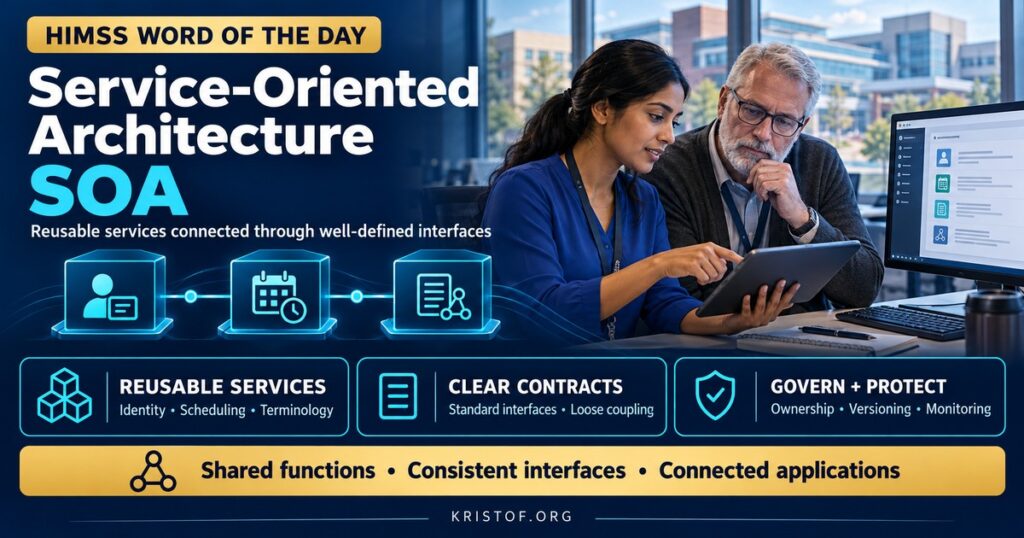
Service-oriented architecture (SOA) is a software design approach in which applications are built from discrete, reusable services that perform specific functions and communicate over a network through well-defined, standardized interfaces.
The HIMSS Dictionary describes SOA as a development model for distributed application components that includes discovery, access control, data mapping, and security. It explains that SOA defines a broad architectural model describing application goals and approaches, and also defines specific implementation specifications, often tied to the Web Services Description Language (WSDL) and the Simple Object Access Protocol (SOAP).
| SOA Concept | What It Means | Healthcare Example |
|---|---|---|
| Service | A self-contained function available over a network | A patient identity lookup service |
| Interface Contract | A formal description of how to call the service | A WSDL file or API specification |
| Loose Coupling | Services can change internally without breaking callers | Replacing a terminology engine behind the same interface |
| Reuse | Many applications use the same service | Portal, EHR, and apps using one scheduling service |
| Enterprise Service Bus (ESB) | Middleware that routes and transforms service messages | Integration platform connecting hospital systems |
| Microservices | Small, independently deployable services | A cloud application built from many small services |
⚠️ Exam Alert: SOA is an architectural approach, not a single product. SOAP is a messaging protocol often used in classic SOA, described by WSDL. REST is an architectural style using standard web methods, and FHIR uses RESTful APIs. Microservices are a finer-grained evolution of service-oriented ideas.
🌐 Why It Matters: Real-World Healthcare IT Context
Healthcare organizations run hundreds of applications that must share information. Point-to-point connections between every pair of systems become fragile and expensive as organizations grow. SOA offers an alternative: expose common functions as services that many systems can reuse.
In the 2000s, SOA was promoted as a way to modernize enterprise IT, often using SOAP-based web services described by WSDL and coordinated through enterprise service buses. Healthcare adopted many of these patterns. IHE integration profiles for cross-enterprise document sharing, for example, use web services to register, query, and retrieve clinical documents among organizations and health information exchanges.
Healthcare standards bodies also explored service definitions. HL7 and other organizations worked on specifications for common healthcare services, such as identity and terminology services, so different vendors could implement the same interfaces.
The ideas behind SOA evolved into today’s APIs. RESTful APIs, which use standard web methods and lightweight formats such as JSON, became dominant for web and mobile development. FHIR applies RESTful principles to healthcare data, defining resources that applications can read and write through standard API calls. Microservices take SOA further by breaking applications into small, independently deployable services, common in cloud platforms.
The benefits of service orientation remain relevant. Reusable services reduce duplication, allow components to be updated independently, and make it easier to add new applications, such as patient apps, that call existing services.
The challenges are real too. Many services mean many dependencies, and a failure in a shared service can affect multiple applications. Version management, security for each interface, monitoring, and performance require discipline. Overly complex service buses became bottlenecks in some organizations.
Security must be built into every interface. Services exposed across networks need authentication, authorization, encryption, input validation, and logging. API gateways, OAuth-based authorization, and centralized monitoring help manage this.
Modernization often blends old and new. Many organizations run SOAP-based services for existing exchange networks alongside newer FHIR APIs, with integration engines translating between them. Planning a gradual transition, rather than replacing everything at once, reduces risk and lets organizations retire older services as partners adopt newer standards.
Governance ties it together. Service catalogs, ownership, version policies, and standards for documentation help organizations manage growing numbers of services and APIs.
Performance and scalability depend on design. Services called thousands of times per minute, such as patient lookup or medication checking, need caching, load balancing, and capacity planning so they do not slow clinical workflows during peak periods.
Common SOA and API challenges:
- Complex dependencies among many services
- Versioning that breaks existing consumers
- Performance bottlenecks in central integration layers
- Inconsistent security across interfaces
- Poor documentation and unclear ownership
- Difficulty troubleshooting distributed failures
Practices for effective service-oriented design:
- Clear interface contracts and documentation
- Standard formats and healthcare standards such as FHIR
- API gateways and consistent security controls
- Monitoring and logging across services
- Versioning policies and backward compatibility
- A governed service and API catalog
🏥 The Nurse’s Perspective: Clinical, Bedside, & Workflow
Service-oriented design is invisible to most clinicians, but it shapes how information reaches them.
At the Bedside
When a nurse opens an outside record, checks a medication interaction, or sees a patient-reported reading in the chart, a service or API is often working in the background. Fast, reliable services mean information appears when needed.
If one shared service fails, several applications may be affected at once, such as patient lookup failing in multiple tools. Reporting widespread symptoms helps IT identify the underlying service quickly.
In Clinical Workflow
Patient apps, portals, and third-party clinical tools increasingly connect to the EHR through standard APIs. Nurses may see information from these tools in the chart, and understanding where it came from helps interpret it.
Document sharing across organizations, such as retrieving records from a health information exchange, often relies on service-based standards. When outside records are missing, connectivity or service issues may be the cause.
Nurse informaticists involved in integration projects help define what information must flow between services and how it should appear in clinical workflow.
Third-party apps connecting through APIs require review before use. Nurses who learn of helpful apps can route them to informatics teams so security and data flows can be assessed.
In EHR Implementation (Go-Live Perspective)
During an Epic Go-Live, integration teams configure web services, APIs, and interfaces connecting the EHR with other systems. Testing confirms that services respond correctly and quickly under realistic loads.
At-the-elbow support analysts may notice slow responses or errors when certain functions call external services. Detailed reports about timing and affected functions help technical teams find and fix integration issues.
🎓 CAHIMS / CPHIMS & HIMSS Perspective
CAHIMS Exam Domain Mapping
SOA appears in architecture and interoperability questions:
| CAHIMS Domain | How SOA Appears |
|---|---|
| Healthcare & Technology Environments | Architecture trends; web services and APIs |
| Clinical Informatics | Information availability in workflow; outside records |
| Healthcare Information & Systems Management | Services, SOAP, REST, ESBs, microservices, API security |
| Management & Leadership | Architecture governance, service catalogs, vendor integration strategy |
Key Terms to Know Alongside SOA
- Web Service — a software function accessible over a network through standard protocols
- SOAP — an XML-based messaging protocol used in many web services
- REST — an architectural style for APIs using standard web methods
- Microservices — small, independently deployable services that together form an application
- Enterprise Service Bus (ESB) — middleware that routes and transforms messages between services
- API Gateway — a component that manages, secures, and monitors API traffic
HIMSS Organizational Position
HIMSS supports standards-based integration and API adoption through its interoperability education and collaboration with IHE. Members can find related education and research through the HIMSS Resource Center.
🔗 Explore Further: External References
- HL7 — FHIR RESTful API https://hl7.org/fhir/http.html
- IHE International — Profiles https://www.ihe.net/resources/profiles/
- ONC — Interoperability Standards Platform https://isp.healthit.gov/
- NIST — SP 800-145, The NIST Definition of Cloud Computing https://csrc.nist.gov/pubs/sp/800/145/final
- HL7 — SMART App Launch https://hl7.org/fhir/smart-app-launch/
- HIMSS — Public Policy & Advocacy https://www.himss.org/public-policy-advocacy-overview
Term source: HIMSS Dictionary of Health Information and Technology Terms, Acronyms, and Organizations, 6th Edition (2025). All definitions in this series are paraphrased for editorial purposes. Readers are encouraged to consult the primary source for exact language.
Eric Andrew Kristof, RN, CAHIMS is a Healthcare IT professional and HIMSS Arkansas Chapter member based in Hot Springs Village, AR, with hands-on Epic Go-Live experience and a diverse healthcare and IT background. He writes at kristof.org at the intersection of clinical care and healthcare technology.
Leave a Reply