By Eric Andrew Kristof, RN, CAHIMS | Healthcare IT Professional | HIMSS Arkansas Chapter Member
About This Series: The HIMSS Word of the Day is a running blog series drawing from the HIMSS Dictionary of Health Information and Technology Terms, Acronyms, and Organizations, 6th Edition (2025) — the authoritative reference for healthcare IT professionals and the primary study resource for CAHIMS and CPHIMS certification. Each post paraphrases the term in plain language, grounds it in real-world healthcare IT context, and adds a bedside nursing perspective you won’t find in a textbook.
📖 The Term: Prescription Drug Monitoring Program (PDMP)
Source: HIMSS Dictionary of Health Information and Technology Terms, Acronyms, and Organizations, 6th Edition (2025)
🔍 Plain-Language Definition
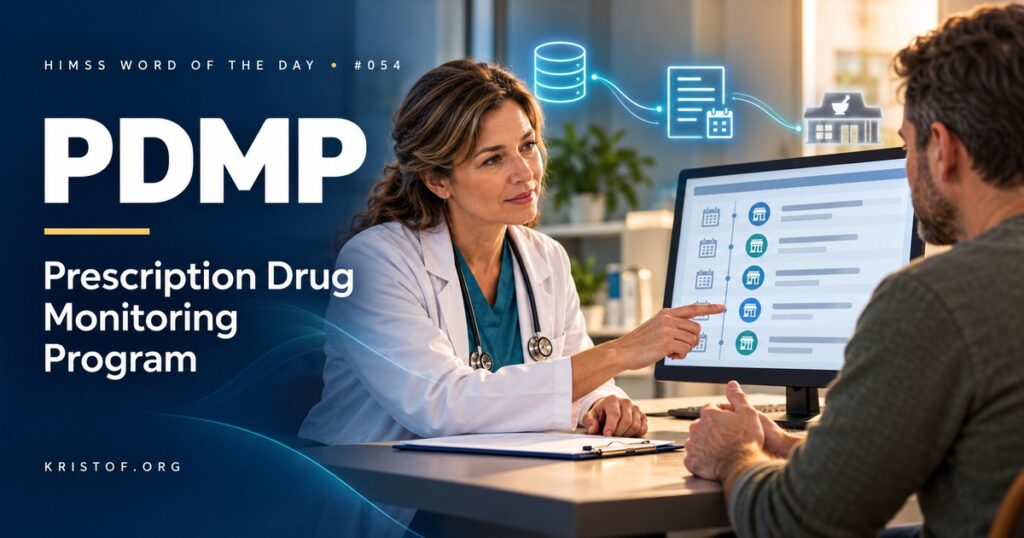
A prescription drug monitoring program (PDMP) is a database, usually run by a state, that collects information about controlled substance prescriptions dispensed to patients. Prescribers and pharmacists can check it to see a patient’s recent history of medications such as opioids, benzodiazepines, and stimulants before prescribing or dispensing more.
The HIMSS Dictionary describes a PDMP as an electronic system, typically operated at the state level, that tracks prescriptions for controlled substances. It notes that PDMPs can give clinicians and health authorities timely information about prescribing patterns and patient behavior.
| PDMP Function | What Happens | Example |
|---|---|---|
| Data Collection | Pharmacies report dispensed controlled substance prescriptions to the state | A pharmacy uploads each dispensed opioid prescription |
| Clinical Query | Prescribers and pharmacists look up a patient’s history | A nurse practitioner checks recent fills before prescribing |
| Interstate Sharing | States exchange data so users can see prescriptions filled across state lines | A clinician near a border sees fills from a neighboring state |
| Alerts and Reports | Programs may flag patterns such as overlapping prescriptions | Concurrent opioid and benzodiazepine prescriptions |
| Public Health Use | Aggregated data informs prevention and policy | Tracking prescribing trends by county |
⚠️ Exam Alert: A PDMP is a state database of dispensed controlled substances. EPCS (electronic prescribing of controlled substances) is a method of transmitting controlled substance prescriptions securely. DEA registration is the federal authorization to prescribe controlled substances. A PDMP check does not replace clinical judgment; it informs it.
🌐 Why It Matters: Real-World Healthcare IT Context
PDMPs became a central tool in responding to the opioid crisis. They help clinicians spot risky combinations, such as opioids prescribed alongside benzodiazepines, identify patients receiving controlled substances from multiple prescribers, and start conversations about safer treatment.
Every state now operates a statewide PDMP. Missouri, the last state without one, brought its statewide program online in December 2023. Rules vary widely by state, including which drugs are reported, how quickly pharmacies must report, and when prescribers are required to check.
Federal policy has added requirements. Under the SUPPORT for Patients and Communities Act, beginning October 1, 2021, states must require certain Medicaid providers to check a qualified PDMP before prescribing controlled substances to Medicaid beneficiaries, with states setting the details.
Research suggests PDMPs can influence prescribing. A 2016 study in Health Affairs by Yuhua Bao and colleagues found that implementing a PDMP was associated with a reduction of more than 30% in the rate of Schedule II opioid prescribing in ambulatory care, with effects that persisted for several years.
Data quality affects usefulness. PDMP records depend on pharmacies reporting promptly and on correct matching between pharmacy data and the clinician’s patient. A patient whose name is spelled differently at two pharmacies may appear as two people, and a prescription filled yesterday may not appear yet. Clinicians should treat the PDMP as one source of information, confirm concerns with the patient, and document their reasoning.
Integration determines use. When clinicians must open a separate website, log in again, and type patient details, PDMP checks are slow and often skipped. Integration into the EHR, where the query runs in the context of the current patient, makes checking practical in busy workflows.
PDMPs also raise concerns. Some platforms generate risk scores whose methods are not fully transparent, and critics worry that rigid use of PDMP data can lead to abrupt tapering, stigma, or patients being turned away rather than offered treatment.
Common PDMP challenges:
- Separate logins and websites that interrupt clinical workflow
- Patient matching errors between pharmacy data and EHR records
- Reporting delays that leave recent fills out of the picture
- Variation in rules and data sharing across states
- Risk scores that clinicians may over-rely on
- Unclear documentation of whether and when a check was performed
Characteristics of effective PDMP use:
- EHR-integrated queries launched in the context of the current patient
- Interstate data sharing for patients who cross state lines
- Clear organizational policies on when checks are required
- Documentation of the check and how results informed the decision
- Training on interpreting results compassionately and accurately
- Links to treatment resources for patients with substance use disorders
🏥 The Nurse’s Perspective: Clinical, Bedside, & Workflow
Nurses interact with PDMP information as prescribers, as members of the care team, and as patient educators.
At the Bedside
Advanced practice registered nurses who prescribe controlled substances are often required by state law to check the PDMP before prescribing. A PDMP report showing overlapping prescriptions from several clinicians, or a combination of opioids and sedatives, may prompt a conversation about safety, naloxone, or referral to treatment.
Bedside nurses see the context behind the data. A patient with escalating pain, a history of substance use, or concerns about withdrawal needs both safe medication practices and respectful, nonjudgmental care.
In Clinical Workflow
In some states, delegates such as nurses may query the PDMP on behalf of a prescriber, which can save time during busy clinic or emergency department shifts. Delegates must follow state rules and use their own credentials.
Pharmacists are partners in this work. Community and hospital pharmacists check the PDMP before dispensing, and a call from a pharmacist about an overlapping prescription is an opportunity for the care team to coordinate rather than a barrier to care.
Discharge planning often involves controlled substances. Nurses educate patients about safe use, storage, and disposal of opioids, the risks of combining them with alcohol or sedatives, and when to use naloxone. That teaching complements what the PDMP shows prescribers.
In EHR Implementation (Go-Live Perspective)
During an Epic Go-Live, PDMP integration is usually configured so prescribers can open PDMP results directly from the patient’s chart, often from the medication ordering or discharge workflow. Credentials, roles, and state connection settings must be tested before Go-Live so the integration works on the first day.
At-the-elbow support analysts often help prescribers and delegates find the PDMP link, understand the results display, and document that the check was completed. When the integration fails, the fallback is the state’s PDMP website, and users should know how to reach it.
🎓 CAHIMS / CPHIMS & HIMSS Perspective
CAHIMS Exam Domain Mapping
PDMPs appear in policy, safety, and integration questions:
| CAHIMS Domain | How PDMPs Appear |
|---|---|
| Healthcare & Technology Environments | State PDMP laws; the SUPPORT Act; opioid crisis policy; interstate data sharing |
| Clinical Informatics | Prescribing workflows; decision support for controlled substances; patient education |
| Healthcare Information & Systems Management | EHR integration, patient matching, credentials and access, data latency |
| Management & Leadership | Compliance with check mandates, policy development, monitoring use and outcomes |
Key Terms to Know Alongside PDMP
- EPCS (Electronic Prescribing of Controlled Substances) — secure electronic transmission of controlled substance prescriptions under DEA rules
- Controlled Substance — a drug regulated by the DEA because of its potential for abuse or dependence
- SUPPORT Act — the 2018 federal law addressing the opioid crisis, including PDMP requirements for Medicaid providers
- Delegate — a person authorized under state rules to query the PDMP on behalf of a prescriber
- Interstate Data Sharing — exchange of PDMP data between states through data-sharing hubs
- Naloxone — a medication that reverses opioid overdose
HIMSS Organizational Position
HIMSS engages on federal health IT and interoperability policy through its public policy work, including issues that affect how data such as PDMP information reaches clinicians inside their normal workflow. Members can find related education and research through the HIMSS Resource Center.
🔗 Explore Further: External References
- PDMP Training and Technical Assistance Center (TTAC) https://www.pdmpassist.org/
- PDMP TTAC — State Profiles https://www.pdmpassist.org/State
- ONC — Pharmacy and Prescription Drug Monitoring Programs https://healthit.gov/pharmacy-pdmp/
- CMS — EPCS Program https://www.cms.gov/medicare/e-health/eprescribing/cms-eprescribing-for-controlled-substances-program
- Bao et al. (2016), Health Affairs — PDMPs Are Associated With Sustained Reductions in Opioid Prescribing by Physicians https://pubmed.ncbi.nlm.nih.gov/27269021/
- DEA Diversion Control Division https://www.deadiversion.usdoj.gov/
Term source: HIMSS Dictionary of Health Information and Technology Terms, Acronyms, and Organizations, 6th Edition (2025). All definitions in this series are paraphrased for editorial purposes. Readers are encouraged to consult the primary source for exact language.
Eric Andrew Kristof, RN, CAHIMS is a Healthcare IT professional and HIMSS Arkansas Chapter member based in Hot Springs Village, AR, with hands-on Epic Go-Live experience and a diverse healthcare and IT background. He writes at kristof.org at the intersection of clinical care and healthcare technology.
Leave a Reply