By Eric Andrew Kristof, RN, CAHIMS | Healthcare IT Professional | HIMSS Arkansas Chapter Member
About This Series: The HIMSS Word of the Day is a running blog series drawing from the HIMSS Dictionary of Health Information and Technology Terms, Acronyms, and Organizations, 6th Edition (2025) — the authoritative reference for healthcare IT professionals and the primary study resource for CAHIMS and CPHIMS certification. Each post paraphrases the term in plain language, grounds it in real-world healthcare IT context, and adds a bedside nursing perspective you won’t find in a textbook.
📖 The Term: Accreditation
Source: HIMSS Dictionary of Health Information and Technology Terms, Acronyms, and Organizations, 6th Edition (2025)
🔍 Plain-Language Definition
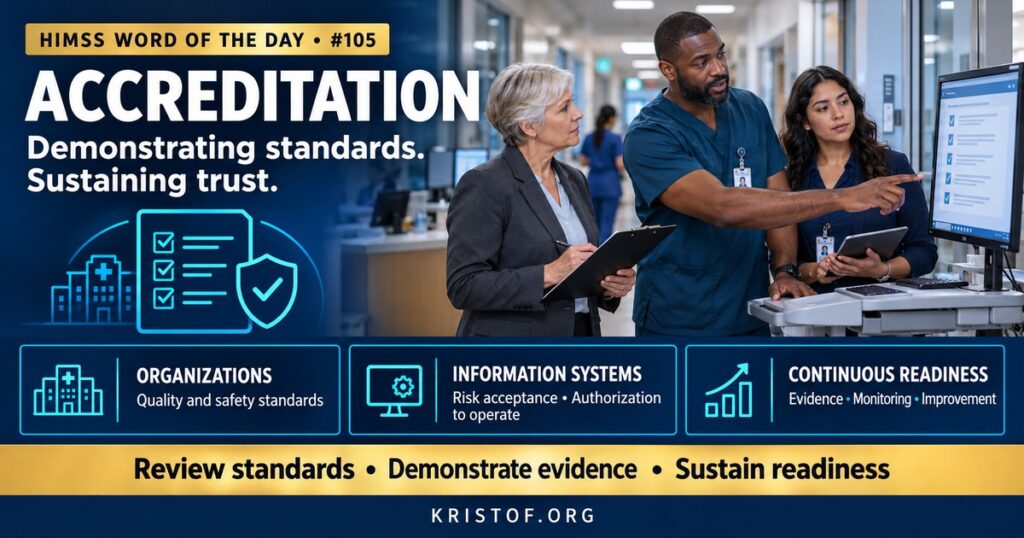
Accreditation is formal recognition that something meets a defined set of standards. In healthcare IT, the word is used in two different ways.
The HIMSS Dictionary gives both meanings. In the first, accreditation is an official decision by an authorized approver that an information system may operate in a particular security mode, using specified safeguards, at an acceptable level of risk. In the second, it is a review process through which healthcare organizations demonstrate that they meet predetermined criteria and standards set by a professional accrediting agency. The Dictionary adds that accreditation represents organizations as credible and committed to continuous compliance with high standards of quality.
| Meaning | Who Grants It | What It Shows | Example |
|---|---|---|---|
| Organizational Accreditation | An accrediting body | The organization meets quality and safety standards | A hospital accredited after an on-site survey |
| Information System Accreditation (Authorization) | A designated senior official | The system’s security risks are acceptable for operation | A government health system granted an authorization to operate |
| Program Certification | An accrediting body | A specific program meets specialty standards | Stroke center or other disease-specific certification |
| Professional Recognition | A professional organization | Excellence in a specific area | Magnet Recognition for nursing excellence |
⚠️ Exam Alert: Organizational accreditation evaluates quality and safety against an accreditor’s standards. Security accreditation, now usually called authorization to operate (ATO) in NIST’s Risk Management Framework, approves an information system’s risk. Certification often refers to a specific program or product, such as ONC certification of health IT. Licensure is a government requirement to operate or practice.
🌐 Why It Matters: Real-World Healthcare IT Context
Organizational accreditation shapes how hospitals and other providers operate. CMS approves certain accrediting organizations to grant deemed status, so organizations they accredit are considered to meet Medicare requirements. For hospitals, The Joint Commission is the most familiar, but other CMS-approved accrediting organizations, such as DNV, also accredit hospitals. Other bodies accredit health plans, such as NCQA, and specific services and programs.
Accreditation requires evidence. Surveyors review policies, observe care, interview staff, and examine records. The EHR holds much of that evidence: assessments, care plans, medication administration, consents, education, and infection control documentation. Reports that monitor compliance throughout the year help organizations stay ready.
The information system meaning of accreditation comes from federal security practice. NIST’s Risk Management Framework, SP 800-37, describes a process in which security and privacy controls are selected, implemented, and assessed, and then a senior official decides whether the remaining risk is acceptable, granting authorization to operate. Older documents called this decision accreditation. Federal health organizations, such as the Department of Veterans Affairs and Indian Health Service, and vendors that host systems for federal agencies follow this kind of process, and many private organizations borrow its discipline for their own risk decisions.
Health IT products have their own certification. ONC’s Health IT Certification Program certifies that EHRs and other health IT products meet specific functional, interoperability, and security criteria. Certification of a product is different from accreditation of an organization, but certified technology is often required for participation in federal programs, and it gives organizations a baseline of capability.
Professional recognition programs, such as the ANCC Magnet Recognition Program for nursing excellence, also rely on data and documentation, including nurse-sensitive quality indicators.
Accreditation is also increasingly digital. Many accrediting bodies ask organizations to submit data electronically, and some evaluate digital capabilities directly. HIMSS’s own maturity model validations, such as EMRAM, assess how fully organizations use digital tools to support safe care.
Common accreditation challenges:
- Treating surveys as events rather than continuous readiness
- Documentation that does not clearly show standards are met
- Policies that do not match actual practice or system workflows
- Security assessments performed once and never revisited
- Undocumented risk acceptance decisions for information systems
- Data needed for recognition programs scattered across systems
What supports successful accreditation:
- Continuous monitoring of key standards using EHR reports
- Policies aligned with documentation tools and workflows
- Mock surveys and tracers
- Documented security risk assessments and authorization decisions
- Clear ownership for each standard area
- Engaged frontline staff who understand the reasons behind standards
🏥 The Nurse’s Perspective: Clinical, Bedside, & Workflow
Nurses are central to organizational accreditation and contribute to the information that supports it.
At the Bedside
Surveyors observe nursing practice directly: patient identification, medication administration, infection prevention, pain management, fall prevention, and patient education. Practicing to standard every day, not just during survey windows, is what accreditation is designed to confirm.
Nurses may be asked to show where specific care is documented. Knowing the EHR well enough to find assessments, reassessments, education records, and care plans quickly demonstrates both competence and the system’s ability to support standards.
Accreditation surveys also examine competency records. Documentation that nurses have completed required education, such as restraint training or equipment competencies, is often stored in learning management systems that must be easy to report on.
In Clinical Workflow
Nursing quality data supports many recognition programs. Magnet-designated organizations, for example, report nurse-sensitive indicators such as falls with injury and hospital-acquired pressure injuries, and the accuracy of those indicators depends on nursing documentation.
Nurses also participate in internal readiness work, including chart audits, mock tracers, and unit-based quality projects that address gaps before a survey.
Nurses also contribute to professional accreditation of programs, such as nursing residency programs and continuing education providers, which rely on documented outcomes and evaluations that are often tracked electronically.
In EHR Implementation (Go-Live Perspective)
An Epic Go-Live changes how evidence for standards is captured and reported. Teams align documentation tools with policies and accreditation requirements, rebuild compliance reports, and educate staff on where required items now live.
At-the-elbow support analysts help nurses locate required documentation in the new system, and after Go-Live, compliance reports help leaders confirm that standards are still being met. On the security side, new systems and interfaces typically undergo risk assessments before go-live approval.
🎓 CAHIMS / CPHIMS & HIMSS Perspective
CAHIMS Exam Domain Mapping
Accreditation appears in regulatory, quality, and security questions:
| CAHIMS Domain | How Accreditation Appears |
|---|---|
| Healthcare & Technology Environments | Accrediting organizations; deemed status; Magnet; program certification |
| Clinical Informatics | Documentation that demonstrates compliance with standards |
| Healthcare Information & Systems Management | Security assessment and authorization; compliance reporting |
| Management & Leadership | Survey readiness, risk acceptance, governance, continuous improvement |
Key Terms to Know Alongside Accreditation
- Deemed Status — CMS recognition that an organization accredited by an approved body meets Medicare requirements
- Accrediting Organization — a body that evaluates and recognizes organizations against standards
- Authorization to Operate (ATO) — a formal decision that an information system’s security risk is acceptable
- Risk Management Framework — NIST’s process for managing security and privacy risk across the system life cycle
- Certification — recognition that a program, product, or person meets defined criteria
- Magnet Recognition — an ANCC designation recognizing nursing excellence
HIMSS Organizational Position
HIMSS addresses accreditation through its emphasis on quality, patient safety, and cybersecurity risk management, and through its own maturity model validations that recognize organizations for digital capabilities. Members can find related education and research through the HIMSS Resource Center.
🔗 Explore Further: External References
- CMS — Accrediting Organizations (AOs) https://www.cms.gov/medicare/health-safety-standards/quality-safety-oversight-general-information/accrediting-organizations-aos
- The Joint Commission https://www.jointcommission.org/
- NIST — SP 800-37 Rev. 2, Risk Management Framework https://csrc.nist.gov/pubs/sp/800/37/r2/final
- ANA — ANCC Magnet Recognition Program https://www.nursingworld.org/organizational-programs/magnet/
- NCQA — National Committee for Quality Assurance https://www.ncqa.org/
- HIMSS — Maturity Models https://www.himss.org/maturity-models
Term source: HIMSS Dictionary of Health Information and Technology Terms, Acronyms, and Organizations, 6th Edition (2025). All definitions in this series are paraphrased for editorial purposes. Readers are encouraged to consult the primary source for exact language.
Eric Andrew Kristof, RN, CAHIMS is a Healthcare IT professional and HIMSS Arkansas Chapter member based in Hot Springs Village, AR, with hands-on Epic Go-Live experience and a diverse healthcare and IT background. He writes at kristof.org at the intersection of clinical care and healthcare technology.
Leave a Reply