By Eric Andrew Kristof, RN, CAHIMS | Healthcare IT Professional | HIMSS Arkansas Chapter Member
About This Series: The HIMSS Word of The Day is a running blog series drawing from the HIMSS Dictionary of Health Information and Technology Terms, Acronyms, and Organizations, 6th Edition (2025) — the authoritative reference for healthcare IT professionals and the primary study resource for CAHIMS and CPHIMS certification. Each post paraphrases the term in plain language, grounds it in real-world healthcare IT context, and adds a bedside nursing perspective you won’t find in a textbook.
📖 The Term: Activity-Based Costing (ABC)
Source: HIMSS Dictionary of Health Information and Technology Terms, Acronyms, and Organizations, 6th Edition (2025)
🔍 Plain-Language Definition
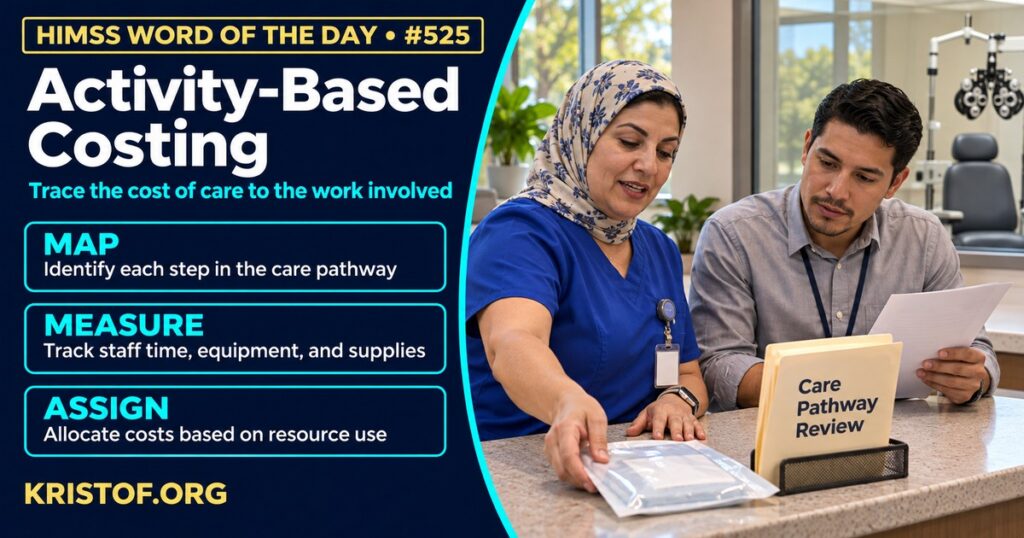
The HIMSS Dictionary describes activity-based costing (ABC) as an accounting technique for finding the actual cost of each product or service an organization produces, regardless of how the organization is structured. Instead of dividing costs among departments such as finance or marketing, ABC connects costs to the activities that cause them. Its core logic has four parts: products or services use activities, activities (not the products) use resources, activities are the cost drivers, and those drivers are not always tied to volume. Typical activities in a business setting include processing an order, handling a complaint, or setting up a machine.
In health care the same idea applies to the work of care. A cataract surgery, a chemotherapy visit, or a pharmacy verification involves a series of steps, and each step uses staff time, equipment, space, and supplies. ABC seeks to measure what each step costs, so that leaders can see where resources go. This is hard with traditional department-level accounting, which tends to hide how different patients use different amounts of the same services.
A refinement called time-driven activity-based costing (TDABC) has become popular in health care. It estimates a cost per minute for each resource (a capacity cost rate), maps the steps in a care pathway, measures the time each step takes, and multiplies. Health IT matters because the time data often come from the electronic health record, scheduling systems, or even a real-time location system, rather than from manual stopwatch studies.
Costing results are used for pricing and contract negotiation, care pathway redesign, benchmarking, and value-based care programs, where leaders need to know the cost of a full cycle of care and not only the reimbursement for a visit.
| Concept | Meaning |
|---|---|
| Activity | A unit of work, such as a clinic check-in or a chemotherapy infusion |
| Cost driver | The factor that causes an activity to use resources |
| Process map | Diagram of the steps in a care pathway |
| Capacity cost rate | Cost per unit of time for a staff member, device, or space |
| Direct cost | Cost that can be traced to a specific service |
| Indirect cost | Shared cost, such as overhead, that must be allocated |
⚠️ Exam Alert: Activity-based costing assigns costs to activities (cost drivers), not to departments or cost centers. TDABC is a time-based version that uses capacity cost rates. Do not confuse costing with cost-benefit analysis, which compares costs with benefits of a decision, or with total cost of ownership, which covers the lifetime cost of a system.
🌐 Why It Matters: Real-World Healthcare IT Context
Evidence on costing in health care comes from systematic reviews and single-institution analyses. Each source below was checked against its published abstract.
Leusder and colleagues, in BMJ Open (2022), systematically reviewed how costs are measured in value-based health care. Searching for publications up to January 1, 2022, they identified 1,930 studies, of which 215 measured costs in a value-based setting. About half measured hospital costs (110 studies, 51.2 percent), and the rest relied on reimbursement amounts. Sophisticated costing methods that allocate direct and indirect costs to care paths were seen as supporting care path adjustments, benchmarking, identification of cost drivers, and measurement of total costs or savings. The reviewers found three practices key to success: process mapping, expert input, and observation. They report TDABC as viewed as the best method, though its usefulness depends on how it is implemented, and they advise costing full care cycles rather than short care paths or surgical episodes.
Nagra and colleagues, in Annals of Surgical Oncology (2022), used TDABC to cost breast cancer care across multiple hospital sites, using data collected from December 2019 to February 2020. Their steps were to create process maps, determine capacity cost rates for staff, equipment, and space, measure time by clinic observation and by data from a real-time location system, and calculate total cost. Surgical care costs ranged from $1,431 for lumpectomy to $12,129 for mastectomy with prepectoral implant reconstruction. Radiation therapy was costed at $1,224 for initial simulation and patient education plus $200 for each additional treatment, and base chemotherapy delivery was $382 per visit. Personnel expenses were the largest contributor to surgical costs, except in mastectomy with implant reconstruction, where device cost was up to 60 percent. The costs reflect the participating organizations and the period studied.
Goldstein and colleagues, in Ophthalmology (2023), applied TDABC to endothelial keratoplasty surgery at a single academic institution, using data from the electronic health record and prior literature. The analysis included 559 procedures from 2016 to 2018 (355 DMEK and 204 DSAEK). DMEK cost $392.31 less than DSAEK and was 16.94 minutes shorter. DMEK cases using preloaded corneal grafts cost $460.19 less, and simultaneous cataract surgery added $855.17 to day-of-surgery cost in the multivariate model. These are day-of-surgery costs at one institution, so they describe cost drivers there rather than universal prices.
Alibrahim and colleagues, in the International Journal of Health Planning and Management (2022), built a flexible costing model for pharmacy services at a diabetes care institute, calculating direct pharmaceutical costs and indirect labor costs at the activity level from electronic health record and observational data. Pharmacy services averaged the equivalent of 1,246 US dollars per patient over one year, with about 98 percent from pharmaceuticals and 2 percent from labor. The authors suggest such models can support value-based comparisons and care redesign. It is one institution’s estimate.
Choudhery and colleagues, in the British Journal of Radiology (2021), wrote a review defining the basic concepts and steps of TDABC with examples in breast imaging. They describe TDABC as a practical way to calculate costs, reduce waste, and improve efficiency, and note that it has only recently gained attention in health care.
Taken together, the sources show that activity-based approaches can reveal cost drivers, that the quality of time and process data determines the quality of the result, and that health IT systems are a growing source of that data.
Common costing problems:
- Costs assigned to departments that hide differences between patients
- Time data gathered by hand that is slow, sparse, or biased
- Partial care paths costed instead of full cycles of care
- Differences in how indirect costs are allocated
- Process maps that do not match actual practice
- Results that are not used to change decisions
What supports effective activity-based costing:
- Process mapping with the clinicians who do the work
- Timestamps from the EHR, scheduling, and location systems
- Costing full cycles of care, not only episodes
- Clear rules for allocating indirect costs
- Expert input and observation to check assumptions
- Using results for pathway redesign and value-based contracts
🏥 The Nurse’s Perspective: Clinical, Bedside, & Workflow
Nurses are the people whose time becomes the cost of care in many activity-based studies, so how that time is described matters.
At the Bedside
Each task at the bedside, from assessments to medication administration to patient education, uses minutes that costing models count. Nurses can see where time is spent on waiting, searching for supplies, or repeating documentation. These observations are the same information a process map tries to capture.
In Clinical Workflow
Nurse informaticists and managers are often asked to verify process maps and time estimates. They know the difference between the pathway on paper and the pathway in practice. Accurate input prevents costing models from undercounting nursing work or building assumptions that no unit follows. Timestamps recorded in the EHR, such as task completion and documentation times, can support these models when they are consistent.
In EHR Implementation (Go-Live Perspective)
During an Epic Go-Live, new workflows change how long common tasks take. Analysts at the elbow see where steps are added or removed, which gives early insight into how costs may shift. Capturing those changes helps keep cost models current after go-live.
🎓 CAHIMS / CPHIMS & HIMSS Perspective
CAHIMS Exam Domain Mapping
Activity-based costing links operations, finance, and data:
| CAHIMS Domain | How Activity-Based Costing Appears |
|---|---|
| Healthcare & Technology Environments | Payment models, value-based care, and health care finance |
| Clinical Informatics | Process mapping, workflow analysis, and EHR timestamp data |
| Healthcare Information & Systems Management | Data sources, quality, and reporting for cost analysis |
| Management & Leadership | Resource allocation, pricing, and business cases for IT |
Key Terms to Know Alongside Activity-Based Costing
- Time-Driven Activity-Based Costing — version of ABC that multiplies time per step by a cost per unit of time
- Cost Driver — factor that causes an activity to consume resources
- Cost-Benefit Analysis — comparison of the costs and benefits of a decision
- Total Cost of Ownership — full cost of acquiring and operating a system over its life
- Value-Based Care — payment and delivery approach focused on outcomes relative to cost
- Value Stream Mapping — technique for charting steps in a process to find waste
HIMSS Organizational Position
HIMSS offers education and research on health information and technology topics through its Resource Center. Members can find related information on the HIMSS Resource Center page.
🧭 More HIMSS Word of The Day Terms
Related terms in the Value-Based Care series:
- Care Coordination
- Underuse (Overuse, Underuse, and Misuse)
- OASIS (Outcome and Assessment Information Set)
- Chronic Care Model
Browse all Value-Based Care terms or the A–Z glossary.
🔗 Explore Further: External References
- Leusder et al. (2022), BMJ open — Cost measurement in value-based healthcare: a systematic review https://pubmed.ncbi.nlm.nih.gov/36600363/
- Nagra et al. (2022), Annals of surgical oncology — Time-Driven Activity-Based Costing in Breast Cancer Care Delivery https://pubmed.ncbi.nlm.nih.gov/34374913/
- Goldstein et al. (2023), Ophthalmology — Cost Drivers of Endothelial Keratoplasty: A Time-Driven Activity-Based Costing Analysis https://pubmed.ncbi.nlm.nih.gov/37279859/
- Alibrahim et al. (2022), International journal of health planning and management — Towards value-based healthcare: Establishing baseline pharmacy care costs for diabetes management https://pubmed.ncbi.nlm.nih.gov/34713500/
- Choudhery et al. (2021), British journal of radiology — Basics of time-driven activity-based costing (TDABC) and applications in breast imaging https://pubmed.ncbi.nlm.nih.gov/33237826/
- HIMSS — Resource Center https://www.himss.org/resource-center
Term source: HIMSS Dictionary of Health Information and Technology Terms, Acronyms, and Organizations, 6th Edition (2025). All definitions in this series are paraphrased for editorial purposes. Readers are encouraged to consult the primary source for exact language.
Eric Andrew Kristof, RN, CAHIMS is a Healthcare IT professional and HIMSS Arkansas Chapter member based in Hot Springs Village, AR, with hands-on Epic Go-Live experience and a diverse healthcare and IT background. He writes at kristof.org at the intersection of clinical care and healthcare technology.
Leave a Reply