By Eric Andrew Kristof, RN, CAHIMS | Healthcare IT Professional | HIMSS Arkansas Chapter Member
About This Series: The HIMSS Word of the Day is a running blog series drawing from the HIMSS Dictionary of Health Information and Technology Terms, Acronyms, and Organizations, 6th Edition (2025) — the authoritative reference for healthcare IT professionals and the primary study resource for CAHIMS and CPHIMS certification. Each post paraphrases the term in plain language, grounds it in real-world healthcare IT context, and adds a bedside nursing perspective you won’t find in a textbook.
📖 The Term: Argonaut Project
Source: HIMSS Dictionary of Health Information and Technology Terms, Acronyms, and Organizations, 6th Edition (2025)
🔍 Plain-Language Definition
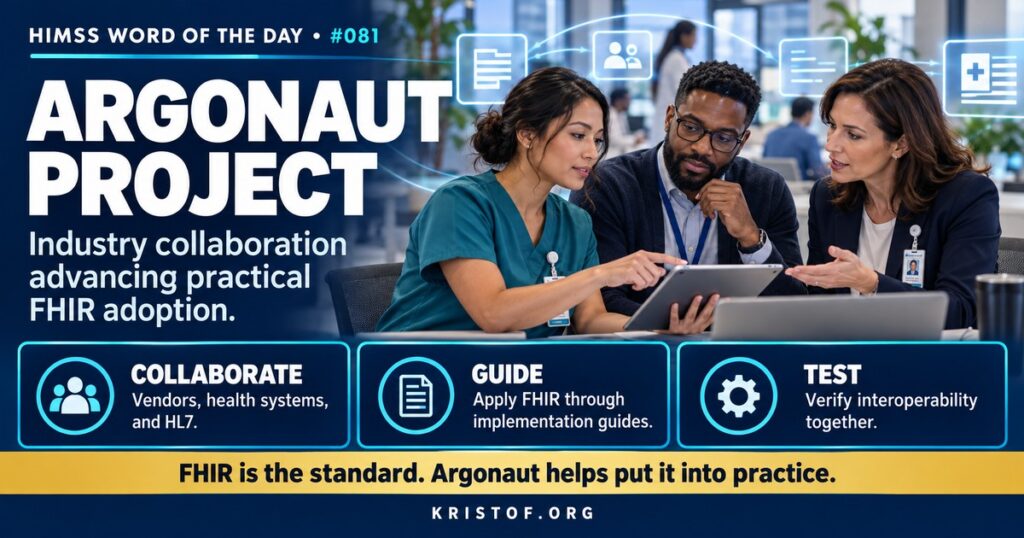
The Argonaut Project is an industry collaboration that formed to accelerate practical use of HL7 FHIR, the modern API-based standard for exchanging health data. Rather than waiting for formal standards processes alone, participants worked together to define and test implementation guides that EHR vendors could build quickly and consistently.
The HIMSS Dictionary characterizes the Argonaut Project as a private-sector effort to speed industry uptake of modern, open standards for interoperability. Its goal was to move fast on an initial FHIR API and a specification for core data services, so that electronic health records and other health IT could share information more widely using internet standards and architectural styles.
| Argonaut Characteristic | What It Meant | Why It Mattered |
|---|---|---|
| Private-Sector Collaboration | EHR vendors, health systems, and technology organizations worked together | Competitors agreed on a common approach before regulations required it |
| Convened With HL7 | Work was coordinated with HL7 International, which maintains FHIR | Results fed back into official standards |
| Implementation Guides | Specific rules for how to use FHIR for defined use cases | Reduced variation between vendors’ APIs |
| Testing and Connectathons | Participants tested their implementations against each other | Problems were found before production use |
| Focused Scope | Started with core patient data and security | Delivered usable results quickly |
⚠️ Exam Alert: FHIR is the standard. The Argonaut Project was an industry initiative that wrote implementation guides to apply FHIR consistently. US Core is the HL7 implementation guide that grew from that work and is used for U.S. regulatory requirements. SMART on FHIR provides the authorization and app launch framework. FHIR Accelerators, such as Da Vinci, CARIN, and Gravity, are later HL7 programs that apply the same collaborative model to other domains.
🌐 Why It Matters: Real-World Healthcare IT Context
In the early 2010s, reports including the 2010 PCAST report on health IT and the JASON reports of 2013 and 2014 called for healthcare to adopt modern, open APIs so that data could move as easily as it does in other industries. FHIR, then a new HL7 standard, offered a promising foundation, but a standard alone does not guarantee that every vendor implements it the same way. Without coordination, each EHR might expose a slightly different API, forcing app developers to write custom code for every system.
The Argonaut Project, launched in 2014, addressed that problem. It published a FHIR DSTU2 Data Query Implementation Guide in 2016 and promoted SMART on FHIR. That early work produced implementation guidance for querying core clinical data, such as patient demographics, problems, medications, allergies, lab results, vital signs, and documents, along with security based on OAuth 2.0 and SMART. That guidance became the basis for the HL7 US Core implementation guide, which defines how FHIR is used in the United States.
Federal policy built on this foundation. ONC’s certification program requires certified EHRs to support a standardized FHIR API using US Core and SMART App Launch, and CMS requires many payers to offer FHIR-based patient access APIs. When a patient connects a health app to a hospital’s patient portal account today, they benefit from standards work that the Argonaut Project helped accelerate.
The model also spread. HL7’s FHIR Accelerator program supports similar collaborations: Da Vinci focuses on payer-provider exchange such as prior authorization, CARIN on consumer access, and Gravity on social determinants of health data. According to the project’s own history, Argonaut participants have continued since 2016 to advance foundational work, including CDS Hooks, Bulk Data, Subscriptions, Clinical Notes, and US Core.
Why industry collaboration matters for standards:
- Vendors implement the same specification in compatible ways
- App developers can build once and connect to many systems
- Real-world testing improves the standard before it is mandated
- Regulators can reference proven implementation guides
- Health systems gain more choices of apps and tools
- Patients get more consistent access to their own data
Limits and challenges:
- Early guides covered a limited set of data and use cases
- Implementations still vary in performance and supported features
- Adoption depends on organizations enabling and supporting APIs
- Write-back and workflow integration remain harder than read access
- Security and privacy concerns grow as more apps connect
- Keeping guides current requires sustained participation
🏥 The Nurse’s Perspective: Clinical, Bedside, & Workflow
Nurses rarely hear the name Argonaut, but they see its effects in apps, data access, and integration.
At the Bedside
Patients increasingly arrive with information pulled from multiple health systems into a single app, made possible by standardized FHIR APIs. Nurses can use that information as a starting point for medication reconciliation and history taking, while confirming details with the patient and other sources.
Clinical apps launched inside the EHR, such as risk calculators or specialty tools, also rely on FHIR and SMART standards. When those apps open in the context of the current patient without a second login, nurses spend less time searching and re-entering information.
In Clinical Workflow
National FHIR profiles make nursing data more portable. Vital signs, allergies, problems, and other structured data documented by nurses can be shared through standardized APIs to other providers, apps, and patients. Accurate structured documentation therefore travels further than many nurses realize.
Nurse informaticists may be involved in evaluating third-party apps that connect through FHIR. Questions about which data an app reads, whether it writes data back, and how it handles privacy all build on the standards foundation the Argonaut Project helped create.
In EHR Implementation (Go-Live Perspective)
During an Epic implementation, FHIR APIs are configured for patient access, third-party apps, and internal integrations. Testing confirms that apps receive the right data and that patients can connect their apps after Go-Live.
At-the-elbow support analysts may field questions from staff about patient-facing apps or embedded clinical apps that stopped working after the transition. Routing those to integration teams, with details about the app and the error, helps restore connections quickly.
🎓 CAHIMS / CPHIMS & HIMSS Perspective
CAHIMS Exam Domain Mapping
The Argonaut Project appears in interoperability and standards history questions:
| CAHIMS Domain | How the Argonaut Project Appears |
|---|---|
| Healthcare & Technology Environments | Industry-led standards initiatives; relationship to HL7 and federal API policy |
| Clinical Informatics | Apps in clinical workflow; patient-provided data |
| Healthcare Information & Systems Management | FHIR implementation guides, US Core, SMART on FHIR, API testing |
| Management & Leadership | Participation in standards collaboratives; vendor strategy; app governance |
Key Terms to Know Alongside Argonaut Project
- FHIR (Fast Healthcare Interoperability Resources) — the HL7 standard for exchanging health data through web-based APIs
- Implementation Guide (IG) — a set of rules and constraints that define how a standard is used for specific purposes
- US Core — the HL7 FHIR implementation guide defining minimum expectations for U.S. data exchange
- SMART on FHIR — a framework for authorizing and launching apps that use FHIR data
- FHIR Accelerator — an HL7 program that supports industry collaborations building FHIR implementation guides
- Connectathon — a testing event where implementers exchange data to verify interoperability
HIMSS Organizational Position
HIMSS supports industry collaboration on interoperability standards and engages on federal API and interoperability policy through its public policy work. Members can find related education and research through the HIMSS Resource Center.
🔗 Explore Further: External References
- HL7 Confluence — Argonaut Project Home https://confluence.hl7.org/spaces/AP/pages/86969961/Argonaut+Project+Home
- HL7 — US Core Implementation Guide https://hl7.org/fhir/us/core/
- HL7 — SMART App Launch https://hl7.org/fhir/smart-app-launch/
- Mandel et al. (2016), JAMIA — SMART on FHIR: A Standards-Based, Interoperable Apps Platform for Electronic Health Records https://pubmed.ncbi.nlm.nih.gov/26911829/
- ONC — Standardized API for Patient and Population Services (Certification Criterion) https://healthit.gov/test-method/standardized-api-for-patient-and-population-services-acb-atl/
- HL7 International — FHIR https://hl7.org/fhir/
Term source: HIMSS Dictionary of Health Information and Technology Terms, Acronyms, and Organizations, 6th Edition (2025). All definitions in this series are paraphrased for editorial purposes. Readers are encouraged to consult the primary source for exact language.
Eric Andrew Kristof, RN, CAHIMS is a Healthcare IT professional and HIMSS Arkansas Chapter member based in Hot Springs Village, AR, with hands-on Epic Go-Live experience and a diverse healthcare and IT background. He writes at kristof.org at the intersection of clinical care and healthcare technology.
Leave a Reply