By Eric Andrew Kristof, RN, CAHIMS | Healthcare IT Professional | HIMSS Arkansas Chapter Member
About This Series: The HIMSS Word of the Day is a running blog series drawing from the HIMSS Dictionary of Health Information and Technology Terms, Acronyms, and Organizations, 6th Edition (2025) — the authoritative reference for healthcare IT professionals and the primary study resource for CAHIMS and CPHIMS certification. Each post paraphrases the term in plain language, grounds it in real-world healthcare IT context, and adds a bedside nursing perspective you won’t find in a textbook.
📖 The Term: HL7 Version 2 (HL7 V2)
Source: HIMSS Dictionary of Health Information and Technology Terms, Acronyms, and Organizations, 6th Edition (2025)
🔍 Plain-Language Definition
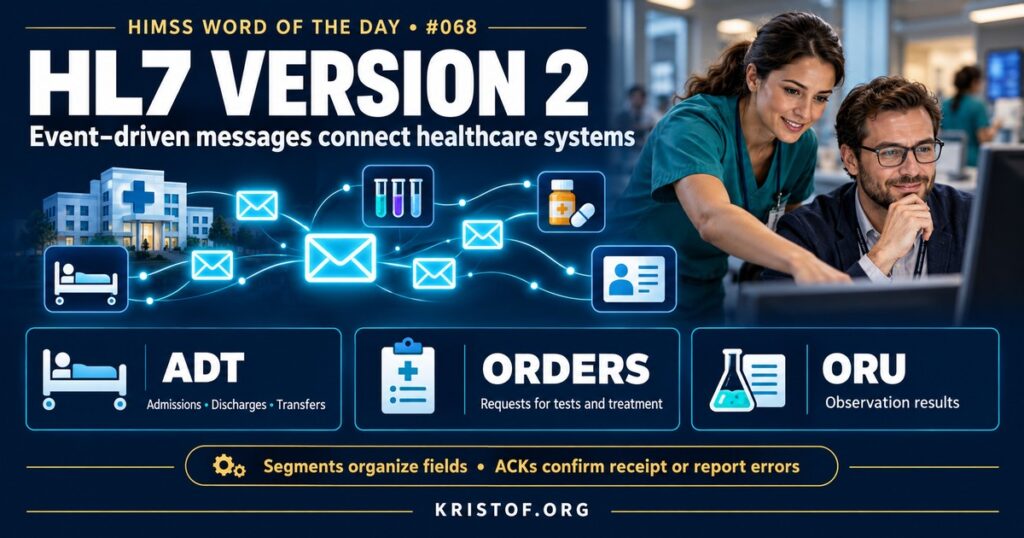
HL7 Version 2 (HL7 V2) is a messaging standard from Health Level Seven International that defines how clinical and administrative events are packaged and sent between healthcare systems. When a patient is admitted, a lab result is finalized, or an order is placed, an HL7 V2 message often carries that event from one system to others.
The HIMSS Dictionary describes HL7 V2 as an electronic messaging standard with broad adoption across healthcare worldwide. It notes that the standard allows clinical data to be exchanged between systems and is designed to work both with a central patient care system and in more distributed environments where data lives in departmental systems.
An HL7 V2 message is a set of text lines called segments, each starting with a three-letter code and divided into fields by delimiters, most often the pipe character.
| Building Block | What It Is | Example |
|---|---|---|
| Message Type and Trigger Event | What kind of message it is and what event caused it | ADT^A01 (admit), ADT^A03 (discharge), ORU^R01 (observation result) |
| MSH Segment | Message header with sender, receiver, date and time, and message type | Identifies the lab system sending to the EHR |
| PID Segment | Patient identification | Name, medical record number, date of birth |
| PV1 Segment | Patient visit information | Location, attending provider, patient class |
| OBR and OBX Segments | Order and observation details | A potassium result with value, units, reference range, and flag |
| Z Segments | Locally defined custom segments | Site-specific data not covered by the standard |
⚠️ Exam Alert: HL7 V2 is an event-driven messaging standard that usually pushes messages through interfaces. FHIR is a resource-based, API-driven standard that supports on-demand requests. HL7 V3 and its Reference Information Model were a more formal successor that saw limited adoption, while CDA, based on V3, is widely used for clinical documents. Version 2 messages are generally designed to be backward compatible across minor versions.
🌐 Why It Matters: Real-World Healthcare IT Context
HL7 V2 is one of the most successful standards in healthcare. Its flexibility let hospitals connect laboratory, pharmacy, radiology, registration, and billing systems from different vendors long before modern web APIs existed. That same flexibility explains why it is still everywhere: thousands of interfaces already work, and replacing them would be expensive and risky.
The most common message families include admission, discharge, and transfer messages; orders; results; scheduling; medical documents; and financial transactions. Interface engines receive these messages, transform them, and route them to every system that needs them.
Acknowledgments keep the exchange reliable. When a system receives a V2 message, it typically returns an acknowledgment message confirming success or reporting an error, so the sender knows whether to resend. Interface engines track these acknowledgments and alert staff when messages are rejected or go unanswered, which is often the first sign that a downstream system is having trouble.
Flexibility has a cost. Many fields are optional, sites interpret fields differently, and custom Z segments carry local data that no other organization understands. Experienced interface analysts often say that once you have seen one HL7 V2 interface, you have seen one HL7 V2 interface. Implementation guides, such as those defining laboratory results interfaces, constrain the standard to make exchange more consistent.
V2 and FHIR increasingly coexist. Internal event messaging often remains V2, while external access through APIs uses FHIR. Interface engines can translate between them, and HL7 publishes guidance for mapping V2 content into FHIR resources.
Common HL7 V2 interface problems:
- Inconsistent use of optional fields between sending and receiving systems
- Local codes that do not map to standard terminologies
- Patient identifier mismatches that leave results unfiled
- Custom Z segments that are poorly documented
- Message ordering problems, such as a result arriving before its order
- Character encoding or delimiter errors that break parsing
Characteristics of well-managed V2 interfaces:
- Interface specifications that define exactly which fields and codes are used
- Use of national implementation guides where they exist
- Standard terminologies such as LOINC for results
- Monitoring and alerting on message queues and errors
- Regression testing whenever either system is upgraded
- Documentation of every local customization
🏥 The Nurse’s Perspective: Clinical, Bedside, & Workflow
Nurses do not read HL7 V2 messages, but many of the events in their day are carried by them.
At the Bedside
When a patient arrives on a unit, an admission or transfer message tells the bed board, pharmacy, dietary, laboratory, and other systems where the patient is. When a lab result is finalized, a result message carries the value, the units, the reference range, and the abnormal flag into the EHR. A delay or error in those messages shows up at the bedside as missing results, wrong locations on labels, or medications delivered to the wrong unit.
Result details matter. When a result shows an unexpected unit or an unusual reference range, it may reflect a mapping issue between systems. Nurses who notice these inconsistencies help integration teams find problems early.
Order details travel the same way. When a provider places a lab or imaging order, a V2 order message carries the test, priority, collection details, and ordering provider to the department system. If something in that message is wrong, such as an outdated location or a missing priority, the specimen collection or exam can be delayed even though the order looks correct in the EHR.
In Clinical Workflow
Transfers generate a series of messages. Moving a patient from the emergency department to an inpatient unit, and later to another bed, triggers updates to many systems. If a transfer is entered late or incorrectly, downstream systems may show the patient in the wrong place, which can affect specimen collection, medication delivery, and nurse assignments.
Downtime recovery also involves V2 messages. After a system outage, queued messages may deliver many results at once, sometimes out of order, so nurses should review recent results carefully once systems return.
In EHR Implementation (Go-Live Perspective)
During an Epic Go-Live, HL7 V2 interfaces connect the new EHR to laboratory systems, pharmacy systems, devices, and external partners. Integration teams test each interface with realistic scenarios and plan the exact moment messages switch from the old system to the new one.
At-the-elbow support analysts recognize interface symptoms quickly: a result that appears in the lab system but not in the chart, a patient missing from a departmental system, or a location that did not update. Capturing the patient, the event, and the time helps integration analysts find the specific message and fix the problem.
🎓 CAHIMS / CPHIMS & HIMSS Perspective
CAHIMS Exam Domain Mapping
HL7 V2 is a core standards topic:
| CAHIMS Domain | How HL7 V2 Appears |
|---|---|
| Healthcare & Technology Environments | Standards development organizations; HL7’s family of standards |
| Clinical Informatics | Orders and results flow; effects of interface errors on care |
| Healthcare Information & Systems Management | Message structure, segments, trigger events, interface engines, testing |
| Management & Leadership | Interface strategy, vendor coordination, migration planning from V2 to FHIR |
Key Terms to Know Alongside HL7 V2
- Segment — a line in an HL7 V2 message that groups related fields, such as PID for patient identification
- Trigger Event — the real-world event that causes a message to be sent, such as an admission
- ADT Message — an admission, discharge, or transfer message that communicates patient movement and demographics
- ORU Message — an observation result message, commonly used for lab results
- Interface Engine — middleware that routes and transforms messages between systems
- Z Segment — a locally defined segment used to carry data not covered by the standard
HIMSS Organizational Position
HIMSS supports interoperability across both established and emerging standards, recognizing that HL7 V2 remains the backbone of internal exchange while FHIR expands API-based access. Members can find related education and research through the HIMSS Resource Center.
🔗 Explore Further: External References
- HL7 International — HL7 Version 2 Product Suite https://www.hl7.org/implement/standards/product_brief.cfm?product_id=185
- HL7 International — Homepage https://www.hl7.org/
- HL7 International — FHIR https://hl7.org/fhir/
- IHE International — Integrating the Healthcare Enterprise https://www.ihe.net/
- ONC — Interoperability Standards Platform https://isp.healthit.gov/
- Regenstrief Institute — LOINC https://www.regenstrief.org/real-world-solutions/loinc/
Term source: HIMSS Dictionary of Health Information and Technology Terms, Acronyms, and Organizations, 6th Edition (2025). All definitions in this series are paraphrased for editorial purposes. Readers are encouraged to consult the primary source for exact language.
Eric Andrew Kristof, RN, CAHIMS is a Healthcare IT professional and HIMSS Arkansas Chapter member based in Hot Springs Village, AR, with hands-on Epic Go-Live experience and a diverse healthcare and IT background. He writes at kristof.org at the intersection of clinical care and healthcare technology.
Leave a Reply