By Eric Andrew Kristof, RN, CAHIMS | Healthcare IT Professional | HIMSS Arkansas Chapter Member
About This Series: The HIMSS Word of the Day is a running blog series drawing from the HIMSS Dictionary of Health Information and Technology Terms, Acronyms, and Organizations, 6th Edition (2025) — the authoritative reference for healthcare IT professionals and the primary study resource for CAHIMS and CPHIMS certification. Each post paraphrases the term in plain language, grounds it in real-world healthcare IT context, and adds a bedside nursing perspective you won’t find in a textbook.
📖 The Term: Standards Development Organization (SDO)
Source: HIMSS Dictionary of Health Information and Technology Terms, Acronyms, and Organizations, 6th Edition (2025)
🔍 Plain-Language Definition
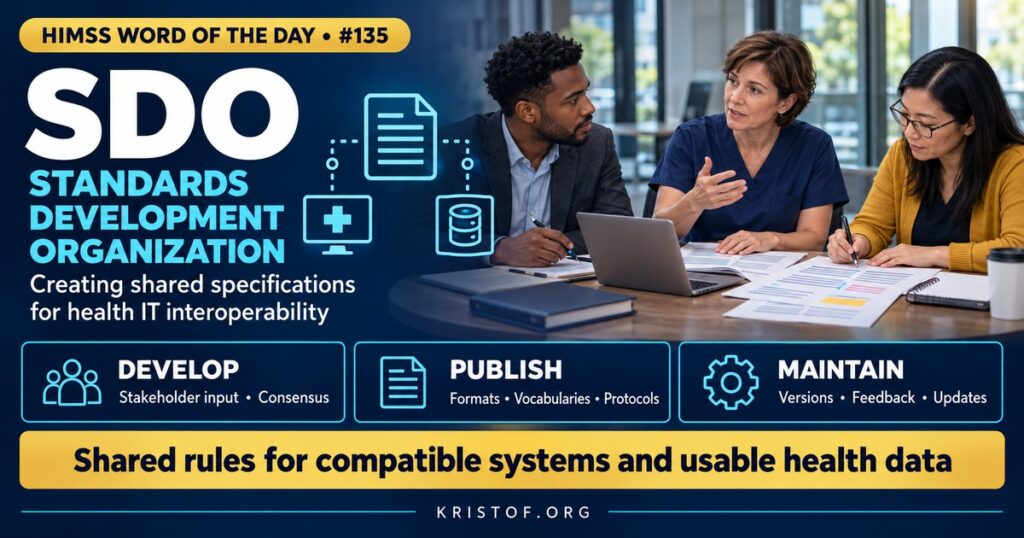
A standards development organization (SDO) is an organization that develops, publishes, and maintains technical standards through a defined process, often based on consensus among industry, government, and other stakeholders. In health IT, SDOs create the formats, vocabularies, and protocols that allow systems to exchange and use data.
The HIMSS Dictionary describes an SDO as an organization focused on standardization in health information and health information and communications technology. It explains that the goals include compatibility and interoperability between independent systems, compatible data for comparative statistics such as classifications, and less duplication of effort.
| SDO | Focus Area | Example Standards |
|---|---|---|
| HL7 International | Clinical and administrative data exchange | HL7 Version 2, C-CDA, FHIR |
| X12 | Administrative and financial transactions | Claims, eligibility, remittance transactions |
| NCPDP | Pharmacy transactions | SCRIPT for e-prescribing, pharmacy claims |
| DICOM (NEMA/MITA) | Medical imaging | Image format and communication |
| ISO/TC 215 | International health informatics standards | Global health informatics standards |
| Terminology Organizations | Clinical vocabularies | SNOMED CT (SNOMED International), LOINC (Regenstrief Institute) |
⚠️ Exam Alert: An SDO creates standards. IHE creates integration profiles describing how to use existing standards together; it is generally described as a profiling organization rather than a base SDO. ONC and CMS adopt standards into regulations but do not usually develop them. ANSI accredits U.S. SDOs and coordinates the U.S. standards system.
🌐 Why It Matters: Real-World Healthcare IT Context
Without standards, every connection between systems would require custom work, and data would mean different things in different places. SDOs provide shared rules for structure, meaning, and transport, making interoperability possible at scale.
Most SDOs use open, consensus-based processes. Members, often including vendors, providers, payers, government agencies, and individuals, propose content, comment on drafts, and vote through balloting. Comments must be addressed before standards are published. This process builds broad acceptance but can take time.
Standards evolve through versions. HL7 Version 2 remains widely used for messaging within hospitals, while FHIR has become the focus for APIs. X12 transaction versions and NCPDP SCRIPT versions are updated periodically, and regulations specify which versions organizations must use. Moving the industry from one version to another is a major undertaking.
Government adoption gives standards force. HIPAA adopted X12 and NCPDP standards for administrative transactions. The ONC Health IT Certification Program references HL7, terminology, and other standards for certified EHRs, and ONC’s Interoperability Standards Platform catalogs standards for specific purposes. Federal agencies are generally directed to use voluntary consensus standards rather than create their own when possible.
Implementation guides matter as much as base standards. A broad standard like FHIR can be used in many ways, so implementation guides, such as US Core or the Da Vinci guides, narrow the options for particular uses. Accelerator programs and collaborative projects help industry agree on these details.
Participation shapes outcomes. Organizations and clinicians who join SDO work groups influence which data elements are captured and how they are defined. Nursing participation, for example, helps ensure that nursing assessments, interventions, and outcomes are represented in standards rather than left out.
Terminology organizations deserve special mention. SNOMED International maintains SNOMED CT for clinical findings and procedures, the Regenstrief Institute maintains LOINC for laboratory and clinical observations, and the National Library of Medicine maintains RxNorm for medications and distributes many vocabularies through the UMLS. These vocabularies give meaning to the data that exchange standards carry, so a message can be technically valid yet clinically useless if its codes are missing or wrong.
Coordination among SDOs is important. Standards often depend on each other, such as FHIR using LOINC and SNOMED CT codes, and SDOs work together through harmonization efforts, liaison agreements, and joint initiatives.
Standards also have an international dimension. ISO’s health informatics committee and collaboration among national bodies help align approaches across countries, which matters for global vendors, research, and public health, even though national regulations often specify their own versions and profiles.
Common challenges with health IT standards:
- Slow development and adoption cycles
- Multiple overlapping standards for similar purposes
- Optional elements that lead to inconsistent implementations
- Version upgrades that require costly system changes
- Limited participation from frontline clinicians
- Licensing and access costs for some standards
What makes standards work in practice:
- Clear implementation guides and profiles
- Testing events and certification programs
- Regulatory alignment on specific versions
- Broad stakeholder participation
- Coordination among SDOs
- Ongoing maintenance and feedback from implementers
🏥 The Nurse’s Perspective: Clinical, Bedside, & Workflow
Standards may seem distant from patient care, but they determine whether nursing information can be shared and reused.
At the Bedside
When a nurse documents vital signs, pain scores, or skin assessments, standards determine whether that information can travel to another facility, populate a registry, or support decision support. Structured documentation using standard terminologies makes nursing data more useful beyond the local chart.
Medication safety depends on standards too. E-prescribing standards from NCPDP, drug terminologies, and barcode standards connect the prescriber, pharmacy, and bedside administration.
In Clinical Workflow
During transitions, nursing information such as functional status, wound care needs, and fall risk is shared through standard documents and APIs. When nursing data elements are well represented in standards, receiving teams get more complete information.
Nurse informaticists can participate in SDO work groups, comment on ballots, or contribute to terminology development. Organizations such as HL7 have work groups where clinical input shapes how data is modeled.
Understanding the basics of standards helps nurses communicate with IT teams about why information might not transfer between systems.
Nursing terminologies are part of this landscape too. Several nursing classification systems and the representation of nursing concepts in SNOMED CT and LOINC allow nursing assessments and interventions to be coded consistently across systems.
In EHR Implementation (Go-Live Perspective)
During an Epic Go-Live, interfaces built on HL7 Version 2, FHIR APIs, DICOM, X12, and NCPDP standards connect the EHR to labs, imaging, pharmacies, payers, and outside organizations. Testing confirms that these standards are implemented consistently with partners.
At-the-elbow support analysts may see issues that trace back to standards, such as a lab result arriving without units or an outside medication list missing codes. Reporting these helps interface teams work with partners to correct mappings.
🎓 CAHIMS / CPHIMS & HIMSS Perspective
CAHIMS Exam Domain Mapping
SDOs appear in interoperability and standards questions:
| CAHIMS Domain | How SDOs Appear |
|---|---|
| Healthcare & Technology Environments | Major SDOs; ANSI accreditation; government adoption of standards |
| Clinical Informatics | Standard terminologies, nursing data representation, clinical input |
| Healthcare Information & Systems Management | HL7, X12, NCPDP, DICOM, implementation guides, versions |
| Management & Leadership | Standards strategy, participation, regulatory compliance |
Key Terms to Know Alongside SDO
- HL7 International — the SDO behind HL7 Version 2, CDA, and FHIR
- X12 — the SDO for administrative and financial transaction standards
- NCPDP — the SDO for pharmacy transaction standards
- IHE — an initiative that creates integration profiles for using standards together
- Implementation Guide — a specification for using a standard in a specific context
- Balloting — the consensus voting and comment process used to approve standards
HIMSS Organizational Position
HIMSS supports standards-based interoperability through education, its collaboration with IHE, and public policy engagement encouraging consistent adoption of consensus standards. Members can find related education and research through the HIMSS Resource Center.
🔗 Explore Further: External References
- HL7 International https://www.hl7.org/
- X12 https://x12.org/
- NCPDP — National Council for Prescription Drug Programs https://www.ncpdp.org/
- DICOM Standard https://www.dicomstandard.org/
- ONC — Interoperability Standards Platform https://isp.healthit.gov/
- SNOMED International https://www.snomed.org/
Term source: HIMSS Dictionary of Health Information and Technology Terms, Acronyms, and Organizations, 6th Edition (2025). All definitions in this series are paraphrased for editorial purposes. Readers are encouraged to consult the primary source for exact language.
Eric Andrew Kristof, RN, CAHIMS is a Healthcare IT professional and HIMSS Arkansas Chapter member based in Hot Springs Village, AR, with hands-on Epic Go-Live experience and a diverse healthcare and IT background. He writes at kristof.org at the intersection of clinical care and healthcare technology.
Leave a Reply