By Eric Andrew Kristof, RN, CAHIMS | Healthcare IT Professional | HIMSS Arkansas Chapter Member
About This Series: The HIMSS Word of The Day is a running blog series drawing from the HIMSS Dictionary of Health Information and Technology Terms, Acronyms, and Organizations, 6th Edition (2025) — the authoritative reference for healthcare IT professionals and the primary study resource for CAHIMS and CPHIMS certification. Each post paraphrases the term in plain language, grounds it in real-world healthcare IT context, and adds a bedside nursing perspective you won’t find in a textbook.
📖 The Term: Wiper
Source: HIMSS Dictionary of Health Information and Technology Terms, Acronyms, and Organizations, 6th Edition (2025)
🔍 Plain-Language Definition
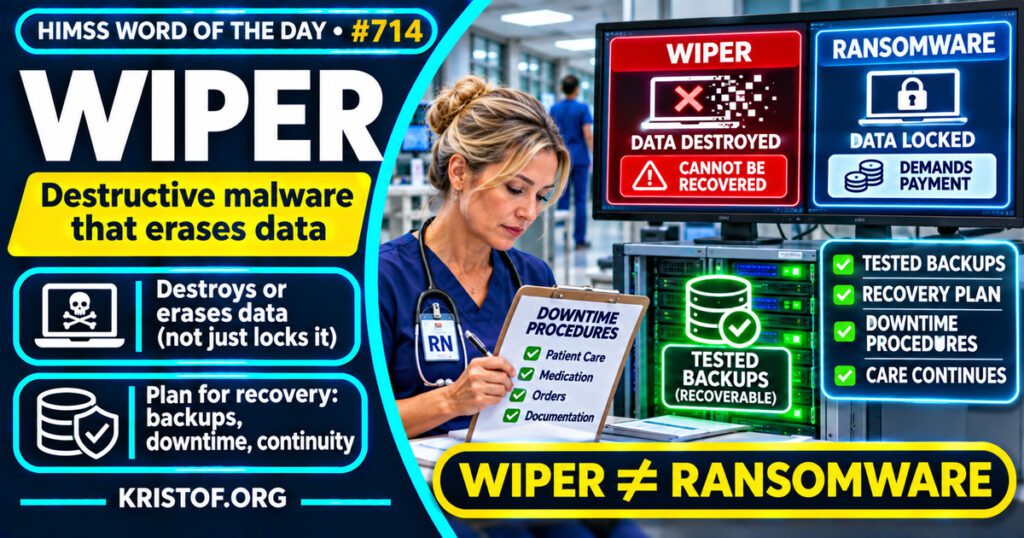
The HIMSS Dictionary describes a wiper as malware whose purpose is to destroy or erase the data on a targeted computer or across a network.
Where ransomware usually locks data in order to demand payment, a wiper is aimed at destruction. CISA’s description of one wiper shows why the two get confused: the malware displays a ransom note, but the data are destroyed and a payment would not bring them back.
| Term | Main aim, as commonly described | What recovery depends on |
|---|---|---|
| Wiper | Destroy or erase data (the dictionary’s wording) | The organization’s own backups, because the data are gone |
| Ransomware | Lock data and demand payment | Backups, or a key from the attacker, which is not guaranteed |
| Backup | A separate copy of data kept for recovery | Whether it is protected and has been tested |
| Downtime procedure | A manual process used when systems are unavailable | Training and practice before an event |
⚠️ Exam Alert: A wiper is not the same as ransomware. Some wipers pose as ransomware, so a ransom note does not prove that data can be recovered. A wiper is mainly an attack on availability, because the data and the systems that use them are no longer usable. The word also appears in legitimate disk-wiping tools used to retire equipment, but the dictionary entry is about malware. For the exam, tie wipers to backups, contingency plans, and downtime procedures.
🌐 Why It Matters: Real-World Healthcare IT Context
Because wiper attacks are documented mostly by government agencies and case reports, this section draws on a CISA and FBI advisory, an HHS alert, a Justice Department press release, the HIPAA contingency plan rule, and two case reports of hospital cyberattacks. The case reports do not say a wiper was involved, so they show what long downtime looks like and not what a wiper does.
What CISA says wipers do. The CISA and FBI advisory AA22-057A, first released on February 26, 2022 and last revised on April 28, 2022 according to the archived page, covers destructive malware used against organizations in Ukraine. It says WhisperGate corrupts the master boot record, shows a fake ransom note, and encrypts files with certain extensions, and that the targeted data are destroyed and cannot be recovered even if a ransom is paid. It says HermeticWiper targets Windows devices by manipulating the master boot record, so that the system fails to boot. The advisory describes both as designed to make systems inoperable and lists general ways malware spreads, including email, instant messages, compromised websites, peer-to-peer downloads, and exploited vulnerabilities. These details concern early 2022 attacks in Ukraine.
What HHS said at the time. An HHS Health Sector Cybersecurity Coordination Center alert dated February 25, 2022 called HermeticWiper destructive wiper malware, said there was no evidence of it on U.S. systems at that time, and urged health sector members to read the referenced report, use the indicators it lists, and report incidents to the FBI, CISA, or the Secret Service. The copy I read is short and has no technical analysis. It is a snapshot from early 2022, not a current threat picture.
What preparation looks like. CISA’s mitigations center on recovery. They include an inventory of critical systems and their dependencies, installation media, licensing keys, configuration backups, and full or differential data backups, plus hard-copy playbooks, tests of baseline restoration, and a business impact analysis to set recovery priorities. They also cover network segmentation, multifactor authentication, monitoring of privileged accounts, staged patch deployment, and contingency plans with contact lists and a secure channel for the recovery team. For HIPAA-covered organizations, the Security Rule‘s contingency plan standard at 45 CFR 164.308(a)(7) requires a data backup plan, a disaster recovery plan, and an emergency mode operation plan. Testing and revision procedures and a criticality analysis of applications and data are addressable. I read the rule through Cornell’s Legal Information Institute copy, so check the current regulation before relying on it.
A health system example. A Justice Department press release dated October 19, 2020 announced charges against six Russian military intelligence officers. It describes NotPetya, released on June 27, 2017, as destructive malware, and names Heritage Valley Health System in western Pennsylvania as one of three victims with losses of nearly one billion dollars combined. It says the attack affected two hospitals, 60 offices, and 18 community satellite facilities, and that patient lists, histories, physical examination files, and laboratory records became unavailable. It says mission-critical systems for cardiology, nuclear medicine, radiology, and surgery were down for about a week, and administrative systems for almost a month. These are allegations in a charging announcement, and the release does not describe how the malware worked.
What long downtime looks like. Goodwin et al. (2022) describe an academic institution whose cyberattack shut down its EHR, laboratory information system, pharmacy, scheduling, billing, imaging, internet, shared drives, payroll, and digital communications. The EHR stayed down for 25 days. The clinical pathology laboratory moved to manual testing, recruited extra staff to report results, and used several channels to communicate, and it lacked accurate counts of diverted samples, specimens processed, and results reported during the downtime. Santalo et al. (2022) describe a 350-bed U.S. hospital that lost its EHR, registration, pharmacy information system, barcode medication administration, automated dispensing cabinet server, and clinical decision support tools in summer 2021, and they lay out a downtime procedure that names pharmacist and technician roles. Both are single-institution accounts, and their abstracts speak of cyberattacks and ransomware, not wipers.
What I could not confirm. I found no peer-reviewed studies of wiper malware in health care in this search. A fetch of CISA’s current advisory page failed, so I used the archived copy at its older address, which says it may be outdated. The Justice Department release does not say how NotPetya worked, and I did not cite news reports that describe it as a wiper. I did not verify technical details such as boot record behavior beyond CISA’s description. I read abstracts for the two case reports, not full texts. I did not check whether federal rules on security or incident reporting have changed since the sources I read.
Common wiper problems:
- Confusing a wiper with ransomware and expecting a decryption key
- Assuming that paying a ransom will restore the data
- Having backups that have never been tested by restoring from them
- Having no manual downtime procedures for medication, orders, and documentation
- Reading a 2022 advisory as the current threat picture
- Mixing up wiper malware with disk-wiping tools used to retire devices
What supports resilience against destructive malware:
- Tested backups and a documented restoration plan, as CISA describes
- Network segmentation and multifactor authentication
- A HIPAA contingency plan with data backup, disaster recovery, and emergency mode operation parts
- Role-based downtime procedures, as the pharmacy report lays out
- Contact lists and a secure channel for the recovery team
🏥 The Nurse’s Perspective: Clinical, Bedside, & Workflow
No study reviewed for this post measured nurses, so the points below are workflow context and not research findings.
At the Bedside
When systems are unavailable, nurses work from paper. The pharmacy case report lists barcode medication administration and the automated dispensing cabinet server among the lost systems, so some of the usual safety checks at administration are gone and manual double checks fill the gap. A nurse who knows where downtime forms are kept, and who to call, loses less time. Which checks apply in a given hospital is a local policy question that the sources reviewed do not answer.
In Clinical Workflow
The laboratory report describes manual reporting and the loss of accurate counts of results. For nurses, the matching problem is knowing which results were reported, to whom, and when, while the EHR is down. Downtime drills that include nurse leaders and informatics staff help find those gaps before an event. When systems return, entering paper records back into the EHR is a safety task as well as a clerical one. That is an inference, and the sources reviewed do not study it.
In EHR Implementation (Go-Live Perspective)
During an Epic Go-Live, analysts and at-the-elbow support staff practice a version of what recovery needs: floor presence, quick triage of problems, and clear communication with units. Recovering from a destructive attack calls for similar skills, along with documented restoration steps. This is context from workflow experience, and the sources reviewed do not examine go-lives or recoveries.
🎓 CAHIMS / CPHIMS & HIMSS Perspective
CAHIMS Exam Domain Mapping
Wipers connect security threats, system availability, and the plans that keep care running:
| CAHIMS Domain | How the Wiper Appears |
|---|---|
| Healthcare & Technology Environments | Threats to health care infrastructure and the rules that apply |
| Clinical Informatics | Safe care and documentation when clinical systems are unavailable |
| Healthcare Information & Systems Management | Backups, restoration, segmentation, and incident response |
| Management & Leadership | Contingency planning and decisions during a prolonged outage |
Key Terms to Know Alongside the Wiper
- Ransomware — malware that locks data to demand payment, often confused with a wiper
- Malware — software designed to harm or disrupt a system
- Disaster Recovery Plan — procedures for restoring data and systems after a loss
- Contingency Plan — the set of plans for keeping essential functions running during an emergency
- HIPAA Security Rule — the federal rule that sets safeguards for electronic protected health information
- Risk Analysis — the assessment of threats and vulnerabilities to protected data
HIMSS Organizational Position
HIMSS offers education and research on health information and technology topics through its Resource Center. Members can find related information on the HIMSS Resource Center page.
🧭 More HIMSS Word of The Day Terms
Related terms in the Cybersecurity and Privacy series:
Browse all Cybersecurity and Privacy terms or the A–Z glossary.
🔗 Explore Further: External References
- CISA and FBI — Destructive Malware Targeting Organizations in Ukraine (Advisory AA22-057A, archived) https://www.cisa.gov/uscert/ncas/alerts/aa22-057a
- HHS Health Sector Cybersecurity Coordination Center — Hermetic Wiper Malware (Alert, February 25, 2022) https://www.hhs.gov/sites/default/files/hermetic-wiper-malware.pdf
- U.S. Department of Justice — Press release on charges against six Russian military intelligence officers for destructive malware (October 19, 2020) https://www.justice.gov/archives/opa/pr/six-russian-gru-officers-charged-connection-worldwide-deployment-destructive-malware-and
- Cornell Legal Information Institute — 45 CFR 164.308, Administrative safeguards (HIPAA Security Rule) https://www.law.cornell.edu/cfr/text/45/164.308
- Goodwin et al. (2022), American Journal of Clinical Pathology — Anatomy of a Cyberattack: Part 2: Managing a Clinical Pathology Laboratory During 25 Days of Downtime. https://pubmed.ncbi.nlm.nih.gov/35188951/
- Santalo et al. (2022), Journal of the American Pharmacists Association — Defining key pharmacist and technician roles in response to a hospital downtime or cyberattack. https://pubmed.ncbi.nlm.nih.gov/35466072/
- HIMSS — Resource Center https://www.himss.org/resource-center
Term source: HIMSS Dictionary of Health Information and Technology Terms, Acronyms, and Organizations, 6th Edition (2025). All definitions in this series are paraphrased for editorial purposes. Readers are encouraged to consult the primary source for exact language.
Eric Andrew Kristof, RN, CAHIMS is a Healthcare IT professional and HIMSS Arkansas Chapter member based in Hot Springs Village, AR, with hands-on Epic Go-Live experience and a diverse healthcare and IT background. He writes at kristof.org at the intersection of clinical care and healthcare technology.
Leave a Reply