By Eric Andrew Kristof, RN, CAHIMS | Healthcare IT Professional | HIMSS Arkansas Chapter Member
About This Series: The HIMSS Word of the Day is a running blog series drawing from the HIMSS Dictionary of Health Information and Technology Terms, Acronyms, and Organizations, 6th Edition (2025) — the authoritative reference for healthcare IT professionals and the primary study resource for CAHIMS and CPHIMS certification. Each post paraphrases the term in plain language, grounds it in real-world healthcare IT context, and adds a bedside nursing perspective you won’t find in a textbook.
📖 The Term: Incident
Source: HIMSS Dictionary of Health Information and Technology Terms, Acronyms, and Organizations, 6th Edition (2025)
🔍 Plain-Language Definition
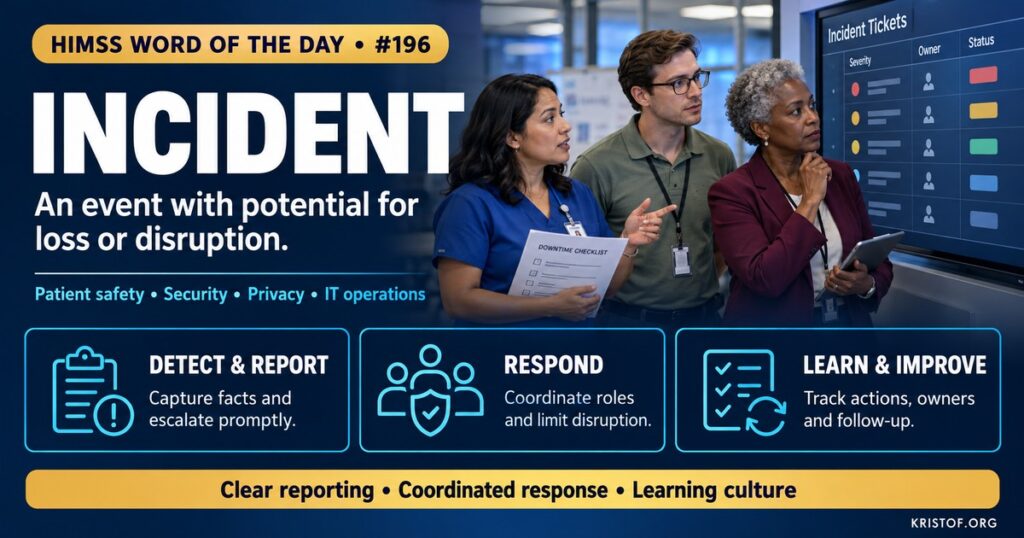
An incident is an event that has the potential to cause human, physical, or intangible loss, or to disrupt an organization’s operations, services, or functions. If it is not managed well, an incident can grow into an emergency, a crisis, or a disaster.
The HIMSS Dictionary keeps the definition broad on purpose. In health care the same word is used by patient safety teams, security teams, emergency managers, and IT operations, and each group adds its own meaning and process.
| Incident Type | Example | Typical Owner |
|---|---|---|
| Patient Safety Incident | Medication reaches the wrong patient | Quality and patient safety |
| Near Miss | Wrong dose caught before administration | Quality and patient safety |
| Security Incident | Phishing leads to a compromised account | Information security |
| Privacy Incident | Record viewed without a job-related reason | Privacy office |
| Operational or IT Incident | EHR unavailable during a shift | IT operations and command center |
| Emergency or Disaster | Power loss, severe weather, mass casualty | Emergency management |
⚠️ Exam Alert: An incident is an event with potential for loss or disruption. A breach is a HIPAA-defined incident involving unsecured protected health information that meets specific criteria. Not every security incident is a breach, and not every breach begins as a recognized security incident. A near miss did not reach the patient, while an incident that reached the patient may or may not cause harm.
🌐 Why It Matters: Real-World Healthcare IT Context
Organizations cannot prevent every problem, but they can detect, contain, and learn from the ones that happen. Incident management is the set of practices that turn an unexpected event into a managed response and then into improvement.
For security, HIPAA frames the requirement directly. The Security Rule defines a security incident as the attempted or successful unauthorized access, use, disclosure, modification, or destruction of information, or interference with system operations in an information system. Covered entities and business associates must have policies to address such incidents, including identifying and responding to suspected or known incidents, mitigating harmful effects to the extent practicable, and documenting incidents and their outcomes.
NIST provides practical structure. Its incident response guidance, SP 800-61 Revision 3, was published in April 2025 and replaced Revision 2. It aligns incident response with the NIST Cybersecurity Framework 2.0 and treats response as part of overall risk management, aimed at preparing for incidents, reducing their number and impact, and improving detection, response, and recovery.
For patient safety, the AHRQ Common Formats describe three types of events: incidents that reached the patient, with or without harm; near misses that did not reach the patient; and unsafe conditions that raise the chance of an event without involving a specific patient. Using shared definitions helps organizations compare data and learn across settings. Use of the Common Formats is voluntary, and they are not intended to replace mandatory reporting requirements.
Reporting systems have limits. A scoping review of voluntary event reporting found that these systems underestimate how often safety events occur, often capture only serious events, and report fewer events than automated detection methods. The review also noted that patients from minoritized groups may be less likely to have events reported and more likely to suffer serious events. A study at a Swiss hospital reached a similar conclusion in practice: voluntary critical incident reports captured far fewer events than other surveillance methods such as trigger tools and a surgical quality database. Organizations therefore combine reports with other detection methods rather than relying on any single source.
Culture shapes reporting. Staff report more when reports lead to learning rather than blame, when feedback is visible, and when the reporting tool is easy to use. A just culture distinguishes human error, at-risk behavior, and reckless behavior, and responds to each differently.
Technology incidents have patient impact. An EHR outage, a failed interface, or a ransomware event can delay care as surely as a staffing gap. Incident command structures, downtime procedures, and communication plans connect IT events to clinical operations.
Learning closes the loop. Good programs triage events by severity, investigate with methods such as root cause or apparent cause analysis, assign actions with owners and dates, and verify that changes worked.
Common incident management gaps:
- Underreporting of near misses and minor events
- Reports that vanish without feedback
- Separate processes for safety, security, and IT events
- Slow escalation of technology outages that affect care
- Unclear roles during response
- Actions assigned without owners or follow-up
What supports effective incident management:
- Shared definitions and categories across departments
- Easy reporting with timely feedback to staff
- A just culture that supports learning
- Documented and practiced response plans
- Combined detection methods beyond voluntary reports
- Tracked corrective actions with owners and dates
🏥 The Nurse’s Perspective: Clinical, Bedside, & Workflow
Nurses are often the first to notice that something is wrong, whether a patient event, a suspicious email, or a screen that stops responding.
At the Bedside
Reporting near misses and unsafe conditions is as valuable as reporting events that reach patients, because those reports show where defenses worked and where they nearly failed. A scanned barcode that flagged a wrong drug, a pump library mismatch, or a look-alike label deserves a report even when no harm occurred.
Useful reports are specific. They describe what happened, where, when, which equipment or screens were involved, and what contributed, without speculation or blame.
In Clinical Workflow
Technology problems deserve reports too. A delayed result, an order that did not transmit, or a device that disconnected can all be incidents. Telling the help desk or command center quickly allows IT to separate a local problem from a systemwide one.
Security awareness is a clinical skill. Reporting a suspicious email, a lost badge, or an unfamiliar person on a unit follows the same principle as reporting a safety hazard: early notice limits harm.
Nurse informaticists connect these worlds. They review event trends that involve technology, help analysts reproduce problems, and translate lessons into build changes, alerts, or education.
In EHR Implementation (Go-Live Perspective)
An Epic Go-Live includes a command center that tracks issues as incidents with severity, owner, and status. Nurses report problems through defined channels, and leaders review them daily to prioritize fixes.
At-the-elbow support analysts help turn vague complaints into clear tickets with examples. Detailed reports during the first days help build teams resolve defects, and patterns in those reports drive training updates.
🎓 CAHIMS / CPHIMS & HIMSS Perspective
CAHIMS Exam Domain Mapping
Incidents appear in security, safety, and operations questions:
| CAHIMS Domain | How Incidents Appear |
|---|---|
| Healthcare & Technology Environments | HIPAA requirements, regulations, accreditation expectations |
| Clinical Informatics | Safety event reporting, technology-related events, learning systems |
| Healthcare Information & Systems Management | Incident response plans, monitoring, downtime procedures |
| Management & Leadership | Governance, just culture, corrective action tracking |
Key Terms to Know Alongside Incident
- Security Incident — attempted or successful unauthorized access or interference with system operations
- Breach — impermissible use or disclosure of unsecured protected health information that meets HIPAA criteria
- Near Miss — event that did not reach the patient
- Root Cause Analysis (RCA) — structured method for investigating why an event occurred
- Just Culture — approach that balances accountability with learning
- Downtime Procedure — plan for continuing care when systems are unavailable
HIMSS Organizational Position
HIMSS supports healthcare cybersecurity and patient safety through its Healthcare Cybersecurity Community, education, and research. Members can find related resources through the HIMSS Resource Center.
🔗 Explore Further: External References
- NIST — SP 800-61 Rev. 3, Incident Response Recommendations and Considerations for Cybersecurity Risk Management: A CSF 2.0 Community Profile https://csrc.nist.gov/pubs/sp/800/61/r3/final
- eCFR — 45 CFR 164.308, Administrative Safeguards (Security Incident Procedures) https://www.ecfr.gov/current/title-45/subtitle-A/subchapter-C/part-164/subpart-C/section-164.308
- AHRQ — Common Formats for Event Reporting https://pso.ahrq.gov/common-formats
- AHRQ PSNet — Reporting Patient Safety Events https://psnet.ahrq.gov/primer/reporting-patient-safety-events
- Hoops et al. (2024), Joint Commission Journal on Quality and Patient Safety — Disparities in Patient Safety Voluntary Event Reporting: A Scoping Review https://pubmed.ncbi.nlm.nih.gov/38057189/
- Adamovic et al. (2026), Journal of Patient Safety — The Importance of Using Multiple Safety Evaluation Systems in Hospitals https://pubmed.ncbi.nlm.nih.gov/41626637/
Term source: HIMSS Dictionary of Health Information and Technology Terms, Acronyms, and Organizations, 6th Edition (2025). All definitions in this series are paraphrased for editorial purposes. Readers are encouraged to consult the primary source for exact language.
Eric Andrew Kristof, RN, CAHIMS is a Healthcare IT professional and HIMSS Arkansas Chapter member based in Hot Springs Village, AR, with hands-on Epic Go-Live experience and a diverse healthcare and IT background. He writes at kristof.org at the intersection of clinical care and healthcare technology.
Leave a Reply