By Eric Andrew Kristof, RN, CAHIMS | Healthcare IT Professional | HIMSS Arkansas Chapter Member
About This Series: The HIMSS Word of the Day is a running blog series drawing from the HIMSS Dictionary of Health Information and Technology Terms, Acronyms, and Organizations, 6th Edition (2025) — the authoritative reference for healthcare IT professionals and the primary study resource for CAHIMS and CPHIMS certification. Each post paraphrases the term in plain language, grounds it in real-world healthcare IT context, and adds a bedside nursing perspective you won’t find in a textbook.
📖 The Term: Disaster Recovery Plan (DRP)
Source: HIMSS Dictionary of Health Information and Technology Terms, Acronyms, and Organizations, 6th Edition (2025)
🔍 Plain-Language Definition
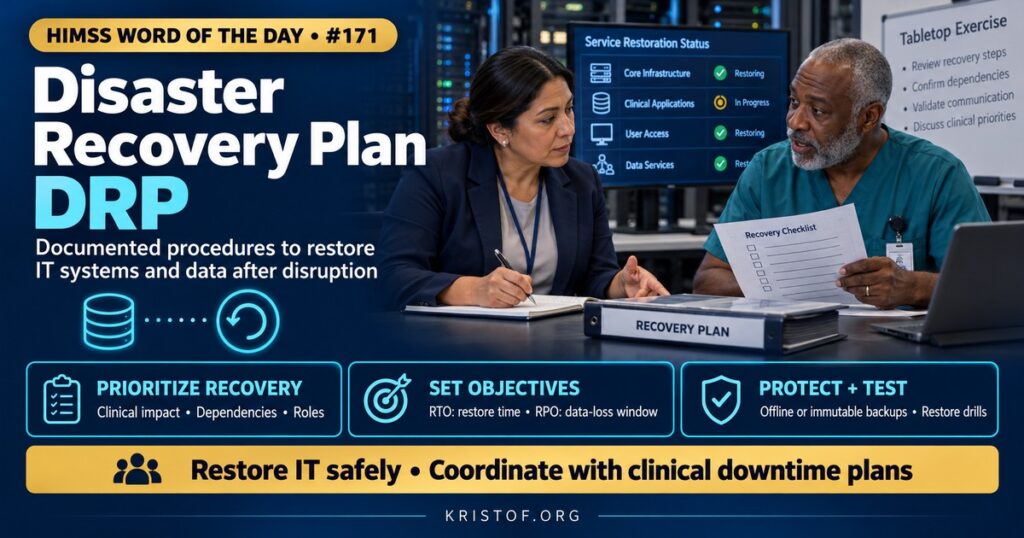
A disaster recovery plan (DRP) is a documented set of procedures for restoring an organization’s IT systems, applications, and data after a disruptive event, so that critical operations can resume as quickly and safely as possible.
The HIMSS Dictionary describes a DRP as a plan for resuming work quickly and effectively after a disaster. It explains that disaster recovery planning is one part of business continuity planning, focused on the parts of an organization that depend on IT infrastructure, with the goal of recovering enough data and system function for the organization to operate, even at a reduced level. It adds that the process typically begins with leadership support and a business impact analysis that identifies the most critical functions and what is needed to restore their IT components on-site or off-site.
| DRP Element | What It Covers | Healthcare Example |
|---|---|---|
| Business Impact Analysis (BIA) | Identifies critical functions and impacts of disruption | EHR, pharmacy, lab, and imaging ranked by clinical impact |
| Recovery Time Objective (RTO) | How quickly a system must be restored | EHR restored within hours |
| Recovery Point Objective (RPO) | How much data loss is acceptable | No more than minutes of lost data |
| Backup Strategy | How and where data is copied | Multiple copies, including offline or immutable backups |
| Alternate Sites | Where systems run if the primary site fails | A secondary data center or cloud region |
| Roles and Communication | Who does what and how teams communicate | An incident command structure and call tree |
⚠️ Exam Alert: A disaster recovery plan restores IT systems and data. A business continuity plan keeps the whole organization operating, including manual workarounds. Downtime procedures let clinical care continue while systems are unavailable. RTO is time to restore; RPO is acceptable data loss.
🌐 Why It Matters: Real-World Healthcare IT Context
Hospitals depend on technology for nearly everything, and disasters, from hurricanes to ransomware, can take that technology away. A DRP determines how quickly and safely an organization can restore what patients and clinicians need.
Regulations require planning. The HIPAA Security Rule requires contingency planning, including a data backup plan, a disaster recovery plan, and an emergency mode operation plan, along with testing and analysis of which applications and data are most critical. CMS’s emergency preparedness requirements for many provider types require risk assessment, emergency plans, communication plans, and training and testing.
The business impact analysis sets priorities. Not every system can be restored first. Organizations rank systems by clinical and operational impact, define RTOs and RPOs, and identify dependencies, such as identity services, networks, and interfaces, without which applications cannot function.
Ransomware has changed disaster recovery. Attackers often target backups, so organizations need copies that cannot be altered or deleted, such as offline or immutable backups, and must verify that restored systems are clean before reconnecting them. Recovery from a cyberattack can take much longer than recovery from a hardware failure because investigation and rebuilding are required. Some health systems have operated on downtime procedures for weeks after attacks.
Technology options vary. Organizations may use secondary data centers, cloud-based recovery, replication, snapshots, and hosted EHR services with built-in redundancy. Each option involves trade-offs in cost, complexity, and recovery speed, and contracts with vendors should specify their disaster recovery commitments.
NIST’s contingency planning guide, SP 800-34, provides a widely used framework, including business impact analysis, preventive controls, recovery strategies, plan testing, and maintenance.
Testing proves the plan. Tabletop exercises, technical restore tests, and full failover drills reveal gaps, such as missing documentation, untested backups, or unclear roles, before a real disaster. Plans must be updated after system changes and lessons learned.
Communication is part of recovery. Clinicians need to know which systems are down, what workarounds to use, and when systems will return. Patients and community partners may also need updates.
Regional disasters add complexity. Hurricanes, wildfires, and floods can affect a hospital’s primary and secondary sites, staff homes, transportation, and supply chains at the same time. Geographic separation of recovery sites and coordination with regional healthcare coalitions help organizations prepare for events that strain whole communities.
Common DRP gaps:
- Backups never tested through full restoration
- Backups reachable and encrypted by ransomware
- Unrealistic RTOs without funding to achieve them
- Missing dependencies in recovery sequences
- Outdated contact lists and documentation
- Vendors’ recovery capabilities not reviewed
Practices for effective disaster recovery:
- A current business impact analysis with clinical input
- Immutable or offline backup copies
- Documented recovery sequences including dependencies
- Regular restore tests and failover exercises
- Coordination with business continuity and downtime plans
- Clear communication plans for staff and partners
🏥 The Nurse’s Perspective: Clinical, Bedside, & Workflow
Nurses keep patients safe while IT teams carry out disaster recovery.
At the Bedside
During a disaster or cyberattack, nurses switch to downtime procedures: paper documentation, printed medication records, manual verification, and runners or phones for communication. Knowing where downtime materials are kept and practicing their use makes transitions smoother.
Physical disasters, such as floods or power failures, may require moving patients, managing equipment on backup power, and maintaining care with limited resources, all of which intersect with IT recovery priorities.
In Clinical Workflow
Nursing leaders participate in business impact analyses by describing which systems are most critical and how long care can continue safely without them. This input helps set realistic recovery priorities.
After systems return, back-entering critical information, such as medications given and vital signs, follows organizational policy. Recovery plans should define what must be entered and by whom to avoid overwhelming staff.
Drills that include clinical units, not just IT, reveal practical problems, such as missing forms or unclear communication paths.
Extended outages strain staff. Planning for staffing, breaks, and support during long recoveries protects both patients and nurses.
In EHR Implementation (Go-Live Perspective)
During an Epic Go-Live, organizations establish disaster recovery for the new environment, including replication, backup schedules, and failover testing. Business continuity access workstations and downtime reports are configured and tested before cutover.
At-the-elbow support analysts help nurses learn where downtime tools are located in the new system and how to report outages. Including downtime scenarios in Go-Live training builds confidence.
🎓 CAHIMS / CPHIMS & HIMSS Perspective
CAHIMS Exam Domain Mapping
Disaster recovery appears in infrastructure, security, and continuity questions:
| CAHIMS Domain | How Disaster Recovery Appears |
|---|---|
| Healthcare & Technology Environments | HIPAA contingency planning; CMS emergency preparedness; ransomware threats |
| Clinical Informatics | Downtime procedures, back-entry, clinical priorities for recovery |
| Healthcare Information & Systems Management | Backups, replication, alternate sites, RTO and RPO, testing |
| Management & Leadership | Business impact analysis, funding, governance, communication |
Key Terms to Know Alongside Disaster Recovery Plan
- Business Continuity Plan (BCP) — a plan for maintaining essential operations during disruptions
- Business Impact Analysis (BIA) — an assessment of the effects of disruption on critical functions
- Recovery Time Objective (RTO) — the target time to restore a system
- Recovery Point Objective (RPO) — the maximum acceptable data loss measured in time
- Immutable Backup — a backup copy that cannot be altered or deleted for a set period
- Failover — switching to a backup system or site
HIMSS Organizational Position
HIMSS addresses resilience, business continuity, and disaster recovery through its cybersecurity education, research, and Healthcare Cybersecurity Community. Members can find related education and research through the HIMSS Resource Center.
🔗 Explore Further: External References
- NIST — SP 800-34 Rev. 1, Contingency Planning Guide for Federal Information Systems https://csrc.nist.gov/pubs/sp/800/34/r1/upd1/final
- eCFR — 45 CFR 164.308, HIPAA Administrative Safeguards https://www.ecfr.gov/current/title-45/subtitle-A/subchapter-C/part-164/subpart-C/section-164.308
- CMS — Emergency Preparedness https://www.cms.gov/medicare/health-safety-standards/quality-safety-oversight-emergency-preparedness
- HHS — Ransomware Fact Sheet https://www.hhs.gov/hipaa/for-professionals/security/guidance/cybersecurity/ransomware-fact-sheet/index.html
- HHS 405(d) Program — Health Industry Cybersecurity Practices https://405d.hhs.gov/
- HIMSS — Healthcare Cybersecurity Community https://www.himss.org/networking/communities/healthcare-cybersecurity/
Term source: HIMSS Dictionary of Health Information and Technology Terms, Acronyms, and Organizations, 6th Edition (2025). All definitions in this series are paraphrased for editorial purposes. Readers are encouraged to consult the primary source for exact language.
Eric Andrew Kristof, RN, CAHIMS is a Healthcare IT professional and HIMSS Arkansas Chapter member based in Hot Springs Village, AR, with hands-on Epic Go-Live experience and a diverse healthcare and IT background. He writes at kristof.org at the intersection of clinical care and healthcare technology.
Leave a Reply