By Eric Andrew Kristof, RN, CAHIMS | Healthcare IT Professional | HIMSS Arkansas Chapter Member
About This Series: The HIMSS Word of the Day is a running blog series drawing from the HIMSS Dictionary of Health Information and Technology Terms, Acronyms, and Organizations, 6th Edition (2025) — the authoritative reference for healthcare IT professionals and the primary study resource for CAHIMS and CPHIMS certification. Each post paraphrases the term in plain language, grounds it in real-world healthcare IT context, and adds a bedside nursing perspective you won’t find in a textbook.
📖 The Term: Contingency Plan
Source: HIMSS Dictionary of Health Information and Technology Terms, Acronyms, and Organizations, 6th Edition (2025)
🔍 Plain-Language Definition
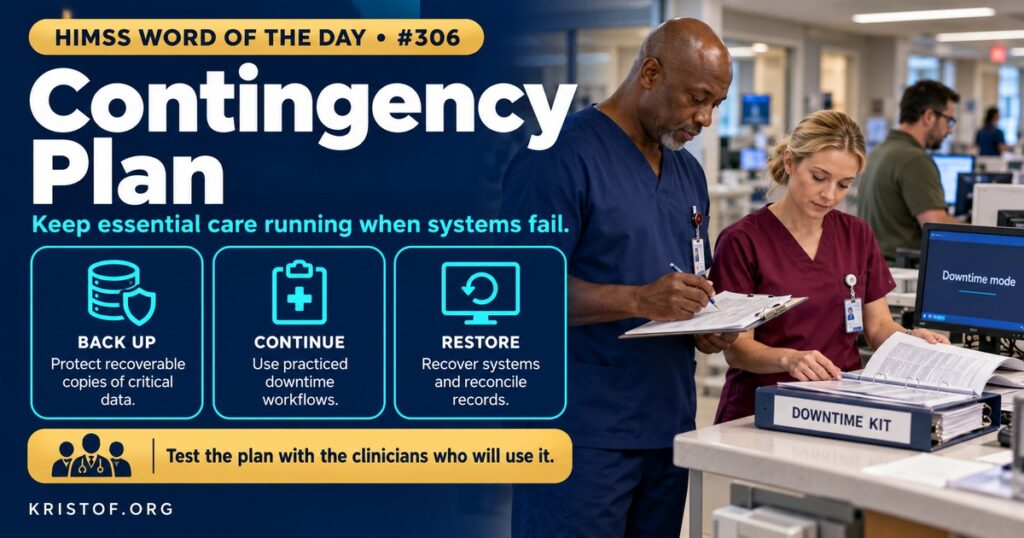
A contingency plan is an alternative plan that takes effect when normal operations are interrupted by an emergency, a system failover, or a disaster. The HIMSS Dictionary describes it in information security terms, as a plan meant to keep business running on site and off site and to maintain service delivery. In health care, the plan has to keep patients safe, which means it covers clinical work as well as data and technology.
The HIPAA Security Rule makes the contingency plan a standard. Under 45 CFR 164.308(a)(7), covered entities and business associates must establish and implement as needed policies and procedures for responding to an emergency or other occurrence, for example fire, vandalism, system failure, or natural disaster, that damages systems containing electronic PHI. The standard has five parts, three of them required: a data backup plan, to create and maintain retrievable exact copies of ePHI; a disaster recovery plan, to restore any loss of data; and an emergency mode operation plan, to continue critical processes that protect the security of ePHI while operating in emergency mode. Two parts are addressable in the current text: testing and revision procedures, for periodic testing and revision of contingency plans, and applications and data criticality analysis, to assess how critical each application and data set is to the other plan components.
NIST Special Publication 800-34 Revision 1, the Contingency Planning Guide for Federal Information Systems, provides a widely used framework for the planning process.
| Plan Element | Purpose | Clinical Example |
|---|---|---|
| Data backup | Keep recoverable copies | Nightly copies stored off the main network |
| Disaster recovery | Restore systems and data | Rebuild the EHR environment after an outage |
| Emergency mode operation | Continue critical work | Paper medication administration records |
| Testing and revision | Prove the plan works | Annual downtime drill on every unit |
| Criticality analysis | Decide what returns first | Medication and order systems before reporting tools |
⚠️ Exam Alert: A contingency plan is the umbrella; a disaster recovery plan focuses on restoring technology and data; business continuity focuses on keeping operations running; emergency mode operation is the interim way of working. In the HIPAA text, testing and revision and criticality analysis are addressable, the other three required.
🌐 Why It Matters: Real-World Healthcare IT Context
Health care now depends on continuous access to electronic systems, and when they fail, units must work without them. Research shows how often this happens and what it affects.
A scoping review in Health Informatics Journal examined downtime-focused literature and news media. It found that 166 US hospitals experienced 701 days of downtime in 43 events between 2012 and 2018, and that almost half (48.8 percent) of the published downtime events involved some form of cyberattack. Healthcare workers during an unexpected downtime must rapidly use paper-based methods that they rarely practice. The authors observed that downtime contingency planning has mostly taken a top-down organizational view, and proposed a bottom-up approach that involves the front-line staff who carry out downtime procedures. The data are from news and published reports, so they undercount smaller events.
A 2025 analysis in Applied Clinical Informatics examined EHR downtime events recorded in the adverse event reports of one Chinese hospital between January 2018 and August 2022. It identified 204 events, 96.1 percent of them unplanned. The most frequent categories were medication-related events (25.5 percent), imaging-related events (17.2 percent), and accounting and billing events (8.3 percent). Seventy-six percent were reported as patient care disruptions. The daily incidence was higher on weekdays than weekends (incidence rate ratio 2.22) and peaked in the morning. The authors called for tiered contingency protocols, stronger technical resilience, and standardized reporting. The hospital and the reporting system are particular to one setting, but the finding that medication processes are the most exposed fits clinical intuition and warrants attention in any plan.
Cyberattacks make the stakes clear. A 2024 interview study in Annals of Emergency Medicine reported that ransomware attacks had significant effects on emergency department workflow, acute care delivery, and staff well-being and that preparedness was limited. A 2026 literature review in the Journal of Emergency Medicine concluded that realistic simulation training and proactive downtime protocols can help emergency departments withstand cyberattacks, and described a retrospective study in which a cyberattack at one health system was followed by more cardiac arrests with unfavorable neurological outcomes at a nearby hospital that was not itself attacked.
Several practices separate paper plans from working ones. Plans identify which systems are critical and how quickly each must be restored. They include clear decision rules for declaring downtime and returning to normal. Units keep downtime kits with current forms, printed reports such as medication lists and census, and backup devices, and staff know where they are. Plans cover how to identify patients, order, administer, and document medications and how to enter paper records back into the EHR afterward. Backups are protected from the attacks they are meant to counter, for example through offline or immutable storage, and recovery is tested, since an untested backup is a hope and not a plan. Drills include clinicians and not only IT, and the plan is reviewed after real events and after major system changes.
Common contingency plan problems:
- Plans written by IT without front-line input
- Printed forms and reports that are out of date or missing
- Backups that were never tested for restoration
- No decision rules for starting and ending downtime
- Paper charting that is never entered back into the EHR
- Dependence on a single vendor or network path
What supports an effective contingency plan:
- Criticality analysis that sets restoration priorities
- Downtime kits and drills on every unit
- Tested, protected backups and recovery procedures
- Clear command roles and communication paths
- Bottom-up input from clinicians who run the procedures
- Review after each real or simulated event
🏥 The Nurse’s Perspective: Clinical, Bedside, & Workflow
Nurses run the clinical side of the contingency plan, often with little warning.
At the Bedside
When systems fail, bedside nurses switch to paper medication records, manual patient identification, written orders, and verbal handoffs. They double-check high-risk medications, since barcode scanning and decision support may be unavailable, and keep careful records of what was given so that the chart can be reconciled later.
In Clinical Workflow
Charge nurses and managers use downtime kits, assign roles, and set communication routines, such as regular updates on expected restoration. House supervisors coordinate across units, and unit leaders decide which nonurgent tasks wait.
Nurse informaticists help design downtime forms and read-only reports, take part in drills, and plan the recovery process, including how paper data are entered afterward and how missed documentation is handled.
In EHR Implementation (Go-Live Perspective)
An Epic Go-Live is itself a time of elevated risk, and new users have not yet built habits for downtime. At-the-elbow support analysts and the command center confirm that downtime kits, read-only access, and backup procedures are in place and understood on each unit before the legacy system is retired.
🎓 CAHIMS / CPHIMS & HIMSS Perspective
CAHIMS Exam Domain Mapping
Contingency planning appears in security, operations, and risk questions:
| CAHIMS Domain | How Contingency Plans Appear |
|---|---|
| Healthcare & Technology Environments | HIPAA Security Rule, emergency preparedness, accreditation |
| Clinical Informatics | Downtime workflows, medication safety, paper-to-electronic recovery |
| Healthcare Information & Systems Management | Backup, recovery, redundancy, testing |
| Management & Leadership | Incident command, risk management, drills, governance |
Key Terms to Know Alongside Contingency Plan
- Data Backup Plan — procedures to create retrievable exact copies of ePHI
- Disaster Recovery Plan — procedures to restore lost data and systems
- Emergency Mode Operation Plan — procedures to continue critical processes during an emergency
- Business Continuity — ability to keep essential operations running
- Recovery Time Objective — target time to restore a system after failure
- Downtime Procedures — manual processes used while electronic systems are unavailable
HIMSS Organizational Position
HIMSS supports healthcare cybersecurity and resilience through its Healthcare Cybersecurity Community, research, and education. Members can find related resources through the HIMSS Healthcare Cybersecurity Community page.
🔗 Explore Further: External References
- eCFR — 45 CFR 164.308, Administrative Safeguards https://www.ecfr.gov/current/title-45/subtitle-A/subchapter-C/part-164/subpart-C/section-164.308
- NIST — SP 800-34 Rev. 1, Contingency Planning Guide for Federal Information Systems https://csrc.nist.gov/pubs/sp/800/34/r1/upd1/final
- Larsen et al. (2020), Health Informatics Journal — Understanding the Scope of Downtime Threats: A Scoping Review of Downtime-Focused Literature and News Media https://pubmed.ncbi.nlm.nih.gov/32403967/
- Fang et al. (2025), Applied Clinical Informatics — Electronic Health Record Downtime Events of a Hospital: A Retrospective Analysis From Adverse Event Reports https://pubmed.ncbi.nlm.nih.gov/41135583/
- van Boven et al. (2024), Annals of Emergency Medicine — Hacking Acute Care: A Qualitative Study on the Health Care Impacts of Ransomware Attacks Against Hospitals https://pubmed.ncbi.nlm.nih.gov/37318433/
- Kahl et al. (2026), Journal of Emergency Medicine — Cybersecurity and Emergency Medicine: A Literary Review https://pubmed.ncbi.nlm.nih.gov/42150298/
Term source: HIMSS Dictionary of Health Information and Technology Terms, Acronyms, and Organizations, 6th Edition (2025). All definitions in this series are paraphrased for editorial purposes. Readers are encouraged to consult the primary source for exact language.
Eric Andrew Kristof, RN, CAHIMS is a Healthcare IT professional and HIMSS Arkansas Chapter member based in Hot Springs Village, AR, with hands-on Epic Go-Live experience and a diverse healthcare and IT background. He writes at kristof.org at the intersection of clinical care and healthcare technology.
Leave a Reply