By Eric Andrew Kristof, RN, CAHIMS | Healthcare IT Professional | HIMSS Arkansas Chapter Member
About This Series: The HIMSS Word of The Day is a running blog series drawing from the HIMSS Dictionary of Health Information and Technology Terms, Acronyms, and Organizations, 6th Edition (2025) — the authoritative reference for healthcare IT professionals and the primary study resource for CAHIMS and CPHIMS certification. Each post paraphrases the term in plain language, grounds it in real-world healthcare IT context, and adds a bedside nursing perspective you won’t find in a textbook.
📖 The Term: Electronic Claim
Source: HIMSS Dictionary of Health Information and Technology Terms, Acronyms, and Organizations, 6th Edition (2025)
🔍 Plain-Language Definition
The HIMSS Dictionary describes an electronic claim as any claim sent to a health plan for payment by electronic means, and it lists a range of ways that can happen, from physical media such as tape or diskette to direct entry, direct lines, dial-in connections, digital fax, and computer upload or download. The dictionary points readers to the EDI Gateway entry. In practice the term is used more narrowly, for a claim sent as structured data to a payer or its intermediary, in place of a paper form.
The studies below look at electronic claims from the provider’s side, the payer’s side, and the point of view of the people who run the process.
| Piece | What it describes | Source in this post |
|---|---|---|
| Claim built from clinical data | A system that fills in the CMS-1500 form from EHR data | Kim et al. |
| Economics | Cost of processing claims electronically compared with paper | Nonvignon et al. |
| Timeliness | Days taken to submit claims | Adzakpah and Kumasenu Mensah |
| Implementation barriers | Why an electronic claim process is not fully used | Anaeli et al. |
| Rules | Medicare electronic submission requirement and HIPAA standard transactions | CMS pages |
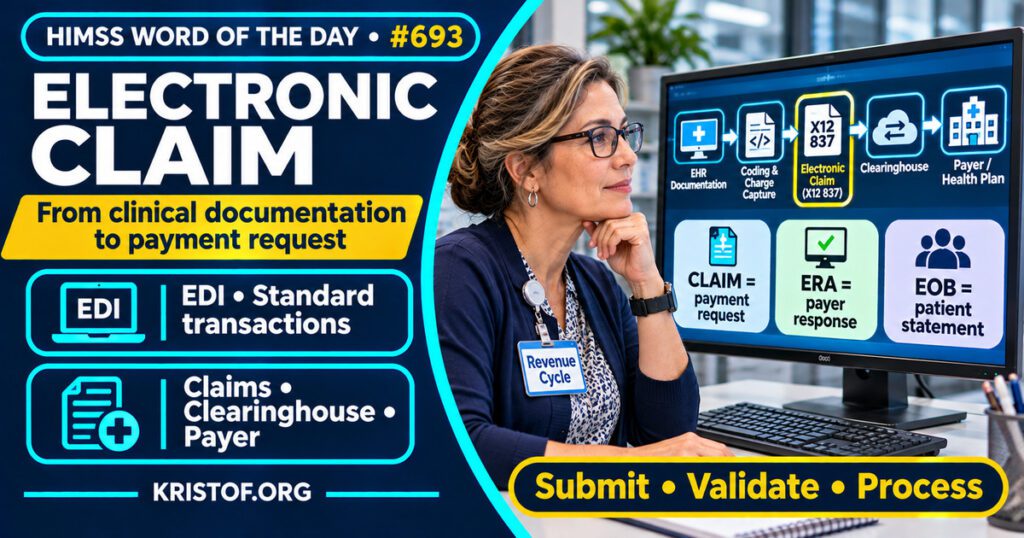
⚠️ Exam Alert: An electronic claim is the request for payment. An electronic remittance advice is the payer’s electronic explanation of what it paid, and an explanation of benefits is the statement sent to the patient. A claim attachment is supporting material needed to process a claim, a different dictionary entry. Under HIPAA, a covered entity that conducts a standard transaction electronically must use the adopted standard, so questions may ask which standard family applies to health care claims and which to pharmacy transactions.
🌐 Why It Matters: Real-World Healthcare IT Context
Where it shows up. Electronic claims sit between clinical documentation and payment. CMS says the Administrative Simplification Compliance Act (ASCA) bars Medicare from paying initial claims that were not sent electronically as of October 16, 2003, with narrow exceptions. Those exceptions include small providers, dental claims, claims from Medicare beneficiaries, and low-volume providers, among others. CMS also says HIPAA adopted standard formats for transactions such as claims, claim status, eligibility, and remittance advice, and that a covered entity that conducts these electronically must use the adopted standard. The four studies below were read as abstracts only.
A claim built from clinical data. Kim et al. (2011) designed an electronic claim system on an integrated EHR platform for office-based physicians in the United States. The system serves as a simple clinical data repository, fills out the CMS-1500 form automatically from patient and clinical information, creates reimbursement charges, and includes an HL7 interface engine to exchange messages. In an experiment, the authors compared the time to fill out the form directly with the time to create the electronic claim data with the system and concluded that the system could save considerable time. They also say the system does not fully meet all the CMS and ONC criteria for EHR systems. It is a 2011 design and small experiment, not a study of payment outcomes.
The economics depend on who is counting. Nonvignon et al. (2022) did a benefit-cost analysis of electronic claims processing under Ghana’s National Health Insurance Scheme, estimating the cost of processing claims electronically and manually from the viewpoint of providers and the purchaser. The incremental benefit-cost ratio was -19.75 for the sampled providers, 25.56 for the purchaser, and 5.10 for providers and purchaser together. Projected to the 330 facilities submitting claims as of December 2014, the ratios were -35.20, 25.56, and 90.06. The results were sensitive to the discount rate and to the share of claims processed electronically. The authors conclude that electronic processing is more efficient than manual processing and makes an economic case for scaling it up. The negative ratio for providers alone shows the gain went mainly to the purchaser.
Faster submission with an information system. Adzakpah and Kumasenu Mensah (2026) studied the effect of health information system implementation on how quickly claims were submitted within the National Catholic Health Service in Ghana, using monthly data from 2010 to 2019. Facilities using an information system submitted claims in 35.11 days on average, compared with 56.51 days for paper-based facilities. Implementation was associated with an immediate 5.84-day reduction, and more than 75% of the facilities achieved timely submission. The study measured information systems, not electronic claims by name, and covers one health service in one country.
Barriers are not only technical. Anaeli et al. (2025) interviewed 19 regional and district health managers, information technology officers, facility in-charges, and focal persons about the improved Community Health Fund electronic claim process in primary care in the Singida region of Tanzania. The barriers they identified were financial governance and oversight, institutional capacity, staff negligence in complying with guidelines, resource availability, and logistical shortcomings. The authors conclude the process was inadequately implemented and call for joint efforts at all levels. It is a qualitative study of one region.
What I could not confirm. Three of the four studies are from Ghana and Tanzania, so they may not describe US claim workflows, which are shaped by commercial payers, clearinghouses, and claim edits. Only one of the four, the 2011 system, is a US design, and it reports a time comparison and not payment results. I did not find a recent US study of electronic claim denial or rejection rates in PubMed, and I did not verify current CMS exception thresholds beyond what the CMS ASCA page lists, which gives different small-provider limits for different groups of providers.
Common electronic claim problems:
- Gains that accrue to the payer more than to the provider, as in the Ghana benefit-cost analysis
- Paper-based facilities submitting claims weeks later than facilities with information systems
- Weak financial oversight, limited capacity, and thin resources behind the process
- Staff not following the guidelines that the process depends on
- A claim form that must be filled from clinical data scattered across systems
What supports electronic claims:
- A Medicare rule that makes electronic submission the default, with listed exceptions
- A standard transaction format that covered entities must use when they conduct the transaction electronically
- Time saved when a system fills in the claim form from existing clinical data, in the 2011 experiment
- Shorter submission times with an information system, in the Ghana facilities studied
- Overall efficiency gains when providers and the purchaser are counted together
🏥 The Nurse’s Perspective: Clinical, Bedside, & Workflow
None of the four studies involve nurses as participants, so this section is workflow context and not evidence.
At the Bedside
A claim line starts with something that was done and recorded. Documentation of the care that was delivered is the material that charge capture and coding later turn into a claim. Nurses do not normally build claims, but documentation that is incomplete or late can delay or change what is billed.
In Clinical Workflow
The 2011 system tried to pull claim data from the clinical record so that no one had to re-enter it. That idea is the reason structured fields matter. When nursing procedures and supplies are captured as discrete entries at the point of care, they are available for charge capture. When they live only in narrative notes, someone else has to find them.
In EHR Implementation (Go-Live Perspective)
During an Epic Go-Live, analysts and at-the-elbow support staff see charge-related questions come up on the floor: which entry creates a charge, what happens when an order is canceled, and who fixes a claim edit. The Tanzania study lists staff compliance with guidelines among its barriers. That is context only, and none of the studies reviewed examines go-lives.
🎓 CAHIMS / CPHIMS & HIMSS Perspective
CAHIMS Exam Domain Mapping
Electronic claim appears in questions about revenue cycle, transactions, and regulation:
| CAHIMS Domain | How Electronic Claim Appears |
|---|---|
| Healthcare & Technology Environments | Payers, clearinghouses, and standard transactions |
| Clinical Informatics | Documentation that supports charge capture and coding |
| Healthcare Information & Systems Management | Claims workflows, edits, and timeliness |
| Management & Leadership | Revenue cycle performance and compliance |
Key Terms to Know Alongside Electronic Claim
- Electronic Data Interchange — the computer-to-computer exchange of business documents in agreed formats
- ASC X12 — the standards body whose transaction standards HIPAA adopted for health care claims
- Electronic Remittance Advice — the payer’s electronic explanation of how a claim was paid
- Explanation of Benefits — the statement that tells a patient what the plan covered
- Healthcare clearinghouse — an entity that converts transactions between standard and nonstandard formats
- HIPAA — the federal law behind the standard transactions
HIMSS Organizational Position
HIMSS offers education and research on health information and technology topics through its Resource Center. Members can find related information on the HIMSS Resource Center page.
🧭 More HIMSS Word of The Day Terms
Related terms in the Healthcare Policy series:
- MSO (Management Service Organizations)
- MMIS (Medicaid Management Information System)
- APC (Ambulatory Payment Class)
Browse all Healthcare Policy terms or the A–Z glossary.
🔗 Explore Further: External References
- CMS — Administrative Simplification Compliance Act Self Assessment https://www.cms.gov/medicare/coding-billing/electronic-billing/administrative-simplification-compliance-act-self-assessment
- CMS — HIPAA Transactions https://www.cms.gov/priorities/key-initiatives/burden-reduction/administrative-simplification/transactions
- Kim et al. (2011), Healthcare Informatics Research — Development of an electronic claim system based on an integrated electronic health record platform to guarantee interoperability. https://pubmed.ncbi.nlm.nih.gov/21886871/
- Nonvignon et al. (2022), BMJ Open — Benefit-cost analysis of electronic claims processing under Ghana’s National Health Insurance Scheme. https://pubmed.ncbi.nlm.nih.gov/35534071/
- Adzakpah and Kumasenu Mensah (2026), Informatics for Health and Social Care — Assessing the impact of health information systems on timeliness of medical claim submission in Ghana: a multi-center quasi-experimental study. https://pubmed.ncbi.nlm.nih.gov/41653441/
- Anaeli et al. (2025), BMJ Open — Barriers to the implementation of an improved Community Health Fund electronic claim process in primary healthcare services in Singida region of Tanzania: a qualitative inquiry. https://pubmed.ncbi.nlm.nih.gov/40490369/
- HIMSS — Resource Center https://www.himss.org/resource-center
Term source: HIMSS Dictionary of Health Information and Technology Terms, Acronyms, and Organizations, 6th Edition (2025). All definitions in this series are paraphrased for editorial purposes. Readers are encouraged to consult the primary source for exact language.
Eric Andrew Kristof, RN, CAHIMS is a Healthcare IT professional and HIMSS Arkansas Chapter member based in Hot Springs Village, AR, with hands-on Epic Go-Live experience and a diverse healthcare and IT background. He writes at kristof.org at the intersection of clinical care and healthcare technology.
Leave a Reply