By Eric Andrew Kristof, RN, CAHIMS | Healthcare IT Professional | HIMSS Arkansas Chapter Member
About This Series: The HIMSS Word of the Day is a running blog series drawing from the HIMSS Dictionary of Health Information and Technology Terms, Acronyms, and Organizations, 6th Edition (2025) — the authoritative reference for healthcare IT professionals and the primary study resource for CAHIMS and CPHIMS certification. Each post paraphrases the term in plain language, grounds it in real-world healthcare IT context, and adds a bedside nursing perspective you won’t find in a textbook.
📖 The Term: Clinical Data Repository (CDR)
Source: HIMSS Dictionary of Health Information and Technology Terms, Acronyms, and Organizations, 6th Edition (2025)
🔍 Plain-Language Definition
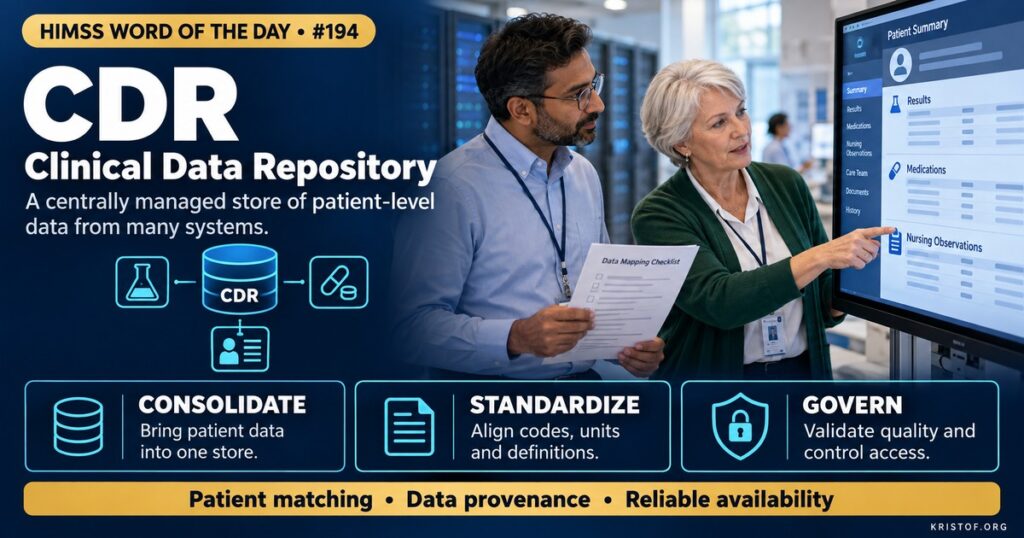
A clinical data repository (CDR) is a structured, centrally managed database of patient-specific clinical data collected from the applications used across a health care organization, so the information can be accessed, viewed, managed, and reported in one place.
The HIMSS Dictionary describes a CDR in two ways: as an organized store of patient-level clinical data, and as a centralized database that gathers clinical, administrative, and financial information from various applications within or across organizations and makes it available through an open environment for viewing, management, and reporting.
| Concept | Primary Purpose | Typical Data View |
|---|---|---|
| EHR | Documenting and delivering care in real time | Patient-centered, transaction-oriented |
| Clinical Data Repository | Consolidating patient-level data from many sources | Patient-centered, current and historical |
| Data Warehouse | Analysis and reporting across populations | Subject-oriented, historical, aggregated |
| Data Lake | Holding raw data of many types for later use | Flexible, often less structured |
| Interface Engine | Moving messages between systems | Messages in transit, not storage |
⚠️ Exam Alert: A CDR organizes patient-level clinical data from many systems for use in care. A data warehouse is built for analysis across populations over time. The two often work together, and some organizations feed the warehouse from the repository. A CDR is not an interface engine, because it stores data rather than only routing messages.
🌐 Why It Matters: Real-World Healthcare IT Context
Most hospitals run separate systems for laboratory, pharmacy, radiology, anesthesia, monitoring, and nursing documentation. Each holds part of the patient story. A CDR draws those pieces into a single structured store so clinicians and analysts can see a more complete picture without logging into each source.
The concept sits near the early stages of the HIMSS Electronic Medical Record Adoption Model, where centralized storage of clinical data, a controlled medical vocabulary, and decision support are associated with building a foundation for a mature EHR. The idea behind it has stayed constant: capture data once, code it consistently, and use it many times.
Terminology and standards give a repository its value. Mapping local codes to standards such as LOINC for observations and SNOMED CT for clinical concepts makes data comparable across systems and over time. A hospital in Germany described its repository work after moving from an in-house hospital information system to commercial software: structured clinical data was consolidated into a FHIR server and mapped to LOINC and SNOMED so it could support multicenter research projects. Research-oriented organizations also use common data models, such as the OMOP model developed by the OHDSI community, to standardize structure for analysis.
Sustainability depends on governance as much as technology. Columbia University has reflected on more than 30 years of building clinical data infrastructure that supports both patient care and research, and recommends including key stakeholders, aligning with data governance, following FAIR principles, protecting safety and quality, and planning for financial health. Those ingredients apply to any organization building a repository.
Data quality is a constant concern. A repository can combine data from sources that use different definitions, units, and time stamps. Without matching rules, patients can be split across records or merged incorrectly, so an accurate master patient index is a prerequisite. Data profiling, validation rules, and feedback loops to source systems help keep the repository trustworthy.
Privacy and security responsibilities grow as data is consolidated. Access should follow role-based rules and the minimum necessary standard, with audit trails showing who viewed what. When repository data supports research or analytics, de-identification, limited data sets, or appropriate authorization rules come into play.
Use cases include clinician summary views, population health queries, quality measure calculation, clinical decision support inputs, and research cohort identification. Each use case benefits from the same discipline: knowing where each data element originated and what it means.
Resilience matters too. If the repository supplies information for care, it must be available, backed up, and included in downtime and recovery planning.
Common CDR challenges:
- Inconsistent codes and units across source systems
- Patient matching errors when identifiers differ
- Unclear data ownership and definitions
- Delays between the source system and the repository
- Unmanaged access to consolidated sensitive data
- Insufficient testing after source system upgrades
What supports a trustworthy repository:
- Standard terminologies mapped consistently
- A reliable master patient index
- Governance with named data stewards
- Data quality monitoring and feedback to sources
- Role-based access and audit logging
- Availability and recovery planning
🏥 The Nurse’s Perspective: Clinical, Bedside, & Workflow
Much of what ends up in a repository starts as nursing documentation, which means the quality of the bedside entry sets the ceiling for everything downstream.
At the Bedside
Flowsheet entries, assessments, medication administration records, and intake and output values all become data that others will query later. Choosing the specific structured field, rather than free text or a nearby but wrong row, makes that data usable for care summaries, quality measures, and research.
Accuracy and timing matter. A value charted in the wrong place or at the wrong time becomes a misleading data point once it is combined with information from other systems.
In Clinical Workflow
Nurses are frequent users of the views a repository supports, such as a single summary of results, medications, and notes drawn from multiple sources. Knowing which system supplied a value helps when something looks inconsistent.
When data does not appear where expected, reporting the specifics helps analysts trace whether the problem began at the source, in the interface, or in the repository.
Nurse informaticists contribute by defining nursing data elements, reviewing mappings to standard terminologies, and checking that measures built on the repository reflect nursing practice accurately.
In EHR Implementation (Go-Live Perspective)
During an Epic Go-Live, build decisions about flowsheet rows, documentation templates, and discrete data elements determine what will be available for reporting later. Teams that think about downstream use during design avoid rework.
At-the-elbow support analysts often notice documentation habits that create unusable data, such as notes where a structured field exists. Coaching nurses on the discrete fields that feed summaries and reports improves data quality from the first week.
🎓 CAHIMS / CPHIMS & HIMSS Perspective
CAHIMS Exam Domain Mapping
Repositories appear in data, architecture, and governance questions:
| CAHIMS Domain | How the CDR Appears |
|---|---|
| Healthcare & Technology Environments | Standards, terminologies, maturity models, data privacy requirements |
| Clinical Informatics | Discrete documentation, data use for care and research, quality measures |
| Healthcare Information & Systems Management | Architecture, master patient index, data quality, availability |
| Management & Leadership | Governance, stewardship, funding, access policies |
Key Terms to Know Alongside CDR
- Data Warehouse — repository designed for analysis and reporting over time
- Master Patient Index (MPI) — directory that links records belonging to the same patient
- Controlled Vocabulary — standard set of terms used to code clinical data
- Data Governance — policies and roles for managing data quality, access, and use
- Data Stewardship — responsibility for definitions and quality of specific data
- Secondary Use of Data — use of care data for purposes beyond direct treatment
HIMSS Organizational Position
HIMSS promotes data standards, analytics maturity, and responsible use of health data through its maturity models and education. Members can find related resources through the HIMSS Resource Center and its maturity model pages.
🔗 Explore Further: External References
- Michel-Backofen et al. (2022), Studies in Health Technology and Informatics — Building a Comprehensive Clinical Data Repository Using FHIR, LOINC and SNOMED https://pubmed.ncbi.nlm.nih.gov/35612145/
- Natarajan et al. (2023), Studies in Health Technology and Informatics — A Model for Multi-Institutional Clinical Data Repository https://pubmed.ncbi.nlm.nih.gov/37203669/
- OHDSI — OMOP Common Data Model https://ohdsi.github.io/CommonDataModel/
- HL7 International — FHIR https://www.hl7.org/fhir/
- HIMSS — Electronic Medical Record Adoption Model (EMRAM) https://www.himss.org/maturity-models/emram
- AHRQ — Data and Analytics https://www.ahrq.gov/data/index.html
Term source: HIMSS Dictionary of Health Information and Technology Terms, Acronyms, and Organizations, 6th Edition (2025). All definitions in this series are paraphrased for editorial purposes. Readers are encouraged to consult the primary source for exact language.
Eric Andrew Kristof, RN, CAHIMS is a Healthcare IT professional and HIMSS Arkansas Chapter member based in Hot Springs Village, AR, with hands-on Epic Go-Live experience and a diverse healthcare and IT background. He writes at kristof.org at the intersection of clinical care and healthcare technology.
Leave a Reply