By Eric Andrew Kristof, RN, CAHIMS | Healthcare IT Professional | HIMSS Arkansas Chapter Member
About This Series: The HIMSS Word of The Day is a running blog series drawing from the HIMSS Dictionary of Health Information and Technology Terms, Acronyms, and Organizations, 6th Edition (2025) — the authoritative reference for healthcare IT professionals and the primary study resource for CAHIMS and CPHIMS certification. Each post paraphrases the term in plain language, grounds it in real-world healthcare IT context, and adds a bedside nursing perspective you won’t find in a textbook.
📖 The Term: MSO (Management Service Organizations)
Source: HIMSS Dictionary of Health Information and Technology Terms, Acronyms, and Organizations, 6th Edition (2025)
🔍 Plain-Language Definition
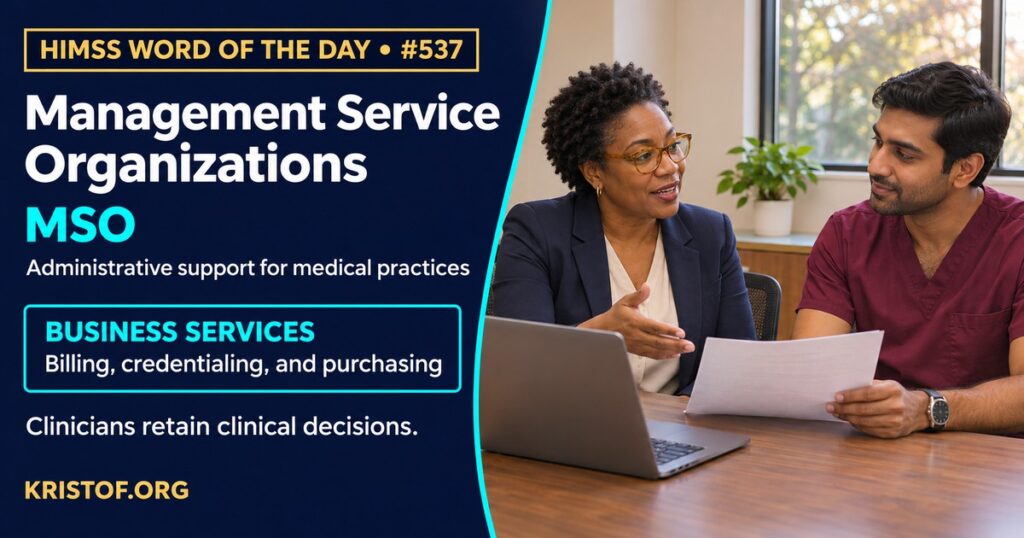
The HIMSS Dictionary describes a management service organization (MSO) as an entity set up to help with the administrative, nonmedical side of running a practice. The clinical work stays with the practice’s clinicians, and the MSO takes on the business functions around it.
According to the dictionary, an MSO can be owned by several kinds of parties: investors who are not health care providers, hospitals, physician groups, hospital-physician joint ventures, or even health plans. The services it can provide are broad. They include everyday operations, finance, human resources, and staff training, along with revenue cycle work such as coding, billing, and collections. The dictionary also lists office space, compliance, contracts, credentialing, purchasing, risk management, and negotiated pricing on EHRs and equipment.
Several of those functions depend on information systems. Billing and collections rely on revenue cycle software, credentialing relies on provider data, and discounted EHR purchases shape which system a practice uses. For this reason, health IT teams, practice managers, and nurse leaders all encounter MSOs, even though the organization sits outside the exam room.
Recent literature often discusses MSOs in connection with private equity. Busam and Shah (2023) note that private equity firms are legally prevented from owning a medical practice in many states, so they usually form an MSO to oversee the nonclinical aspects while physician owners keep the clinical functions. That arrangement is one use of the MSO model, not the whole of it, since the dictionary also lists hospitals, physicians, and health plans as possible owners.
| Element | What it means |
|---|---|
| Role | Handles administrative, nonclinical work for a practice |
| Clinical care | Stays with the physicians and clinicians |
| Possible owners | Investors, hospitals, physician groups, hospital-physician ventures, health plans |
| Typical services | Finance, HR, billing, credentialing, contracts, purchasing, compliance |
| Health IT link | Revenue cycle systems, provider data, and EHR purchasing |
⚠️ Exam Alert: An MSO provides nonclinical administrative services to a practice, while clinical decisions remain with the clinicians. Do not confuse an MSO with an ACO (a group that shares responsibility for the quality and cost of care), a health plan (which can own an MSO), or a private equity firm (an investor that may form one).
🌐 Why It Matters: Real-World Healthcare IT Context
Most published work on MSOs appears inside discussions of practice consolidation, so the literature is mainly narrative overviews and a few observational studies. Each source below was checked against its published abstract, and the type of source is noted.
Konda and Francis, in Clinics in Dermatology (2020), described the evolution of private equity in dermatology. They report that private equity first entered clinical dermatology over a decade earlier and that there were more than 30 private equity-backed dermatology groups. Many use the MSO model, which, in their words, allows firms to work around corporate practice of medicine laws and to align cooperating physicians. They describe stages of group evolution and say groups become more alike as they mature. It is a narrative overview, so it describes patterns rather than testing outcomes.
Busam and Shah, in Gastroenterology and Hepatology (2023), examined private equity investment in gastroenterology practices. They report that firms usually form an MSO to oversee all nonclinical aspects, leaving clinical functions to the physician owners, and that gastroenterology is attractive in part because of the willingness of gastroenterologists to join and the potential to profit from consolidation. They say research has started to examine effects on patients and on the specialty, while questions remain about the benefits for physicians. This is also a narrative review.
Nasseh and colleagues, in the International Journal of Health Economics and Management (2020), used 2013 to 2015 American Dental Association dentist-level data, census data, and insurer concentration data from FAIR Health to study dental consolidation. They looked at practice size, the decision to own a practice, and the choice to work at a dental management service organization, a type of corporate group practice. They found a modest effect of insurance market concentration on practice size, an association between higher concentration and a dentist’s decision not to own a practice, and inconclusive evidence on joining a dental management service organization. The data are observational and from before 2016, and the setting is dentistry rather than medicine.
Fariyike and colleagues, in the Bulletin of the Hospital for Joint Disease (2025), provided an overview of private equity in orthopedic practices for surgeons choosing positions. They report that private equity transactions in health care surged between 2015 and 2022, and that firms use leveraged buyouts and often form MSOs to streamline operations. They describe benefits, including access to capital and corporate expertise, and concerns about reduced autonomy, increased procedural volumes, and possible effects on care quality and costs. It is an overview intended to inform decisions, not a study of outcomes.
Kapoor and colleagues, in the Journal of Market Access and Health Policy (2025), named MSOs among the affiliation models physicians now join, along with hospitals, health systems, payers, and corporate entities. They compared affiliation model, site of care, and cost for selected high-volume procedures in procedure-intensive specialties under Medicare and commercial insurance. Hospital-affiliated physicians were least likely, and private equity-affiliated physicians most likely, to provide care in lower-cost settings, and site of care contributed meaningfully to procedure unit price, which was consistently greater in hospital-based settings. The abstract does not report separate findings for MSOs, so the results speak to hospital and private equity affiliation. The authors suggest strategies such as site-neutral payments.
Taken together, the sources show that MSOs are a common structure in practice consolidation, that evidence on their effects is still thin and mostly descriptive, and that ownership and affiliation shape where and how care is delivered.
Common MSO problems:
- Unclear division between the MSO’s business role and clinicians’ clinical decisions
- Concerns about physician autonomy and procedural volume
- Limited evidence on effects on patients, costs, and quality
- Uncertainty about legal limits on who may own a practice
- Practices that lose flexibility in choosing systems and vendors
- Consolidation that may reduce local choice
What supports an effective MSO relationship:
- Written agreements that separate administrative services from clinical decisions
- Clear ownership and governance, including who controls data and systems
- Transparent reporting on billing, credentialing, and contracts
- Clinician voice in decisions about technology and staffing
- Review of legal and regulatory requirements in the practice’s state
- Monitoring of patient access, quality, and site of care
🏥 The Nurse’s Perspective: Clinical, Bedside, & Workflow
Nurses and practice staff often feel the effects of an MSO in daily work, even if the arrangement never appears in a care plan.
At the Bedside
Nurses in MSO-supported practices focus on patient care while the MSO may handle scheduling support, supplies, billing, or credentialing behind the scenes. Questions about who buys equipment, who sets staffing, or who chooses the EHR often trace back to the administrative structure. Nurses who raise patient safety concerns through the practice’s usual channels help keep clinical priorities visible.
In Clinical Workflow
Nurse leaders and informaticists in these practices work with the MSO on shared processes such as referrals, prior authorizations, and documentation needed for billing. Because the MSO and the practice may use different systems, interfaces and data ownership become real questions. Clear role definitions prevent gaps in which no one is sure who handles a task.
In EHR Implementation (Go-Live Perspective)
During an Epic Go-Live at a practice affiliated with an MSO, analysts at the elbow see how much of the build reflects decisions made outside the clinic: shared templates, billing rules, and credentialing data. Clinicians sometimes ask why a screen or workflow looks the way it does. Tracing those questions back to the right decision-maker speeds up fixes.
🎓 CAHIMS / CPHIMS & HIMSS Perspective
CAHIMS Exam Domain Mapping
MSOs connect organizational structure, policy, and operations:
| CAHIMS Domain | How MSOs Appear |
|---|---|
| Healthcare & Technology Environments | Practice ownership models, consolidation, and payer relationships |
| Clinical Informatics | Clinician workflow, documentation, and quality reporting |
| Healthcare Information & Systems Management | Revenue cycle systems, provider data, EHR purchasing, and interfaces |
| Management & Leadership | Governance, contracts, credentialing, risk management, and compliance |
Key Terms to Know Alongside MSO
- ACO (Accountable Care Organization) — group of providers that shares responsibility for the quality and cost of care
- Revenue Cycle Management — processes that capture, bill, and collect payment for care
- Credentialing — verifying a clinician’s qualifications to practice and to join a network
- Corporate Practice of Medicine — state rules that limit who may own or control a medical practice
- Private Equity — investment firms that buy stakes in companies, including some practices
- Group Purchasing — pooling purchases by several organizations to lower costs
HIMSS Organizational Position
HIMSS offers education and research on health information and technology topics through its Resource Center. Members can find related information on the HIMSS Resource Center page.
🧭 More HIMSS Word of The Day Terms
Related terms in the Healthcare Policy series:
- Covered Entity (HIPAA)
- National Provider Identifier (NPI)
- Administrative Code Sets
- APC (Ambulatory Payment Class)
Browse all Healthcare Policy terms or the A–Z glossary.
🔗 Explore Further: External References
- Konda and Francis (2020), Clinics in dermatology — The evolution of private equity in dermatology https://pubmed.ncbi.nlm.nih.gov/32563337/
- Busam and Shah (2023), Gastroenterology & hepatology — The Rise of Private Equity in Gastroenterology Practices https://pubmed.ncbi.nlm.nih.gov/37799457/
- Nasseh et al. (2020), International journal of health economics and management — Consolidation in the dental industry: a closer look at dental payers and providers https://pubmed.ncbi.nlm.nih.gov/31583512/
- Fariyike et al. (2025), Bulletin of the Hospital for Joint Disease — Private equity investment in orthopedic practices: Part of the changing landscape of health care https://pubmed.ncbi.nlm.nih.gov/41637593/
- Kapoor et al. (2025), Journal of market access & health policy — Physician Practice Affiliation Drives Site of Care Cost Differentials: An Opportunity to Reduce Healthcare Expenditures https://pubmed.ncbi.nlm.nih.gov/40860953/
- HIMSS — Resource Center https://www.himss.org/resource-center
Term source: HIMSS Dictionary of Health Information and Technology Terms, Acronyms, and Organizations, 6th Edition (2025). All definitions in this series are paraphrased for editorial purposes. Readers are encouraged to consult the primary source for exact language.
Eric Andrew Kristof, RN, CAHIMS is a Healthcare IT professional and HIMSS Arkansas Chapter member based in Hot Springs Village, AR, with hands-on Epic Go-Live experience and a diverse healthcare and IT background. He writes at kristof.org at the intersection of clinical care and healthcare technology.
Leave a Reply