By Eric Andrew Kristof, RN, CAHIMS | Healthcare IT Professional | HIMSS Arkansas Chapter Member
About This Series: The HIMSS Word of the Day is a running blog series drawing from the HIMSS Dictionary of Health Information and Technology Terms, Acronyms, and Organizations, 6th Edition (2025) — the authoritative reference for healthcare IT professionals and the primary study resource for CAHIMS and CPHIMS certification. Each post paraphrases the term in plain language, grounds it in real-world healthcare IT context, and adds a bedside nursing perspective you won’t find in a textbook.
📖 The Term: Electronic Data Interchange (EDI)
Source: HIMSS Dictionary of Health Information and Technology Terms, Acronyms, and Organizations, 6th Edition (2025)
🔍 Plain-Language Definition
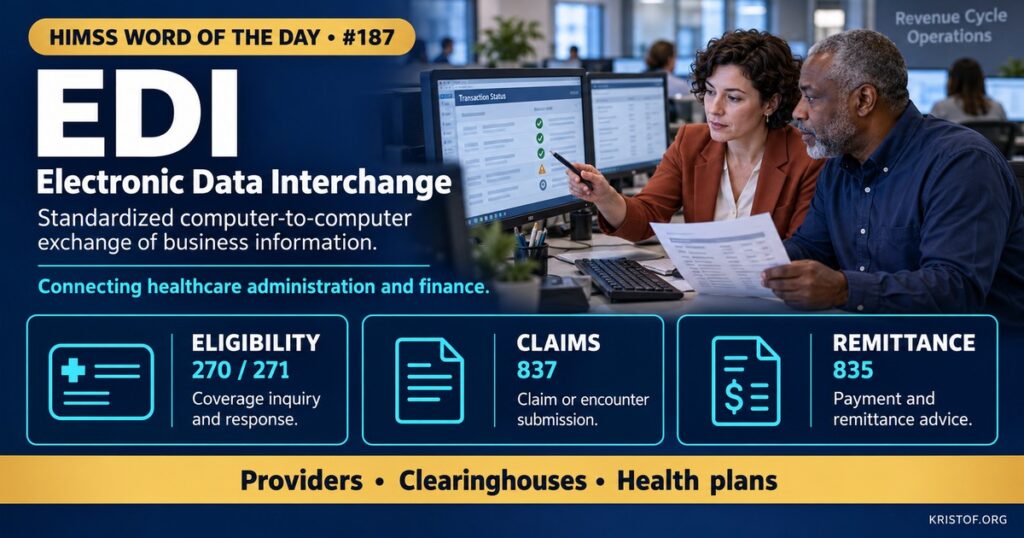
Electronic data interchange (EDI) is the structured, computer-to-computer exchange of business information between organizations using standardized formats. In healthcare, EDI carries administrative and financial transactions among providers, health plans, clearinghouses, and other entities.
The HIMSS Dictionary offers two descriptions. It notes that the American National Standards Institute had approved the process for creating the X12 EDI standards before HIPAA existed, a collection of standard message formats that let businesses exchange data through electronic messaging services. It also describes EDI as electronic data transfer between companies over networks, including the internet, and notes that healthcare needs secure communications to exchange eligibility checks, referrals and authorizations, claims and encounters, and the payment data used to manage contracts and remittances.
| X12 Transaction | Purpose | Example |
|---|---|---|
| 837 | Health care claim or encounter | Submitting a hospital or professional claim |
| 835 | Payment and remittance advice | Explaining what a payer paid or denied |
| 270/271 | Eligibility inquiry and response | Checking a patient’s coverage at registration |
| 276/277 | Claim status inquiry and response | Following up on an unpaid claim |
| 278 | Prior authorization and referral request and response | Requesting approval for an MRI |
| 834 | Benefit enrollment and maintenance | Employer enrollment data sent to a health plan |
| 820 | Premium payment | Payment of health plan premiums |
⚠️ Exam Alert: HIPAA adopted X12 standards for most administrative transactions and NCPDP standards for retail pharmacy transactions. A clearinghouse converts nonstandard data into standard formats and is a HIPAA covered entity. Operating rules add business requirements to the standards. EDI is distinct from clinical data exchange standards such as HL7.
🌐 Why It Matters: Real-World Healthcare IT Context
Healthcare’s administrative processes generate enormous volumes of transactions. Before standards, payers used many proprietary formats, forcing providers to support different submission methods for each plan. HIPAA’s Administrative Simplification provisions adopted national standards so that providers, plans, and clearinghouses could exchange information consistently.
The current HIPAA transaction standards use X12 version 5010 for most transactions and NCPDP standards for pharmacy claims. Covered entities that conduct these transactions electronically must use the adopted standards, and CMS enforces compliance on behalf of HHS.
Operating rules complement the standards. Under the Affordable Care Act, HHS adopted operating rules that specify business requirements, such as response times, data content, and connectivity, to make transactions more consistent and useful. The CORE operating rules address transactions such as eligibility, claim status, payment, and prior authorization.
Clearinghouses play a central role. Many providers send transactions through clearinghouses that validate, convert, and route them to payers, and return responses. This concentration also creates risk: the 2024 cyberattack on Change Healthcare, a major clearinghouse, disrupted claims and payments for many organizations nationwide, showing how dependent the system is on a few intermediaries.
EDI drives revenue cycle performance. Accurate eligibility checks reduce denials, clean claims speed payment, and electronic remittance allows automated posting. Errors in registration, coding, or documentation propagate into transactions and cause rejections.
Prior authorization remains partly manual. Although the X12 278 transaction exists, adoption has lagged, and much prior authorization still happens through portals, phone, and fax. Federal interoperability rules now require many payers to implement FHIR-based prior authorization APIs, so X12 and FHIR approaches will coexist, with mapping between them where needed.
Security matters. EDI transactions contain PHI and financial data, so organizations protect connections with encryption, authentication, and monitoring, and include clearinghouses and vendors in risk management.
Attachments are a long-standing gap. Payers often need clinical documentation to support claims or authorization requests, and for years these attachments traveled by fax or mail. Federal rulemaking has proposed standards for electronic health care attachments, and FHIR-based approaches are being developed to send documentation electronically, which could reduce delays and manual work.
Data from EDI supports analytics. Claims and remittance data reveal denial patterns, payer performance, and utilization trends that help organizations improve processes.
Small practices often depend entirely on vendors for EDI. Practice management systems and clearinghouses handle transaction formats, so practices may not see problems until payments slow. Monitoring rejection reports and payment timelines helps catch issues early.
Common EDI problems:
- Registration errors causing eligibility and claim rejections
- Missing or invalid codes in claims
- Delayed or unreadable remittance data
- Heavy reliance on a few clearinghouses
- Low adoption of electronic prior authorization
- Payer-specific variations despite standards
Practices for effective EDI:
- Real-time eligibility checks at scheduling and registration
- Claim scrubbing before submission
- Automated remittance posting and denial analysis
- Contingency plans for clearinghouse outages
- Adoption of operating rules and electronic prior authorization
- Strong security for EDI connections and vendors
🏥 The Nurse’s Perspective: Clinical, Bedside, & Workflow
EDI may seem far from nursing, but nurses feel its effects in access, authorization, and discharge planning.
At the Bedside
Eligibility and benefit information returned through EDI determines what services are covered and whether authorization is needed. Nurses planning discharges, ordering equipment, or arranging post-acute care rely on accurate coverage information.
When authorization delays affect patient care, such as waiting for approval for a procedure or medication, nurses often coordinate with case management and payers.
Explaining to patients why insurance information must be verified, and helping them update it, reduces billing problems that can affect their access to care.
In Clinical Workflow
Clinical documentation feeds claims. Accurate documentation of services, diagnoses, and medical necessity supports clean claims and reduces denials that may later require chart review.
Nurses in utilization review and case management interact with payers through authorization and notification processes, some of which now occur electronically.
During clearinghouse outages, organizations may need manual processes for eligibility and authorization, affecting scheduling and admissions. Awareness of these contingencies helps nurses support patients during disruptions.
Accurate demographic and insurance information collected at registration, including subscriber details, prevents eligibility rejections that can delay scheduled procedures.
In EHR Implementation (Go-Live Perspective)
During an Epic Go-Live, revenue cycle teams configure EDI connections, payer setups, eligibility checks, and claims workflows. Testing with clearinghouses and payers ensures transactions flow correctly from the first day.
At-the-elbow support analysts in registration and scheduling areas help staff interpret eligibility responses, while issues with authorization workflows may reach nursing and case management teams.
🎓 CAHIMS / CPHIMS & HIMSS Perspective
CAHIMS Exam Domain Mapping
EDI appears in administrative standards and revenue cycle questions:
| CAHIMS Domain | How EDI Appears |
|---|---|
| Healthcare & Technology Environments | HIPAA Administrative Simplification; operating rules; clearinghouses |
| Clinical Informatics | Documentation supporting claims; authorization workflows |
| Healthcare Information & Systems Management | X12 transactions, clearinghouse connectivity, FHIR coexistence |
| Management & Leadership | Revenue cycle performance, vendor risk, denial management |
Key Terms to Know Alongside EDI
- X12 — the standards organization and standards used for HIPAA administrative transactions
- Clearinghouse — an entity that converts and routes health transactions
- 837 — the X12 transaction for health care claims
- 835 — the X12 transaction for payment and remittance advice
- Operating Rules — business rules that supplement transaction standards
- Administrative Simplification — HIPAA provisions establishing standard transactions, code sets, and identifiers
HIMSS Organizational Position
HIMSS supports administrative simplification and payer-provider interoperability, including electronic prior authorization, through its public policy work and education. Members can find related education and research through the HIMSS Resource Center.
🔗 Explore Further: External References
- X12 — Transaction Sets https://x12.org/products/transaction-sets
- CMS — Electronic Billing and EDI Transactions https://www.cms.gov/medicare/coding-billing/electronic-billing
- CMS — Administrative Simplification https://www.cms.gov/priorities/key-initiatives/burden-reduction/administrative-simplification
- CORE — Committee on Operating Rules for Information Exchange https://www.dataspring.com/core
- HHS — Change Healthcare Cybersecurity Incident Frequently Asked Questions https://www.hhs.gov/hipaa/for-professionals/special-topics/change-healthcare-cybersecurity-incident-frequently-asked-questions/index.html
- HIMSS — Public Policy & Advocacy https://www.himss.org/public-policy-advocacy-overview
Term source: HIMSS Dictionary of Health Information and Technology Terms, Acronyms, and Organizations, 6th Edition (2025). All definitions in this series are paraphrased for editorial purposes. Readers are encouraged to consult the primary source for exact language.
Eric Andrew Kristof, RN, CAHIMS is a Healthcare IT professional and HIMSS Arkansas Chapter member based in Hot Springs Village, AR, with hands-on Epic Go-Live experience and a diverse healthcare and IT background. He writes at kristof.org at the intersection of clinical care and healthcare technology.
Leave a Reply