By Eric Andrew Kristof, RN, CAHIMS | Healthcare IT Professional | HIMSS Arkansas Chapter Member
About This Series: The HIMSS Word of the Day is a running blog series drawing from the HIMSS Dictionary of Health Information and Technology Terms, Acronyms, and Organizations, 6th Edition (2025) — the authoritative reference for healthcare IT professionals and the primary study resource for CAHIMS and CPHIMS certification. Each post paraphrases the term in plain language, grounds it in real-world healthcare IT context, and adds a bedside nursing perspective you won’t find in a textbook.
📖 The Term: Interface Engine
Source: HIMSS Dictionary of Health Information and Technology Terms, Acronyms, and Organizations, 6th Edition (2025)
🔍 Plain-Language Definition
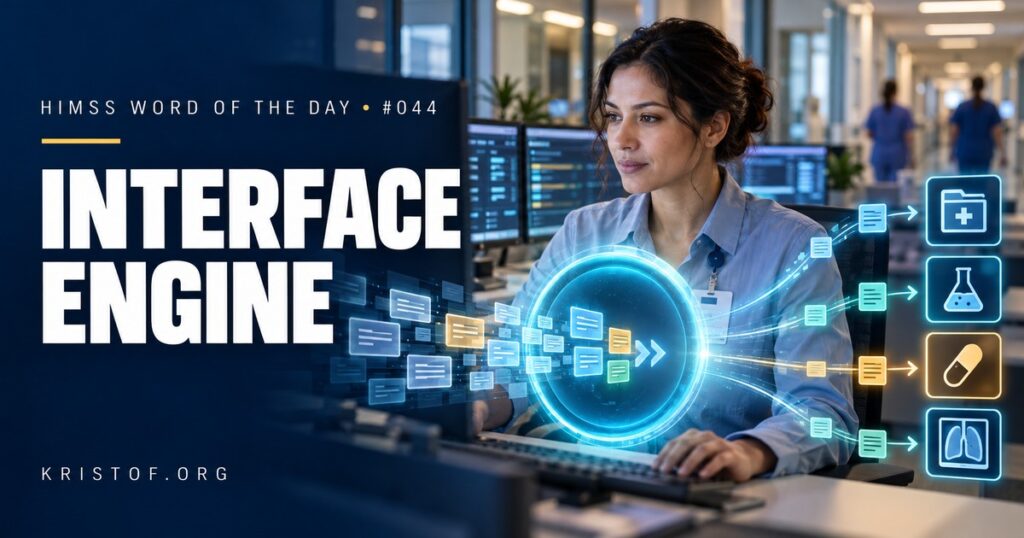
An interface engine, also called an integration engine, is software that sits between hospital systems and passes information among them. It receives a message from one system, converts it into the structure the receiving system expects, and delivers it to every system that needs it.
The HIMSS Dictionary describes an interface engine as a tool that converts the functions and protocols of different systems into a shared format so information can be exchanged. In its words, the engine works as a translator that lets data or files move from one system to another.
A useful comparison is an airport hub. Instead of flying direct between every pair of cities, flights connect through a hub. Instead of building a separate connection between every pair of systems, hospitals connect each system once to the engine, which handles the rest.
| Function | What the Engine Does | Example |
|---|---|---|
| Receiving | Accepts messages from source systems over many protocols | An admission message from the EHR |
| Translating | Converts formats, codes, and field structures | Mapping the EHR’s test codes to the lab system’s codes |
| Routing | Sends each message to the right destinations based on rules | Sending the admission to lab, pharmacy, dietary, and billing |
| Filtering | Drops or holds messages that a destination does not need | Sending only inpatient admissions to the bed board |
| Queuing | Holds messages when a destination is down and delivers them later | Storing results during a lab system outage |
| Monitoring | Tracks message flow and alerts staff to errors | Alerting when results stop flowing for ten minutes |
⚠️ Exam Alert: An interface engine is middleware that routes and transforms messages between systems inside or across organizations. An API is a defined request-and-response doorway into one system. HL7 v2 is a message standard the engine often carries. A health information exchange is an organization or network that shares data between separate organizations. Point-to-point interfaces grow quickly as systems are added, which is the classic argument for a hub-and-spoke engine.
🌐 Why It Matters: Real-World Healthcare IT Context
A typical hospital runs dozens or hundreds of systems: the EHR, laboratory, pharmacy, radiology, PACS, blood bank, dietary, bed management, billing, device integration, and many more. Each of them needs some of the same information, especially patient identity, location, orders, and results.
Without an engine, every pair of systems would need its own custom connection. The number of possible connections grows rapidly as systems are added, and each one has to be built, tested, and maintained. With an engine, each system connects once, and new destinations can be added by changing routing rules.
Most traffic still uses HL7 version 2 messages, such as admission, discharge, and transfer events, orders, results, scheduling, and charges. Engines also handle files, web services, payer transactions, and increasingly FHIR resources. Many engines can expose FHIR APIs on top of older systems, helping organizations modernize without replacing everything at once.
Interface engines are also an operational control point. Integration teams watch queues and error logs, resend failed messages, and coordinate interface changes during upgrades. When an engine stops working, information silently stops moving, which makes monitoring and alerting critical.
Common interface problems:
- Code mapping errors that send the wrong test, unit, or medication to a downstream system
- Patient identity mismatches that file results to the wrong record or leave them unmatched
- Message backlogs after downtime that deliver hundreds of results at once
- Unmonitored queues that fail silently overnight
- Changes in one system that break interfaces to others
- Poor documentation of what each interface does and who owns it
Characteristics of a healthy integration program:
- A central engine with clear standards for message formats and mappings
- Real-time monitoring with alerts routed to on-call staff
- Change control and regression testing for every system upgrade
- Documented downtime and recovery procedures, including backlog handling
- Shared ownership between integration analysts and application teams
- Strong patient identity management upstream of every interface
🏥 The Nurse’s Perspective: Clinical, Bedside, & Workflow
Nurses rarely see the interface engine, but they feel it every time information moves, or fails to move, between systems.
At the Bedside
When a patient is admitted, an admission message tells other systems who the patient is and where the patient is located. If that message is delayed, the pharmacy may not see the patient, the lab may print labels with an old location, or the dietary system may not deliver a tray. Nurses are often the first to notice those gaps.
Results depend on interfaces too. A critical potassium value travels from the analyzer to the laboratory system and then through the interface engine to the EHR. A result that appears in the lab system but not in the chart is a classic interface issue and should be escalated rather than worked around.
In Clinical Workflow
Medication workflows rely on several interfaces at once: orders flow to pharmacy, verified orders return to the eMAR, and smart pump integrations may send programming details and infusion data back and forth. Device integration also feeds vital signs from monitors into flowsheets.
After a downtime, interfaces may deliver a large backlog of results and messages. Nurses may see many results arrive at once, some out of order, and should review them carefully rather than assuming the newest result is the most recent measurement.
In EHR Implementation (Go-Live Perspective)
Interfaces are among the highest-risk parts of an Epic Go-Live. Integration teams test each interface with realistic scenarios, often through several rounds of integrated testing, and the cutover plan includes the exact timing for switching message flows from the old system to the new one.
On the floor, at-the-elbow support analysts learn to recognize interface symptoms: a result missing from the chart, an order that never reached the lab, or a patient missing from a departmental system. Capturing the patient, the order or accession number, and the time of the event helps integration teams find the message quickly.
🎓 CAHIMS / CPHIMS & HIMSS Perspective
CAHIMS Exam Domain Mapping
Interface engines appear in integration and systems management questions:
| CAHIMS Domain | How Interface Engines Appear |
|---|---|
| Healthcare & Technology Environments | Interoperability standards and trends; legacy systems; vendor ecosystems |
| Clinical Informatics | Orders and results flow; device integration; effects of interface failures on care |
| Healthcare Information & Systems Management | HL7 v2 messaging, mapping, routing, monitoring, testing, downtime recovery |
| Management & Leadership | Integration strategy, change control, staffing for interface support, vendor coordination |
Key Terms to Know Alongside Interface Engine
- HL7 Version 2 — the widely used message standard for admissions, orders, results, and other clinical events
- Point-to-Point Interface — a direct connection between two systems without a central engine
- Hub-and-Spoke Architecture — a design in which each system connects to a central hub that routes messages
- Data Mapping — defining how fields and codes in one system correspond to those in another
- Middleware — software that connects applications and helps them exchange data
- Message Queue — a holding area where messages wait until the receiving system is available
HIMSS Organizational Position
HIMSS treats integration as a foundation of interoperability and works with standards organizations and federal agencies on policies that affect how systems exchange data. Members can find related education and research on integration and interoperability through the HIMSS Resource Center.
🔗 Explore Further: External References
- HL7 International — HL7 Version 2 Product Brief https://www.hl7.org/implement/standards/product_brief.cfm?product_id=185
- HL7 International — FHIR https://hl7.org/fhir/
- IHE International — Integrating the Healthcare Enterprise https://www.ihe.net/
- ONC — Interoperability Standards Platform https://isp.healthit.gov/
- ONC — Interoperability https://healthit.gov/interoperability/
- HIMSS — Resource Center https://www.himss.org/resource-center
Term source: HIMSS Dictionary of Health Information and Technology Terms, Acronyms, and Organizations, 6th Edition (2025). All definitions in this series are paraphrased for editorial purposes. Readers are encouraged to consult the primary source for exact language.
Eric Andrew Kristof, RN, CAHIMS is a Healthcare IT professional and HIMSS Arkansas Chapter member based in Hot Springs Village, AR, with hands-on Epic Go-Live experience and a diverse healthcare and IT background. He writes at kristof.org at the intersection of clinical care and healthcare technology.
Leave a Reply