By Eric Andrew Kristof, RN, CAHIMS | Healthcare IT Professional | HIMSS Arkansas Chapter Member
About This Series: The HIMSS Word of the Day is a running blog series drawing from the HIMSS Dictionary of Health Information and Technology Terms, Acronyms, and Organizations, 6th Edition (2025) — the authoritative reference for healthcare IT professionals and the primary study resource for CAHIMS and CPHIMS certification. Each post paraphrases the term in plain language, grounds it in real-world healthcare IT context, and adds a bedside nursing perspective you won’t find in a textbook.
📖 The Term: Secondary Data Use
Source: HIMSS Dictionary of Health Information and Technology Terms, Acronyms, and Organizations, 6th Edition (2025)
🔍 Plain-Language Definition
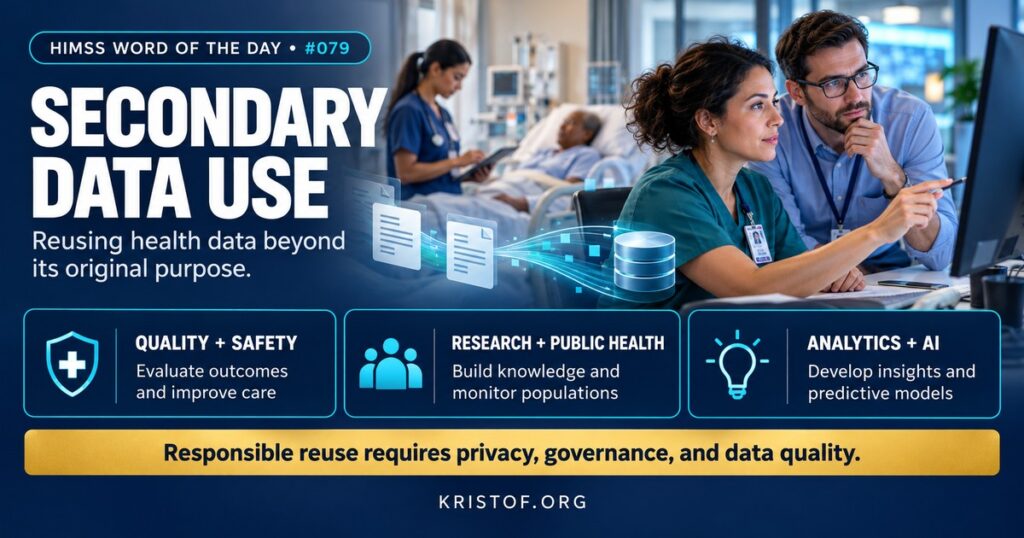
Secondary data use means using data for a purpose other than the one it was originally collected for. In healthcare, data is usually collected first to care for an individual patient, document that care, and bill for it. Any later use, such as research, quality measurement, public health, or building predictive models, is secondary.
The HIMSS Dictionary describes secondary data use as applying data to purposes beyond the main reason it was gathered, which adds value to that data.
A widely cited 2007 white paper from the American Medical Informatics Association, led by Charles Safran, described secondary use as applying personal health information outside of direct health care delivery, including analysis, research, quality and safety measurement, public health, payment, certification or accreditation, marketing, and other business uses, some purely commercial.
| Secondary Use | Purpose | Example |
|---|---|---|
| Quality and Safety Measurement | Evaluate and improve care | Measuring sepsis bundle compliance across units |
| Research | Generate new knowledge | A retrospective study of outcomes after a new protocol |
| Public Health | Monitor and protect population health | Syndromic surveillance and disease reporting |
| Payment and Operations | Support reimbursement and management | Risk adjustment, utilization review, staffing analysis |
| Analytics and AI | Predict, prioritize, and automate | Training a deterioration prediction model |
| Commercial Uses | Support products and markets | Licensing de-identified data to companies |
⚠️ Exam Alert: Primary use is using data for direct patient care of the individual. Secondary use is any other purpose. Secondary use may involve identifiable data with authorization or another HIPAA permission, a limited data set under a data use agreement, or de-identified data. Questions often ask which HIPAA pathway fits a scenario, such as a research study using dates of service.
🌐 Why It Matters: Real-World Healthcare IT Context
Secondary use is how healthcare learns. Every patient encounter adds to a body of data that can show which treatments work, where safety risks hide, how diseases spread, and how resources should be allocated. The concept of a learning health system depends on turning everyday care data into evidence that improves future care.
Secondary use also raises difficult questions. The AMIA white paper noted that complex ethical, political, technical, and social issues surround secondary use, and called for a national framework addressing transparency, privacy, data stewardship, and public trust. Those issues remain current as health data is used for AI development and commercial products.
Several frameworks govern secondary use. HIPAA allows certain uses for health care operations and public health, permits research under authorization, waivers, limited data sets, or de-identified data, and requires attention to minimum necessary. Institutional review boards oversee research involving human subjects. Organizational data governance decides which requests are approved and under what conditions.
Patient perspectives matter too. Many people support using their data to improve care and advance research but feel differently about commercial uses, and trust in the organization holding the data shapes those views. Organizations that explain how data is used, and that involve patients in governance, build the trust that secondary use depends on.
Data quality is a limiting factor. Data collected for care is shaped by workflow, billing incentives, and documentation habits. A diagnosis code may reflect billing needs rather than clinical certainty. Missing data may mean “not done” or “not documented.” Researchers and analysts must understand how data was created before drawing conclusions from it.
Common secondary use challenges:
- Data that means different things in different systems or units
- Documentation shaped by billing more than clinical detail
- Missing or inconsistent data that biases results
- Unclear governance for who may use data and for what
- Privacy concerns about commercial use and re-identification
- Limited transparency to patients about how their data is reused
Characteristics of responsible secondary use:
- Data governance with clear approval processes and stewardship
- Use of the least identifiable data that meets the need
- Documentation of data definitions and known limitations
- Data quality checks before analysis
- Transparency with patients and the public about data uses
- Ethical review for research and high-impact AI applications
🏥 The Nurse’s Perspective: Clinical, Bedside, & Workflow
Nursing documentation is one of the richest sources of data for secondary use, and nurses are increasingly users of that data as well.
At the Bedside
Vital signs, assessments, pain scores, fall risk ratings, skin assessments, and interventions recorded by nurses are reused for quality reporting, early warning models, research on nursing interventions, and staffing analysis. Accurate, timely, structured documentation makes those uses more reliable, and it makes nursing’s contribution to outcomes visible in the data.
The reverse is also true. If nursing work is documented only in free text, or not at all, it may be invisible when organizations analyze what drives outcomes and staffing needs.
Nursing-sensitive indicators are a clear example of secondary use. Measures such as falls with injury, hospital-acquired pressure injuries, and catheter-associated infections are calculated largely from nursing documentation and used to benchmark units and hospitals.
In Clinical Workflow
Nurses use secondary data in quality improvement projects, evidence-based practice initiatives, and research. A nurse examining falls on a unit may request data on fall rates, times of day, and risk scores. Working with data governance and analytics teams, and choosing de-identified or limited data where possible, keeps those projects compliant and efficient.
Interpreting secondary data takes care. A rise in documented pressure injuries might reflect better detection rather than worse care. Nurses’ clinical understanding helps analytics teams interpret results correctly.
In EHR Implementation (Go-Live Perspective)
An EHR transition affects secondary use for years. Data definitions, flowsheet rows, and documentation patterns change, which can create apparent shifts in measures that reflect the new system rather than real changes in care. Mapping legacy and new data carefully helps preserve trends.
At-the-elbow support analysts influence data quality during Go-Live by helping nurses document in the intended structured fields. Those small corrections determine how well the new system’s data can be reused in quality reports and research later.
🎓 CAHIMS / CPHIMS & HIMSS Perspective
CAHIMS Exam Domain Mapping
Secondary use appears in data governance, privacy, and analytics questions:
| CAHIMS Domain | How Secondary Use Appears |
|---|---|
| Healthcare & Technology Environments | Research and public health uses; learning health systems; AI and commercial data use |
| Clinical Informatics | Documentation that supports reuse; quality improvement and evidence-based practice |
| Healthcare Information & Systems Management | Data warehouses, de-identification, data quality checks, research data models |
| Management & Leadership | Data governance, approval processes, ethics, transparency, data partnerships |
Key Terms to Know Alongside Secondary Data Use
- Primary Use — using health data for the direct care of the individual patient
- Learning Health System — a system in which data from care routinely generates knowledge that improves care
- Real-World Data — data about patient health and care collected outside traditional clinical trials
- Data Governance — policies and decision rights that guide how data is managed and used
- Institutional Review Board (IRB) — a committee that reviews research involving human subjects
- De-identified Data — data with identifiers removed so it is no longer protected health information under HIPAA
HIMSS Organizational Position
HIMSS supports responsible secondary use of health data for analytics, research, and AI, emphasizing governance, data quality, and privacy, and its Analytics Maturity Assessment Model reflects how organizations build the foundation for trusted data reuse. Members can find related education and research through the HIMSS Resource Center.
🔗 Explore Further: External References
- Safran et al. (2007), JAMIA — Toward a National Framework for the Secondary Use of Health Data https://pubmed.ncbi.nlm.nih.gov/17077452/
- HHS — HIPAA and Research https://www.hhs.gov/hipaa/for-professionals/special-topics/research/index.html
- HHS — Guidance Regarding Methods for De-identification https://www.hhs.gov/hipaa/for-professionals/special-topics/de-identification/index.html
- OHDSI — OMOP Common Data Model https://ohdsi.github.io/CommonDataModel/
- PCORnet — The National Patient-Centered Clinical Research Network https://pcornet.org/
- HIMSS — Analytics Maturity Assessment Model (AMAM) https://www.himss.org/maturity-models/amam
Term source: HIMSS Dictionary of Health Information and Technology Terms, Acronyms, and Organizations, 6th Edition (2025). All definitions in this series are paraphrased for editorial purposes. Readers are encouraged to consult the primary source for exact language.
Eric Andrew Kristof, RN, CAHIMS is a Healthcare IT professional and HIMSS Arkansas Chapter member based in Hot Springs Village, AR, with hands-on Epic Go-Live experience and a diverse healthcare and IT background. He writes at kristof.org at the intersection of clinical care and healthcare technology.
Leave a Reply