By Eric Andrew Kristof, RN, CAHIMS | Healthcare IT Professional | HIMSS Arkansas Chapter Member
About This Series: The HIMSS Word of the Day is a running blog series drawing from the HIMSS Dictionary of Health Information and Technology Terms, Acronyms, and Organizations, 6th Edition (2025) — the authoritative reference for healthcare IT professionals and the primary study resource for CAHIMS and CPHIMS certification. Each post paraphrases the term in plain language, grounds it in real-world healthcare IT context, and adds a bedside nursing perspective you won’t find in a textbook.
📖 The Term: Diagnosis Related Group (DRG)
Source: HIMSS Dictionary of Health Information and Technology Terms, Acronyms, and Organizations, 6th Edition (2025)
🔍 Plain-Language Definition
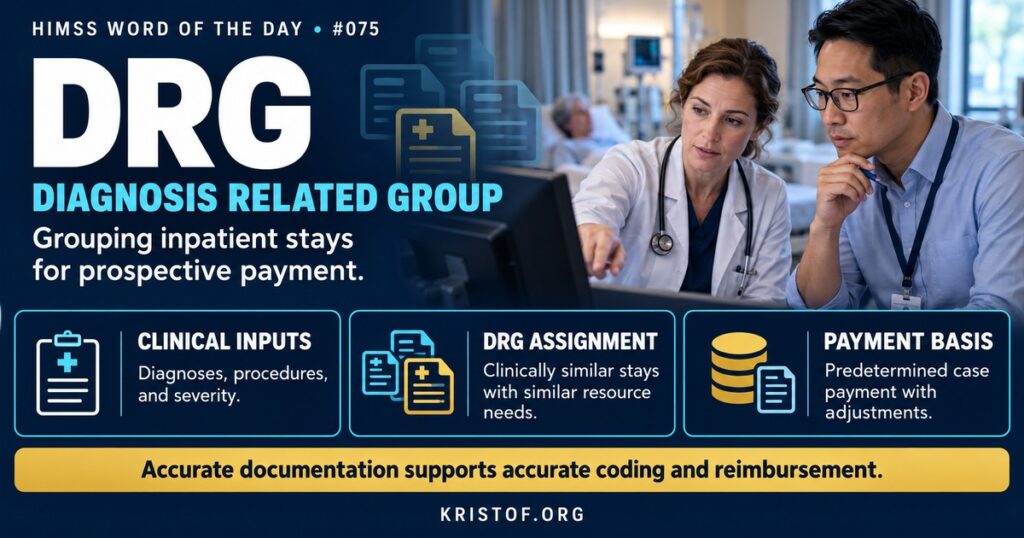
A diagnosis related group (DRG) is a category used to classify hospital inpatient stays that are clinically similar and use similar resources. Each stay is assigned to one DRG, and under a prospective payment system, the hospital receives a predetermined amount for that DRG rather than being paid for each individual service.
The HIMSS Dictionary describes the DRG as a classification system that sorts patients into groups using factors such as their diagnosis, the treatment they receive, their age, and other pertinent characteristics. It explains that with prospective payment, hospitals are paid a set amount for each case in a DRG, whatever that individual patient’s care actually costs.
Medicare uses Medicare Severity DRGs (MS-DRGs), which account for the severity of illness through secondary diagnoses that represent complications or comorbidities.
| DRG Input | What It Means | Example |
|---|---|---|
| Principal Diagnosis | The condition established after study to be chiefly responsible for the admission | Sepsis due to urinary tract infection |
| Secondary Diagnoses (CC and MCC) | Additional conditions that may raise severity as a complication or comorbidity (CC) or a major one (MCC) | Acute kidney injury; acute respiratory failure |
| Procedures | Significant procedures performed, which may shift the case to a surgical DRG | Mechanical ventilation, major joint replacement |
| Discharge Status | Where the patient went after discharge | Home, skilled nursing facility, expired |
| Other Factors | Age, sex, and other variables used by some groupers | Newborn birth weight |
Each MS-DRG has a relative weight reflecting average resources compared with other DRGs. Payment is based on that weight multiplied by a hospital’s base rate, with adjustments such as wage index and outlier payments.
⚠️ Exam Alert: A DRG groups inpatient stays for payment. ICD-10-CM and ICD-10-PCS codes are the inputs that a grouper uses to assign the DRG. The case mix index is the average relative weight of a hospital’s cases. Ambulatory Payment Classifications (APCs) serve a similar role for hospital outpatient services. DRG payment is a form of prospective payment, not fee-for-service.
🌐 Why It Matters: Real-World Healthcare IT Context
DRGs changed hospital economics. Medicare’s inpatient prospective payment system, introduced in the 1980s, replaced cost-based reimbursement with fixed payments per case. That shift gave hospitals a strong incentive to manage length of stay and resource use, because a hospital that spends less than the DRG payment keeps the difference, while one that spends more absorbs the loss, except for unusually costly outlier cases.
CMS updates the MS-DRG classifications and relative weights annually through rulemaking, and many other payers, including many Medicaid programs and commercial insurers, use DRG-based methods or variations of them.
Because DRG assignment depends on coded diagnoses and procedures, documentation is central. A patient treated for acute respiratory failure, but documented only as “shortness of breath,” may be coded and grouped differently, which affects payment and the hospital’s recorded severity of illness. Clinical documentation integrity (CDI) programs review records during the stay and ask providers to clarify documentation when clinical evidence suggests a more specific diagnosis.
DRG data also feeds quality and performance measurement. Risk adjustment for mortality, readmissions, and length of stay depends on the same coded diagnoses, so incomplete documentation can make a hospital’s outcomes look worse than they are.
DRGs also shape hospital operations. Because payment is fixed per case, hospitals track length of stay against the expected length for each DRG, coordinate discharge planning early, and look for avoidable delays, such as waiting for tests or post-acute placement. Case managers often use DRG-based expected length of stay as one guide for daily progression conversations, while keeping clinical readiness as the deciding factor.
Accuracy works in both directions. Documentation and coding must reflect the patient’s true condition; overstating severity to raise payment is upcoding and can lead to audits, repayment, and legal liability.
Common DRG-related challenges:
- Vague diagnoses that do not capture severity
- Conditions present during the stay but never documented by a provider
- Query fatigue among providers from frequent CDI questions
- Coding delays that hold up billing
- Inconsistent documentation between nursing, provider, and consult notes
- Audit risk from overly aggressive coding
Characteristics of strong DRG and documentation practice:
- Concurrent CDI review during the hospital stay
- Compliant, clinically supported provider queries
- Documentation templates that prompt for specificity
- Collaboration between coding, CDI, quality, and clinical teams
- Monitoring of case mix index and DRG shifts over time
- Regular education on documentation requirements
🏥 The Nurse’s Perspective: Clinical, Bedside, & Workflow
Nurses rarely assign DRGs, but their documentation and observations contribute to the clinical picture behind them.
At the Bedside
Nursing assessments often capture early evidence of conditions that matter for severity: a new pressure injury, delirium, malnutrition risk, worsening respiratory status, or signs of infection. When those observations are documented clearly and communicated to providers, the provider can evaluate and document the condition, which supports both appropriate treatment and accurate coding.
Present-on-admission status matters too. Some conditions, such as certain pressure injuries and infections, are tracked as hospital-acquired if they were not present at admission. Thorough admission skin and risk assessments help establish what was present when the patient arrived.
In Clinical Workflow
Coding depends on provider documentation, so nursing documentation alone does not change a DRG. However, coders and CDI specialists review the entire record for clinical evidence, and discrepancies between nursing and provider notes can prompt queries. Consistent, specific documentation across the team reduces confusion.
Many CDI specialists are registered nurses. Their clinical knowledge allows them to recognize when a patient’s treatment and findings suggest a diagnosis that has not been clearly documented, and to ask compliant, nonleading questions.
In EHR Implementation (Go-Live Perspective)
During an Epic Go-Live, revenue cycle and documentation workflows change together. CDI worklists, query tools, problem lists, and coding interfaces are configured and tested, and early monitoring often compares case mix index and DRG distribution with pre-Go-Live baselines to catch documentation or coding gaps.
At-the-elbow support analysts may help providers find where to respond to queries and update problem lists, and help nurses locate admission assessments that support present-on-admission reporting.
🎓 CAHIMS / CPHIMS & HIMSS Perspective
CAHIMS Exam Domain Mapping
DRGs appear in reimbursement, coding, and data questions:
| CAHIMS Domain | How DRGs Appear |
|---|---|
| Healthcare & Technology Environments | Prospective payment; Medicare IPPS; payer methods; value-based adjustments |
| Clinical Informatics | Documentation specificity; problem lists; present-on-admission assessment |
| Healthcare Information & Systems Management | ICD coding inputs, grouper software, CDI tools, billing interfaces |
| Management & Leadership | Case mix index, revenue cycle performance, compliance and audit risk |
Key Terms to Know Alongside DRG
- MS-DRG — Medicare Severity Diagnosis Related Group, the system Medicare uses for inpatient payment
- Inpatient Prospective Payment System (IPPS) — Medicare’s method of paying hospitals predetermined amounts per inpatient stay
- Relative Weight — a value reflecting the average resources needed for cases in a DRG
- Case Mix Index (CMI) — the average relative weight of all cases treated by a hospital in a period
- CC and MCC — complications or comorbidities, and major ones, that increase DRG severity
- Clinical Documentation Integrity (CDI) — programs that improve the accuracy and completeness of clinical documentation
HIMSS Organizational Position
HIMSS addresses DRGs and payment methods as part of its work on revenue cycle, value-based care, and the data that connects clinical documentation to reimbursement and quality. Members can find related education and research through the HIMSS Resource Center.
🔗 Explore Further: External References
- CMS — MS-DRG Classifications and Software https://www.cms.gov/medicare/payment/prospective-payment-systems/acute-inpatient-pps/ms-drg-classifications-and-software
- CMS — Acute Inpatient PPS https://www.cms.gov/medicare/payment/prospective-payment-systems/acute-inpatient-pps
- CMS — Prospective Payment Systems: General Information https://www.cms.gov/medicare/payment/prospective-payment-systems
- CMS — ICD-10 https://www.cms.gov/medicare/coding-billing/icd-10-codes
- AHIMA — American Health Information Management Association https://www.ahima.org/
- MedPAC — Medicare Payment Advisory Commission https://www.medpac.gov/
Term source: HIMSS Dictionary of Health Information and Technology Terms, Acronyms, and Organizations, 6th Edition (2025). All definitions in this series are paraphrased for editorial purposes. Readers are encouraged to consult the primary source for exact language.
Eric Andrew Kristof, RN, CAHIMS is a Healthcare IT professional and HIMSS Arkansas Chapter member based in Hot Springs Village, AR, with hands-on Epic Go-Live experience and a diverse healthcare and IT background. He writes at kristof.org at the intersection of clinical care and healthcare technology.
Leave a Reply