By Eric Andrew Kristof, RN, CAHIMS | Healthcare IT Professional | HIMSS Arkansas Chapter Member
About This Series: The HIMSS Word of the Day is a running blog series drawing from the HIMSS Dictionary of Health Information and Technology Terms, Acronyms, and Organizations, 6th Edition (2025) — the authoritative reference for healthcare IT professionals and the primary study resource for CAHIMS and CPHIMS certification. Each post paraphrases the term in plain language, grounds it in real-world healthcare IT context, and adds a bedside nursing perspective you won’t find in a textbook.
📖 The Term: Telehealth
Source: HIMSS Dictionary of Health Information and Technology Terms, Acronyms, and Organizations, 6th Edition (2025)
🔍 Plain-Language Definition
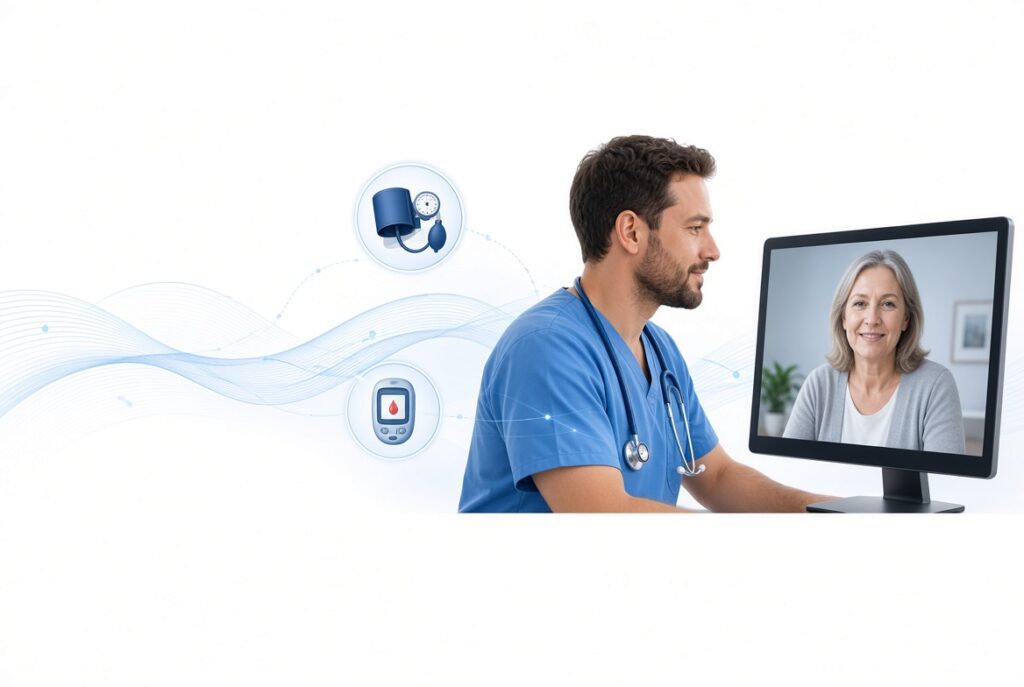
Telehealth is the broad category of technologies and practices that deliver medical care, health services, patient education, professional education, and administrative functions across a distance. It is the umbrella term — encompassing but not limited to telemedicine, which refers specifically to clinical diagnosis, treatment, and monitoring delivered via technology.
Telehealth reaches beyond direct clinical care into behavioral health and counseling, dental care, rehabilitation therapies, home-based services, remote tracking of chronic conditions, and health education for both consumers and professionals. Whenever health-related interaction is mediated by technology across a distance, it belongs somewhere on the telehealth spectrum.
Telehealth modalities fall into four operational categories:
| Modality | Description |
|---|---|
| Synchronous (Live) Telehealth | Real-time, two-way audio and video interaction between patient and provider — the model most people picture when they hear “telehealth visit” |
| Asynchronous (Store-and-Forward) | Clinical data (images, videos, patient histories) captured at one time and reviewed by a provider later — common in dermatology, radiology, and ophthalmology |
| Remote Patient Monitoring (RPM) | Continuous or periodic collection of patient physiological data (BP, glucose, weight, cardiac rhythms) from home-based devices, transmitted to the care team |
| Mobile Health (mHealth) | Health services and information delivered via mobile devices and apps — patient education, medication reminders, symptom tracking, and consumer wellness tools |
⚠️ Exam Alert: Telehealth is the broad umbrella; telemedicine is a subset focused specifically on clinical diagnosis and treatment. CAHIMS answer choices will present these as interchangeable — they aren’t. Also distinguish synchronous from asynchronous modalities: a live video visit and a store-and-forward dermatology consult are both telehealth, but the workflow, reimbursement, and technology requirements differ substantially.
🌐 Why It Matters: Real-World Healthcare IT Context
Telehealth spent two decades as a niche capability, then became infrastructure almost overnight.
Before 2020, telehealth adoption was concentrated in rural health, mental health, and specific specialty consult scenarios. The COVID-19 public health emergency triggered CMS to expand telehealth reimbursement, waive originating-site restrictions, and allow phone-only visits for many services. Utilization spiked from roughly 1% of ambulatory visits pre-pandemic to over 30% at peak in 2020, then settled to a durable new baseline in the double digits — permanently higher than pre-pandemic levels.
Post-pandemic, telehealth is a permanent feature of the healthcare delivery system, but the regulatory and reimbursement framework is still catching up. CMS extended many pandemic-era telehealth flexibilities through legislation and rulemaking, but state-by-state licensure, cross-state practice, controlled-substance prescribing (DEA), and payer parity remain contested policy territory.
Health IT infrastructure required for telehealth:
- HIPAA-compliant video conferencing integrated with the EHR
- Scheduling workflows that distinguish in-person from virtual visits
- Patient portal and mobile app pathways for check-in, documentation, and payment
- Remote monitoring device integrations (Bluetooth, cellular, Wi-Fi) with structured data feeds
- Broadband access — the persistent equity issue that limits telehealth reach into rural and low-income areas
- Interoperability between telehealth platforms and the EHR chart
Persistent challenges:
- Digital divide — patients without broadband, devices, or digital literacy are systematically excluded
- Documentation and coding for reimbursement, which varies by payer and state
- Cross-state licensure and provider credentialing
- Detection of clinical conditions that require physical examination
- Fraud and abuse enforcement in a distributed delivery model
Telehealth is not a temporary workaround; it is a permanent modality that healthcare IT teams now support as core infrastructure alongside inpatient and ambulatory systems.
🏥 The Nurse’s Perspective: Clinical, Bedside, & Workflow
Telehealth has fundamentally expanded what nursing practice looks like, and what “the bedside” even means.
At the Bedside
The bedside is no longer only the physical patient room. For a telehealth nurse triaging incoming video visits, the bedside is a workstation with two monitors, a headset, and a queue of patient calls. For a remote patient monitoring nurse, the bedside is a dashboard of glucose readings, blood pressures, and weight trends across dozens of patients simultaneously. For a school nurse using a peripheral otoscope camera to consult a pediatrician, the bedside straddles both locations.
Telehealth nursing requires new competencies: technology troubleshooting under time pressure, clinical assessment via a camera view instead of hands-on examination, structured communication that compensates for the loss of nonverbal cues, and workflow orchestration across multiple systems on one screen.
In Clinical Workflow
Nursing telehealth workflows span triage and intake, pre-visit vital sign collection via patient-owned devices, on-camera assessment support, technology assistance for patients unfamiliar with the platform, and documentation of virtual encounters in the EHR. Remote patient monitoring workflows include alarm review, patient outreach when values drift out of range, escalation to the ordering provider, and coordination with home health when in-person follow-up is needed.
Nurses are often the workflow anchor that makes telehealth actually work. Providers focus on the clinical encounter; nurses handle the operational reality of getting the patient onto the call, capturing the data, documenting the visit, and closing the loop afterward.
In EHR Implementation (Go-Live Perspective)
During Epic Go-Lives that include telehealth build (Epic MyChart Video, Care Companion, and Healthy Planet), configuration decisions determine the entire virtual-care patient experience. Video platform integration, in-app check-in workflows, provider camera and audio testing, patient technology-check reminders, and post-visit summary delivery all get built into the Go-Live scope.
End-user support analysts during telehealth Go-Live face two distinct user populations: providers learning a new modality, and patients navigating unfamiliar technology from home. The support scripts, warm-transfer processes to help patients through connection problems, and structured feedback loops from the first two weeks of virtual visits are among the most valuable deliverables of a telehealth Go-Live.
Understanding that telehealth is a workflow redesign, not just a video platform, is one of the defining insights of a telehealth-competent informatics professional.
🎓 CAHIMS / CPHIMS & HIMSS Perspective
CAHIMS Exam Domain Mapping
Telehealth appears across CAHIMS exam domains, with growing weight as the modality matures:
| CAHIMS Domain | How Telehealth Appears |
|---|---|
| Healthcare & Technology Environments | CMS telehealth reimbursement policies; state licensure and cross-state practice; DEA controlled-substance prescribing rules; HRSA telehealth resource centers |
| Clinical Informatics | Synchronous vs. asynchronous vs. RPM workflows; clinical documentation for virtual visits; integration of remote-monitoring data into the EHR |
| Healthcare Information & Systems Management | Video platform selection and integration; RPM device management; broadband and connectivity considerations; HIPAA-compliant telehealth architecture |
| Management & Leadership | Change management for provider adoption; addressing digital-divide equity issues; telehealth program development and staffing models |
Key Terms to Know Alongside Telehealth
- Telemedicine — a subset of telehealth focused specifically on clinical diagnosis, treatment, and monitoring
- Remote Patient Monitoring (RPM) — continuous or periodic collection of patient physiological data from home devices, transmitted to the care team
- Store-and-Forward (Asynchronous) — clinical data captured at one time and reviewed later, without real-time interaction
- mHealth (Mobile Health) — health services and information delivered via mobile devices and apps
- Originating Site — the physical location where the patient is present during a telehealth encounter; historically restricted for CMS reimbursement, largely waived post-pandemic
- Distant Site — the physical location where the provider is present during a telehealth encounter
HIMSS Organizational Position
HIMSS supports telehealth maturity through its Virtual Care Community, public policy advocacy on telehealth flexibilities and reimbursement, and Global Health Conference programming. HIMSS members can find virtual care research and implementation guidance through the HIMSS Resource Center.
🔗 Explore Further: External References
- Telehealth.HHS.gov — Federal Telehealth Resources https://telehealth.hhs.gov
- HRSA — Telehealth Resource Centers https://www.hrsa.gov/rural-health/telehealth
- CMS — Telehealth Services https://www.cms.gov/medicare/coverage/telehealth
- American Telemedicine Association (ATA) https://www.americantelemed.org
- ONC — Telehealth and Health IT https://healthit.gov/public-health/telemedicine-and-telehealth/
- HIMSS — Virtual Care Community https://www.himss.org/networking/communities/virtual-care/
Term source: HIMSS Dictionary of Health Information and Technology Terms, Acronyms, and Organizations, 6th Edition (2025). All definitions in this series are paraphrased for editorial purposes. Readers are encouraged to consult the primary source for exact language.
Eric Andrew Kristof, RN, CAHIMS is a Healthcare IT professional and HIMSS Arkansas Chapter member based in Hot Springs Village, AR, with hands-on Epic Go-Live experience and a diverse healthcare and IT background. He writes at kristof.org at the intersection of clinical care and healthcare technology.
Leave a Reply