By Eric Andrew Kristof, RN, CAHIMS | Healthcare IT Professional | HIMSS Arkansas Chapter Member
About This Series: The HIMSS Word of the Day is a running blog series drawing from the HIMSS Dictionary of Health Information and Technology Terms, Acronyms, and Organizations, 6th Edition (2025) — the authoritative reference for healthcare IT professionals and the primary study resource for CAHIMS and CPHIMS certification. Each post paraphrases the term in plain language, grounds it in real-world healthcare IT context, and adds a bedside nursing perspective you won’t find in a textbook.
📖 The Term: Plan of Care (Care Plan)
Source: HIMSS Dictionary of Health Information and Technology Terms, Acronyms, and Organizations, 6th Edition (2025)
🔍 Plain-Language Definition
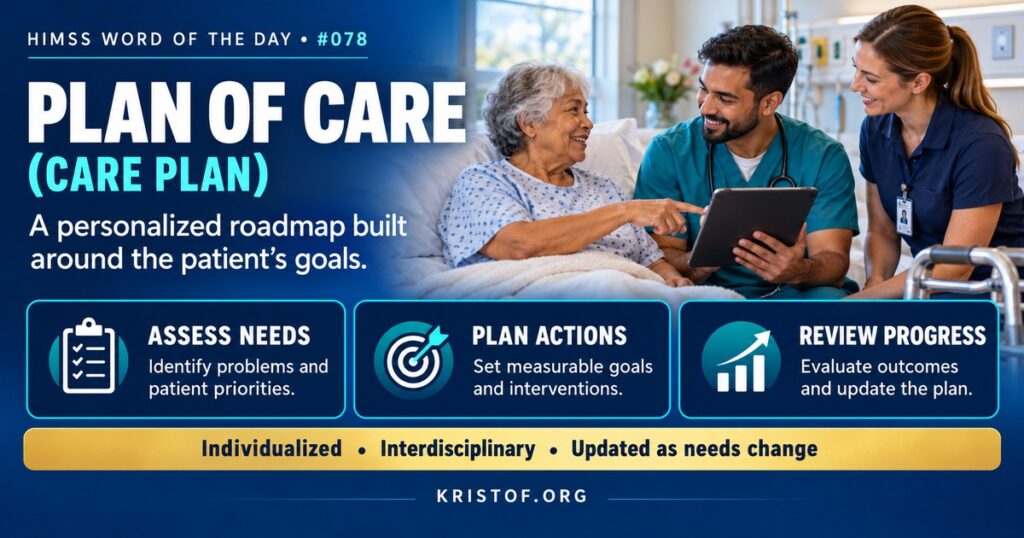
A plan of care, often called a care plan, is the documented roadmap for a patient’s care. It starts from assessment, names the patient’s problems or needs, sets goals, lists the interventions the team will provide, and records progress toward those goals.
The HIMSS Dictionary describes the plan of care as a plan built from assessment data that identifies the person’s care needs, lays out the approach for meeting them, records treatment goals and objectives, defines when particular interventions should end, and documents progress. It notes that organizations may shape the format with patient-specific policies, protocols, clinical practice guidelines, clinical pathways, or care maps, and that a plan may cover care, treatment, habilitation, and rehabilitation. An interdisciplinary plan of care brings together contributions from nursing, medicine, therapy, pharmacy, nutrition, social work, and other disciplines.
| Care Plan Component | What It Captures | Example |
|---|---|---|
| Assessment Data | Findings that reveal needs | Limited mobility after hip surgery, Braden score indicating risk |
| Problem or Diagnosis | The need being addressed | Risk for pressure injury; impaired physical mobility |
| Goal or Outcome | A measurable target with a timeframe | Skin intact through discharge; ambulates 50 feet with walker by day 3 |
| Interventions | Actions the team will take | Reposition every 2 hours; physical therapy twice daily |
| Evaluation | Whether goals are met, and what changes | Goal met; problem resolved; or plan revised |
| Discharge Criteria | When the plan or intervention ends | Independent with transfers; caregiver demonstrates wound care |
⚠️ Exam Alert: A plan of care is the patient-specific plan. A clinical practice guideline is evidence-based guidance for a population. A clinical pathway is a standardized, time-based sequence of care for a condition. An order set groups orders for a situation. Care plans often draw on guidelines and pathways but must be individualized to the patient.
🌐 Why It Matters: Real-World Healthcare IT Context
Care plans are a regulatory requirement and a coordination tool. Medicare’s Conditions of Participation for hospitals require the nursing staff to develop and keep current a nursing care plan for each patient that reflects the patient’s goals and the nursing care needed to meet them, and they allow that plan to be part of an interdisciplinary care plan. Accreditation surveys often look for evidence that plans are individualized and updated as patients change.
Electronic care plans also connect care across settings. Care plan information can be exchanged through C-CDA care plan documents and the HL7 FHIR CarePlan resource, which helps receiving teams in skilled nursing, home health, and primary care continue the work.
Standardized terminologies make care plans more useful as data. Nursing terminologies, such as NANDA-I nursing diagnoses and the Omaha System, and reference terminologies like SNOMED CT and LOINC allow care plan problems, interventions, and outcomes to be coded consistently. That supports research on nursing outcomes, quality measurement, and comparison across organizations.
Care plans also matter beyond the hospital. Home health agencies, hospices, and skilled nursing facilities operate under their own federal requirements for individualized plans of care, and those plans often depend on information sent from the hospital at discharge. When hospital care plans clearly state active problems, goals, and the patient’s progress, the receiving team can build its own plan faster and with fewer gaps.
The challenge is meaningfulness. Many nurses have experienced electronic care plans that require repetitive updates every shift, generate long lists of generic problems, and are rarely read by anyone. When care plans become a compliance exercise, they add burden without improving care.
Common care plan problems:
- Generic problems added from templates without individualization
- Daily updates required for problems that have not changed
- Care plans disconnected from orders, flowsheets, and handoff tools
- Plans written in nursing language that other disciplines do not use
- Goals that are not measurable or time-bound
- Care plans that do not follow the patient to the next setting
Characteristics of useful electronic care plans:
- Problems driven by assessment findings and patient priorities
- Measurable goals with clear timeframes
- Interventions linked to flowsheets and orders so work is documented once
- Shared interdisciplinary views of goals and progress
- Updates required only when something changes
- Exchange of active problems and goals at transitions of care
🏥 The Nurse’s Perspective: Clinical, Bedside, & Workflow
Nurses lead most inpatient care planning, and the design of electronic care plans directly affects their time and the plan’s value.
At the Bedside
A good care plan reflects what matters to the patient. Asking the patient about goals, such as walking to the bathroom independently, going home in time for a family event, or managing pain well enough to sleep, helps nurses set goals that the patient cares about and can participate in.
Care plans should change as the patient changes. When a new risk appears, such as a fall or a new pressure injury, or when a goal is met, updating the plan keeps the whole team focused on current priorities rather than yesterday’s problems.
In Clinical Workflow
Care plans are most useful when they connect to handoff. If the active problems and goals appear in the shift report, oncoming nurses see at a glance what the patient is working toward and what interventions are in progress. Interdisciplinary rounds that review the shared plan help nursing, therapy, case management, and providers coordinate discharge.
Documentation burden is a real concern. When interventions documented in flowsheets automatically count toward the care plan, nurses avoid charting the same work twice. When they do not, care plans tend to drift away from actual care.
In EHR Implementation (Go-Live Perspective)
During an Epic Go-Live, care planning tools are often redesigned, and organizations decide how many problems are suggested automatically, how often updates are required, and how care plans connect to education and flowsheets. These decisions have a large effect on nurses’ daily workload.
At-the-elbow support analysts frequently help nurses add or resolve problems, document progress, and find the interdisciplinary view. Feedback collected during Go-Live, such as which required updates feel redundant, is valuable input for optimization.
🎓 CAHIMS / CPHIMS & HIMSS Perspective
CAHIMS Exam Domain Mapping
Care plans appear in documentation, standards, and regulatory questions:
| CAHIMS Domain | How Plans of Care Appear |
|---|---|
| Healthcare & Technology Environments | CMS Conditions of Participation; accreditation expectations; care coordination policy |
| Clinical Informatics | Nursing process; interdisciplinary planning; documentation burden; handoff integration |
| Healthcare Information & Systems Management | Standardized nursing terminologies, C-CDA care plans, FHIR CarePlan, data reuse |
| Management & Leadership | Documentation policy, survey readiness, optimization priorities |
Key Terms to Know Alongside Plan of Care
- Interdisciplinary Plan of Care — a care plan shared and updated by multiple disciplines
- Nursing Process — assessment, diagnosis, planning, implementation, and evaluation
- Clinical Pathway — a standardized, time-based plan for managing a specific condition
- Nursing Diagnosis — a clinical judgment about a patient’s response to health conditions, such as NANDA-I diagnoses
- Outcome — the measurable result a care plan aims to achieve
- FHIR CarePlan — the HL7 FHIR resource for representing care plans electronically
HIMSS Organizational Position
HIMSS highlights care planning as a nursing informatics priority, including standardized terminologies and reducing documentation burden. Its Nursing Informatics Community and TIGER initiative address how technology can support nursing practice. Members can find related education and research through the HIMSS Resource Center.
🔗 Explore Further: External References
- eCFR — 42 CFR 482.23, Condition of Participation: Nursing Services https://www.ecfr.gov/current/title-42/chapter-IV/subchapter-G/part-482/subpart-C/section-482.23
- HL7 — FHIR CarePlan Resource https://hl7.org/fhir/careplan.html
- The Omaha System https://www.omahasystem.org/
- NANDA International https://nanda.org/
- AHRQ — Preventing Pressure Ulcers in Hospitals Toolkit https://www.ahrq.gov/patient-safety/settings/hospital/resource/pressureulcer/tool/index.html
- HIMSS — Nursing Informatics Community https://www.himss.org/networking/communities/nursing-informatics/
Term source: HIMSS Dictionary of Health Information and Technology Terms, Acronyms, and Organizations, 6th Edition (2025). All definitions in this series are paraphrased for editorial purposes. Readers are encouraged to consult the primary source for exact language.
Eric Andrew Kristof, RN, CAHIMS is a Healthcare IT professional and HIMSS Arkansas Chapter member based in Hot Springs Village, AR, with hands-on Epic Go-Live experience and a diverse healthcare and IT background. He writes at kristof.org at the intersection of clinical care and healthcare technology.
Leave a Reply