By Eric Andrew Kristof, RN, CAHIMS | Healthcare IT Professional | HIMSS Arkansas Chapter Member
About This Series: The HIMSS Word of the Day is a running blog series drawing from the HIMSS Dictionary of Health Information and Technology Terms, Acronyms, and Organizations, 6th Edition (2025) — the authoritative reference for healthcare IT professionals and the primary study resource for CAHIMS and CPHIMS certification. Each post paraphrases the term in plain language, grounds it in real-world healthcare IT context, and adds a bedside nursing perspective you won’t find in a textbook.
📖 The Term: LTSS (Long-Term Services and Support)
Source: HIMSS Dictionary of Health Information and Technology Terms, Acronyms, and Organizations, 6th Edition (2025)
🔍 Plain-Language Definition
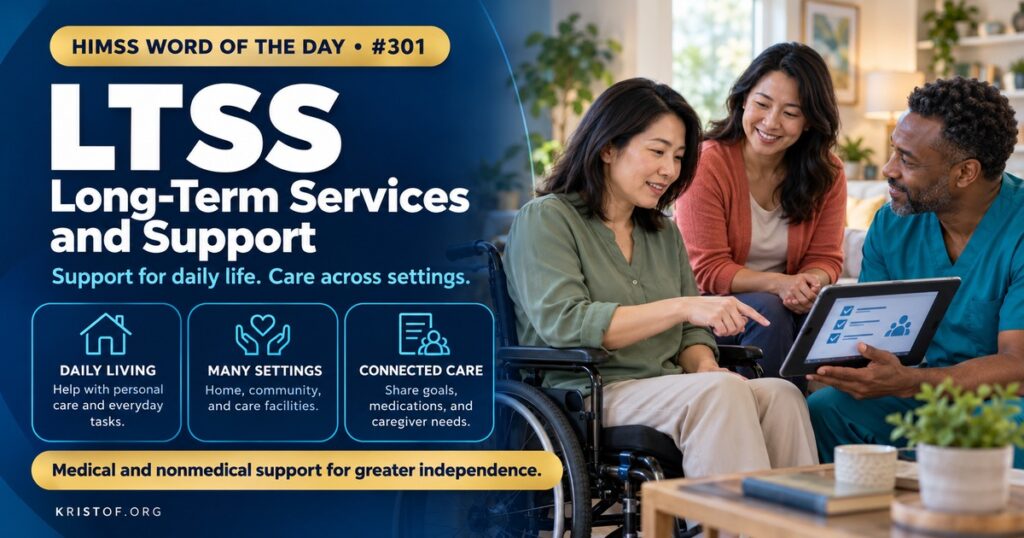
Long-term services and supports (LTSS), listed in the HIMSS Dictionary as long-term services and support, are a wide range of medical and nonmedical services provided over a long period to people of any age who have limited mobility, impaired thinking, disabilities of body or mind, complex medical needs, or chronic disease. Caregivers help with activities of daily living, such as eating, bathing, and dressing, and with other tasks, such as housekeeping or managing medications, so that people can live as independently as possible.
LTSS are delivered in many places: a person’s own home, community settings such as adult day programs, assisted living, and nursing facilities. Providers include family caregivers, home health and personal care aides, nurses, therapists, social workers, and facility staff. Payment comes from a mix of sources, including public programs, private insurance, and personal funds. The federal Administration for Community Living describes long-term care as a range of services and supports for personal care needs and notes that most people turning 65 can expect to use some form of long-term care during their lives.
| LTSS Setting | Typical Services | Information Challenge |
|---|---|---|
| Home and community | Personal care, home health, day programs | Agencies use different systems from hospitals |
| Assisted living | Housing with help for daily needs | Variable clinical documentation |
| Nursing facility | 24-hour nursing and rehabilitation | Transfers with incomplete records |
| Family caregiver | Unpaid help and coordination | No access to formal records |
⚠️ Exam Alert: LTSS include nonmedical help with daily living as well as medical care. Long-term care is a common synonym, though LTSS also stresses home and community-based services. LTSS providers often use different record systems from hospitals, which contributes to interoperability gaps. Activities of daily living (ADLs) measure basic self-care ability.
🌐 Why It Matters: Real-World Healthcare IT Context
People who use LTSS are often older, have several chronic conditions, and move among home, hospital, and facility. Their care depends on information that crosses organizational boundaries, and these are the boundaries where systems often fail to connect. LTSS providers frequently use different software from hospitals, may not have the same exchange capabilities, and work with a mix of clinical and nonclinical staff.
A 2025 qualitative study in the Journal of the American Medical Directors Association illustrates the problem in one clinical area, post-sepsis care. Researchers interviewed 91 participants in 61 interviews across five US health systems and their affiliated home health agencies. Health information technology helped with identification of sepsis, documentation, communication, information sharing, and care coordination during the move from hospital to home. But the barriers were missing, delayed, or inaccessible information across disparate EHR systems, and participants proposed interoperable systems and tools to support timely follow-up. For a home health nurse, a missing discharge summary can mean arriving at a patient’s door without knowing which medications changed.
Technology’s role at home is expanding. A 2026 scoping review in Frontiers in Medicine analyzed 15 studies from 10 countries on collaboration between nurses and technology in home-based rehabilitation for older adults under long-term care insurance systems. The authors described a three-stage framework, from tools that replace tasks to tools that enhance nurse capacity and, eventually, integration across the service ecosystem. Ten studies fell in the capability-enhancement stage, five in tool replacement, and the integration stage needed more exploration. Measurable effectiveness was reported in three areas: physiological monitoring, risk warning, and rehabilitation training, with evidence concentrated in monitoring and risk warning. It is a scoping review and does not pool outcomes, but it suggests that technology works best when nurses remain central to interpretation and response.
Integrating health and social care is a policy goal in many countries. A 2026 qualitative study in the Journal of Medical Internet Research examined the Key Information Summary used in Lothian, Scotland for 13 years, which shares key patient information among general practitioners, out-of-hours services, ambulance services, hospitals, social workers, and caregivers. Drawing on 54 interviews, 20 hours of observation, and 59 documents, the authors identified three waves of effort to interlink disparate information systems, with persistent challenges in coding practices, data-sharing mechanisms, and stakeholder needs. The Scottish context differs from the US, but the lesson is shared: connecting health and social care takes many years and sustained governance.
For US organizations, practical steps focus on the boundaries. Hospitals can send discharge information to post-acute and home health partners in usable electronic form, and confirm that it arrives. LTSS providers can adopt standards-based exchange where possible and agree on a minimum dataset for transfers: medications, allergies, code status, functional status, cognitive status, and contact information for the family caregiver. Care plans can include the person’s goals and the caregiver’s role. Staff can be trained on privacy rules that apply to sharing information with family. Quality programs track avoidable returns to the hospital and measure how often transfers include a complete summary.
Common LTSS information problems:
- Transfers without a usable summary
- Different systems across hospitals, agencies, and facilities
- Documentation of function and cognition that varies in format
- Family caregivers excluded from information flow
- Limited resources for technology in smaller providers
- Unclear responsibility for follow-up after discharge
What supports LTSS information sharing:
- Agreed minimum datasets for transfers
- Standards-based exchange with confirmation of receipt
- Care plans that include goals and caregiver roles
- Nurse-led interpretation and response to monitoring data
- Training and support for smaller providers
- Governance across health and social care partners
🏥 The Nurse’s Perspective: Clinical, Bedside, & Workflow
Nurses are central in LTSS, from home visits to facility care, and they are often the people bridging information gaps.
At the Bedside
In nursing facilities and at home, nurses assess function, cognition, skin, nutrition, and medication use, and teach patients and caregivers. When a patient arrives from the hospital, the nurse compares what came with the patient to what is actually needed and calls to fill gaps.
In Clinical Workflow
Home health nurses arrive with the information available to them, often a referral and partial records. Nurse managers in facilities and agencies set expectations for what must accompany every transfer and track delays. Care managers coordinate with family caregivers, social workers, and community services.
Nurse informaticists in these settings select and configure documentation systems, define transfer data, and work with hospital partners on exchange. They also support remote monitoring programs and clarify who responds to alerts.
In EHR Implementation (Go-Live Perspective)
An Epic Go-Live in a health system that refers to home health and post-acute partners changes what is sent and how. At-the-elbow support analysts hear from nurses at partner organizations when the new discharge documents lack information they need, and those examples help the build team improve what is sent.
🎓 CAHIMS / CPHIMS & HIMSS Perspective
CAHIMS Exam Domain Mapping
LTSS appear in care continuum, interoperability, and policy questions:
| CAHIMS Domain | How LTSS Appear |
|---|---|
| Healthcare & Technology Environments | Care continuum, payers, post-acute providers, policy |
| Clinical Informatics | Transitions, functional assessment, care plans |
| Healthcare Information & Systems Management | Exchange with post-acute systems, remote monitoring, standards |
| Management & Leadership | Partnerships, governance, quality measurement |
Key Terms to Know Alongside LTSS
- Home and Community-Based Services (HCBS) — services that help people live at home or in community settings
- Activities of Daily Living (ADLs) — basic self-care tasks such as eating, bathing, and dressing
- Post-Acute Care — rehabilitation and nursing care after a hospital stay
- Home Health — skilled nursing and therapy provided at home
- Care Transition — movement of a patient between settings
- Caregiver — person, paid or unpaid, who helps with daily needs
HIMSS Organizational Position
HIMSS supports interoperability and coordinated care across the care continuum through its public policy work, research, and education. Members can find related resources through the HIMSS Nursing Informatics Community page.
🔗 Explore Further: External References
- You et al. (2025), Journal of the American Medical Directors Association — Qualitative Study of the Context of Health Information Technology in Sepsis Care Transitions: Facilitators, Barriers, and Strategies for Improvement https://pubmed.ncbi.nlm.nih.gov/40286812/
- Sun et al. (2026), Frontiers in Medicine — A Scoping Review of “Nursing-Technology Collaboration” in Home-Based Rehabilitation for the Elderly Under the Long-Term Care Insurance System https://pubmed.ncbi.nlm.nih.gov/42856876/
- Sai et al. (2026), Journal of Medical Internet Research — Evolution of Regional Information Infrastructures Integrating Health and Social Care in Scotland: Qualitative Study https://pubmed.ncbi.nlm.nih.gov/42430230/
- Samal et al. (2016), BMC Health Services Research — Care Coordination Gaps Due to Lack of Interoperability in the United States: A Qualitative Study and Literature Review https://pubmed.ncbi.nlm.nih.gov/27106509/
- Administration for Community Living — Long-Term Care https://acl.gov/ltc
Term source: HIMSS Dictionary of Health Information and Technology Terms, Acronyms, and Organizations, 6th Edition (2025). All definitions in this series are paraphrased for editorial purposes. Readers are encouraged to consult the primary source for exact language.
Eric Andrew Kristof, RN, CAHIMS is a Healthcare IT professional and HIMSS Arkansas Chapter member based in Hot Springs Village, AR, with hands-on Epic Go-Live experience and a diverse healthcare and IT background. He writes at kristof.org at the intersection of clinical care and healthcare technology.
Leave a Reply