By Eric Andrew Kristof, RN, CAHIMS | Healthcare IT Professional | HIMSS Arkansas Chapter Member
About This Series: The HIMSS Word of the Day is a running blog series drawing from the HIMSS Dictionary of Health Information and Technology Terms, Acronyms, and Organizations, 6th Edition (2025) — the authoritative reference for healthcare IT professionals and the primary study resource for CAHIMS and CPHIMS certification. Each post paraphrases the term in plain language, grounds it in real-world healthcare IT context, and adds a bedside nursing perspective you won’t find in a textbook.
📖 The Term: Total Cost of Ownership (TCO)
Source: HIMSS Dictionary of Health Information and Technology Terms, Acronyms, and Organizations, 6th Edition (2025)
🔍 Plain-Language Definition
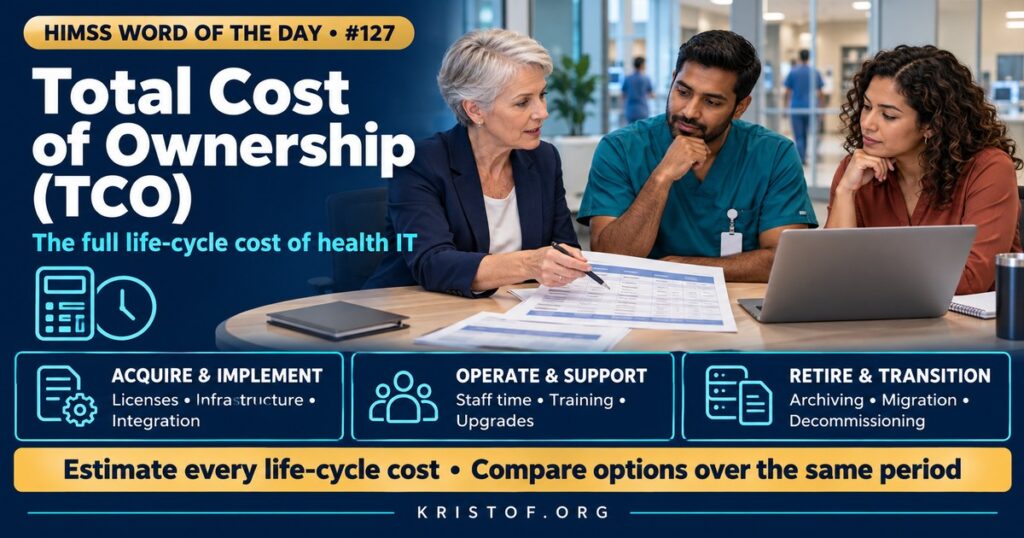
Total cost of ownership (TCO) is an estimate of all costs associated with a system, project, or asset over its entire life cycle, including acquisition, implementation, operation, maintenance, and eventual replacement or retirement.
The HIMSS Dictionary describes TCO as a document that lays out what a project or initiative will cost, typically covering hardware, software, development, and continuing expenses.
| Cost Category | What It Includes | Health IT Example |
|---|---|---|
| Acquisition | Licenses, subscriptions, and purchase price | EHR software licenses or annual subscription fees |
| Infrastructure | Hardware, hosting, networks, and storage | Servers, cloud hosting, wireless upgrades, end-user devices |
| Implementation | Build, testing, interfaces, data conversion, consultants | Interface development and legacy data migration |
| People | Analysts, trainers, support staff, and backfill | Paying for nurses to attend training and cover shifts |
| Ongoing Operations | Maintenance, support, upgrades, security | Annual maintenance fees and regular version upgrades |
| Retirement | Archiving, decommissioning, and transition | Maintaining read-only access to a legacy system |
⚠️ Exam Alert: TCO estimates all costs over a system’s life. Return on investment (ROI) compares benefits to costs. Capital expenses are large upfront purchases; operating expenses are ongoing costs, such as subscriptions. A low purchase price can still mean a high TCO.
🌐 Why It Matters: Real-World Healthcare IT Context
Health IT decisions often focus on the price in a vendor proposal, but that figure can be a small part of what an organization will spend. Implementation services, interfaces, hardware, staff time, training, and years of maintenance and upgrades frequently exceed the initial license cost.
TCO matters during vendor selection. Comparing proposals fairly requires estimating each option’s full cost over the same period, often five to ten years for major systems. A vendor with a lower license fee may require more interfaces, more customization, or more internal staff, making it more expensive overall.
Cloud and on-premises options complicate comparisons. Hosted and software-as-a-service models shift costs from capital purchases of servers and data center space to ongoing subscription fees. A fair comparison includes what the organization would otherwise spend on hardware refreshes, power, cooling, backup, disaster recovery, security, and staff to manage infrastructure.
People costs are easy to underestimate. Analysts to build and maintain the system, trainers, help desk staff, and super users all require funding. Backfill for clinicians attending training and supporting Go-Live is a real expense, as is temporary productivity loss during the transition.
Clinical time is part of the true cost. A system that adds minutes to every nursing assessment or medication pass consumes staff time across thousands of shifts. Usability problems rarely appear in budgets, but they affect staffing, burnout, and turnover.
Retirement belongs in the analysis too. When systems are replaced, organizations often must maintain access to legacy data for legal and clinical reasons, through archiving or read-only systems, which continues to cost money.
Contract terms shape TCO over time. Annual price escalators, fees tied to user counts or patient volumes, charges for additional modules or interfaces, and costs to extract data when leaving a vendor can significantly change long-term costs. Reviewing these terms during negotiation, rather than discovering them at renewal, protects the organization and makes comparisons more accurate.
Security and compliance add ongoing costs as well: vulnerability management, monitoring, audits, and incident response capacity must be sustained for as long as a system holds sensitive data.
Benefits deserve equal care. A system with a higher TCO may still be the better choice if it improves safety, reduces documentation time, supports revenue capture, or replaces several older systems. Pairing TCO with realistic benefit estimates leads to sounder decisions than comparing costs alone.
Commonly overlooked TCO elements:
- Interfaces and integration maintenance
- Data conversion and legacy archiving
- Training and backfill for clinical staff
- Upgrade testing and regulatory changes
- Security monitoring and compliance work
- Productivity loss during transitions
Practices for sound TCO analysis:
- A consistent time horizon for all options
- Input from IT, finance, clinical, and operations leaders
- Explicit assumptions documented and reviewed
- Inclusion of both capital and operating costs
- Sensitivity analysis for uncertain estimates
- Comparison of costs with expected benefits and risks
🏥 The Nurse’s Perspective: Clinical, Bedside, & Workflow
Nurses rarely see TCO spreadsheets, but they experience many of the costs those spreadsheets try to capture.
At the Bedside
Every extra click, duplicate entry, or workaround costs nursing time. When systems are selected or changed, the time burden on bedside nurses is a real cost that belongs in decisions, even though it rarely appears in vendor quotes.
Devices are part of TCO as well. Scanners, workstations on wheels, mobile devices, and printers need replacement, repair, and support. Nurses who report broken or failing equipment promptly help organizations understand true device costs and avoid workarounds.
Downtime is a hidden cost too. When systems are unavailable, nurses switch to paper, reconcile information afterward, and spend extra time catching up, all of which affect staffing and safety.
In Clinical Workflow
Training time is a significant investment. Nurses attending classes, completing e-learning, and practicing in training environments require scheduling and backfill. Efficient, role-based training that respects nurses’ time reduces cost and improves learning.
Optimization after Go-Live is an ongoing cost that pays back in efficiency. Requests submitted by nurses to fix inefficient workflows compete for analyst time, and governance processes weigh their value against other priorities.
Nurse informaticists can help leaders quantify clinical time costs, such as minutes spent on documentation per shift, which strengthens the case for usability improvements.
Consolidating systems can reduce costs over time. When one platform replaces several departmental tools, nurses may also benefit from fewer logins, fewer places to look for information, and less duplicate documentation.
In EHR Implementation (Go-Live Perspective)
Go-Live costs extend beyond software: command centers, at-the-elbow support staff, overtime, temporary staffing, and reduced patient volumes during stabilization. Organizations that plan for these costs avoid cutting support short when clinicians need it most.
At-the-elbow support analysts, often contracted, are a visible Go-Live expense. Their value shows in faster adoption, fewer errors, and quicker issue resolution, which reduce longer-term costs.
🎓 CAHIMS / CPHIMS & HIMSS Perspective
CAHIMS Exam Domain Mapping
TCO appears in management, systems selection, and finance questions:
| CAHIMS Domain | How TCO Appears |
|---|---|
| Healthcare & Technology Environments | Cloud versus on-premises models; vendor market |
| Clinical Informatics | Usability and clinician time as costs; training needs |
| Healthcare Information & Systems Management | Infrastructure, interfaces, maintenance, upgrades, life cycle |
| Management & Leadership | Budgeting, business cases, ROI, vendor selection, contract negotiation |
Key Terms to Know Alongside TCO
- Return on Investment (ROI) — the comparison of benefits gained with costs incurred
- Capital Expense (CapEx) — spending on long-term assets, such as hardware purchases
- Operating Expense (OpEx) — ongoing spending, such as subscriptions and support
- Business Case — a justification for an investment based on costs, benefits, and risks
- Software as a Service (SaaS) — software delivered by subscription and hosted by a vendor
- System Life Cycle — the stages of a system from planning to retirement
HIMSS Organizational Position
HIMSS supports sound technology investment decisions through education and its CPHIMS certification, which covers systems analysis, selection, and management. Members can find related education and research through the HIMSS Resource Center.
🔗 Explore Further: External References
- ONC — Certified Health IT Product List (CHPL) https://chpl.healthit.gov/
- NIST — SP 800-145, The NIST Definition of Cloud Computing https://csrc.nist.gov/pubs/sp/800/145/final
- HHS — Guidance on HIPAA and Cloud Computing https://www.hhs.gov/hipaa/for-professionals/special-topics/health-information-technology/cloud-computing/index.html
- ONC — SAFER Guides https://healthit.gov/clinical-quality-and-safety/safer-guides/
- AMA — Digital Health Implementation Playbook Series https://www.ama-assn.org/practice-management/digital-health/digital-health-implementation-playbook-series
- HIMSS — Certifications (CAHIMS and CPHIMS) https://www.himss.org/certifications
Term source: HIMSS Dictionary of Health Information and Technology Terms, Acronyms, and Organizations, 6th Edition (2025). All definitions in this series are paraphrased for editorial purposes. Readers are encouraged to consult the primary source for exact language.
Eric Andrew Kristof, RN, CAHIMS is a Healthcare IT professional and HIMSS Arkansas Chapter member based in Hot Springs Village, AR, with hands-on Epic Go-Live experience and a diverse healthcare and IT background. He writes at kristof.org at the intersection of clinical care and healthcare technology.
Leave a Reply