By Eric Andrew Kristof, RN, CAHIMS | Healthcare IT Professional | HIMSS Arkansas Chapter Member
About This Series: The HIMSS Word of the Day is a running blog series drawing from the HIMSS Dictionary of Health Information and Technology Terms, Acronyms, and Organizations, 6th Edition (2025) — the authoritative reference for healthcare IT professionals and the primary study resource for CAHIMS and CPHIMS certification. Each post paraphrases the term in plain language, grounds it in real-world healthcare IT context, and adds a bedside nursing perspective you won’t find in a textbook.
📖 The Term: Underuse (Overuse, Underuse, and Misuse)
Source: HIMSS Dictionary of Health Information and Technology Terms, Acronyms, and Organizations, 6th Edition (2025)
🔍 Plain-Language Definition
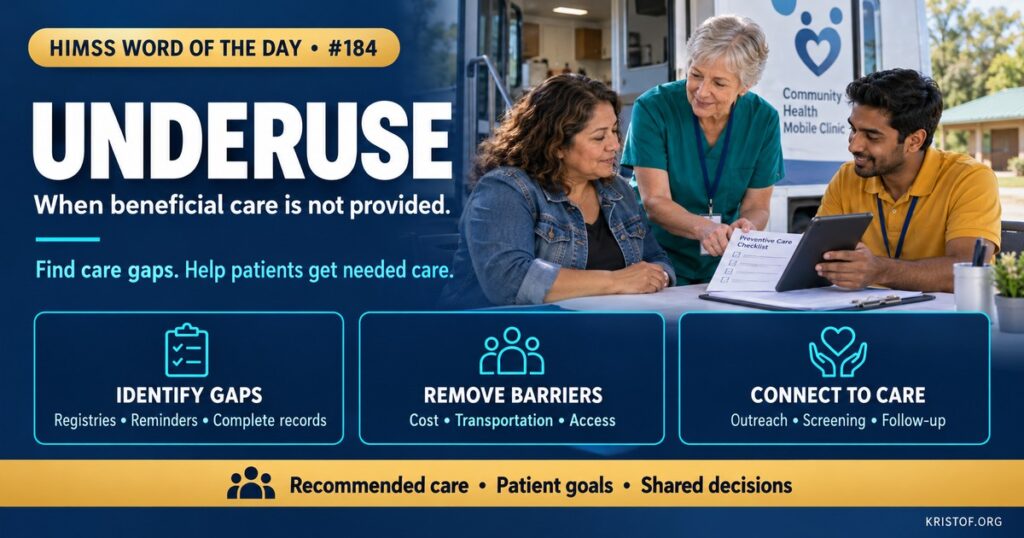
Underuse means a patient does not receive a service that would have helped them. It is one of three widely used categories of healthcare quality problems, alongside overuse and misuse.
The HIMSS Dictionary describes underuse as failing to provide care that would have benefited a patient. Its examples include missed preventive services for eligible patients, such as cervical cancer screening, influenza vaccination for older adults, and blood pressure screening, and proven medications for chronic illness that are not provided, such as inhaled steroids for asthma or aspirin, beta-blockers, and lipid-lowering drugs after a heart attack.
| Quality Problem | What It Means | Example |
|---|---|---|
| Underuse | Beneficial care is not provided | A patient with diabetes never receives a recommended eye exam |
| Overuse | Care is provided when risks outweigh benefits | Antibiotics for a viral infection |
| Misuse | Appropriate care is provided poorly, causing preventable harm | A medication error during an appropriate treatment |
⚠️ Exam Alert: Underuse = too little of beneficial care; overuse = too much or unnecessary care; misuse = appropriate care delivered with errors. Care gaps are specific instances of underuse identified by measures or registries. Low-value care is a form of overuse.
🌐 Why It Matters: Real-World Healthcare IT Context
The overuse, underuse, and misuse framework gained prominence in the late 1990s, when a national roundtable convened by the Institute of Medicine, summarized in JAMA in 1998, described these as the major categories of quality problems in American healthcare. The framework helps organizations recognize that quality improvement means both doing more of some things and less of others.
Underuse is common. A landmark 2003 study in the New England Journal of Medicine found that adults in the United States received about 55 percent of recommended care, with similar gaps for preventive, acute, and chronic care. Although many measures have improved since then, gaps persist in areas such as screening, vaccination, chronic disease control, and follow-up.
Underuse has many causes. Patients may face cost barriers, transportation problems, limited access, or lack of awareness. Clinicians may lack time, reminders, or complete information about what care is due. Care that spans settings, such as follow-up after a hospital stay, may fall between organizations. Fee-for-service payment historically paid poorly for outreach and prevention.
Equity matters. Underuse often falls unequally across populations defined by race, ethnicity, income, language, disability, and geography. Stratifying quality measures by demographic groups helps reveal disparities that overall rates hide.
Transitions of care are a frequent source of underuse. Follow-up appointments, test results pending at discharge, and medication changes can be lost between hospital and outpatient settings. Tracking pending results and scheduling follow-up before discharge reduces these gaps.
Quality measures target underuse. Many widely used measures, including HEDIS measures and electronic clinical quality measures, assess whether recommended care was delivered, such as cancer screening, vaccinations, and medication therapy for chronic conditions. Value-based payment programs reward closing these gaps.
Health IT is a powerful tool against underuse. Registries identify patients overdue for care. Health maintenance reminders and clinical decision support prompt clinicians during visits. Patient portals and automated outreach remind patients. Standing orders allow nurses and staff to deliver routine preventive services without waiting for individual orders.
Data completeness matters. If care delivered elsewhere is not recorded, patients may appear to have gaps they do not have, leading to wasted outreach. Health information exchange and documentation of outside results improve accuracy.
Measurement must be fair. Patients who decline recommended care after informed discussion, or for whom care is not appropriate because of other conditions, should be documented so they are excluded from measures where specifications allow. Otherwise, quality reports may label informed choices as failures and push clinicians toward care that does not fit patients’ goals.
Balance is important. Efforts to reduce overuse, such as limiting low-value tests, should not inadvertently increase underuse of needed care. Shared decision-making helps align care with patients’ goals.
Common causes of underuse:
- Missing reminders or information at the point of care
- Cost, access, and transportation barriers
- Fragmented care across settings
- Time constraints in visits
- Incomplete records of care delivered elsewhere
- Limited outreach capacity
Strategies that reduce underuse:
- Registries and care gap reports
- Point-of-care reminders and decision support
- Standing orders for preventive services
- Patient outreach through portals, calls, and texts
- Health information exchange to capture outside care
- Stratified measurement to address disparities
🏥 The Nurse’s Perspective: Clinical, Bedside, & Workflow
Nurses are central to finding and closing care gaps.
At the Bedside
During visits and hospital stays, nurses often identify missed vaccines, screenings, or education opportunities. Standing orders allow them to act directly, such as administering an influenza or pneumococcal vaccine when criteria are met.
Medication reconciliation can reveal underuse, such as a patient after a heart attack who is not on recommended therapy, or a patient who stopped a medication because of cost. Raising these issues with the care team supports evidence-based treatment.
Language access matters too. Patients with limited English proficiency may miss recommended care when reminders and education are not offered in their preferred language, so interpreter services and translated materials help close gaps.
In Clinical Workflow
Ambulatory nurses and care managers work from registries and care gap lists, contacting patients due for screenings or follow-up and helping them overcome barriers such as transportation or scheduling.
Pre-visit planning, often led by nurses or medical assistants, identifies gaps before the patient arrives so they can be addressed during the visit.
Documenting outside care, such as a mammogram performed elsewhere, prevents false gaps and unnecessary outreach.
Nurses also educate patients about why recommended care matters, which can increase participation in screenings and adherence to medications.
Community partnerships, such as mobile screening events or pharmacy-based vaccination, extend reach to patients who face barriers to clinic visits.
In EHR Implementation (Go-Live Perspective)
During an Epic Go-Live, health maintenance rules, registries, and standing order protocols are configured and validated. Converting historical immunizations and screening dates accurately prevents patients from appearing overdue.
At-the-elbow support analysts help nurses find and use health maintenance tools and document completed care correctly.
🎓 CAHIMS / CPHIMS & HIMSS Perspective
CAHIMS Exam Domain Mapping
Underuse appears in quality and population health questions:
| CAHIMS Domain | How Underuse Appears |
|---|---|
| Healthcare & Technology Environments | Quality frameworks; national quality findings; value-based programs |
| Clinical Informatics | Care gaps, reminders, standing orders, medication reconciliation |
| Healthcare Information & Systems Management | Registries, quality measures, decision support logic, data completeness |
| Management & Leadership | Quality strategy, equity, outreach resources |
Key Terms to Know Alongside Underuse
- Overuse — providing care when its risks outweigh its benefits
- Misuse — appropriate care delivered with preventable errors
- Care Gap — a specific instance of recommended care not received
- Health Maintenance — EHR tools that track preventive and routine care
- Standing Orders — protocols allowing staff to deliver defined services without individual orders
- Low-Value Care — services that provide little or no benefit
HIMSS Organizational Position
HIMSS supports quality improvement and population health through education on data, decision support, and interoperability that help organizations identify and close care gaps. Members can find related education and research through the HIMSS Resource Center.
🔗 Explore Further: External References
- Chassin et al. (1998), JAMA — The Urgent Need to Improve Health Care Quality https://pubmed.ncbi.nlm.nih.gov/9749483/
- McGlynn et al. (2003), New England Journal of Medicine — The Quality of Health Care Delivered to Adults in the United States https://pubmed.ncbi.nlm.nih.gov/12826639/
- U.S. Preventive Services Task Force https://www.uspreventiveservicestaskforce.org/uspstf/
- NCQA — HEDIS https://www.ncqa.org/hedis/
- eCQI Resource Center — Digital Quality Measures https://ecqi.healthit.gov/dqm/about-dqms
- HIMSS — Nursing Informatics Community https://www.himss.org/networking/communities/nursing-informatics/
Term source: HIMSS Dictionary of Health Information and Technology Terms, Acronyms, and Organizations, 6th Edition (2025). All definitions in this series are paraphrased for editorial purposes. Readers are encouraged to consult the primary source for exact language.
Eric Andrew Kristof, RN, CAHIMS is a Healthcare IT professional and HIMSS Arkansas Chapter member based in Hot Springs Village, AR, with hands-on Epic Go-Live experience and a diverse healthcare and IT background. He writes at kristof.org at the intersection of clinical care and healthcare technology.
Leave a Reply