By Eric Andrew Kristof, RN, CAHIMS | Healthcare IT Professional | HIMSS Arkansas Chapter Member
About This Series: The HIMSS Word of The Day is a running blog series drawing from the HIMSS Dictionary of Health Information and Technology Terms, Acronyms, and Organizations, 6th Edition (2025) — the authoritative reference for healthcare IT professionals and the primary study resource for CAHIMS and CPHIMS certification. Each post paraphrases the term in plain language, grounds it in real-world healthcare IT context, and adds a bedside nursing perspective you won’t find in a textbook.
📖 The Term: WAP (Wireless Application Protocol)
Source: HIMSS Dictionary of Health Information and Technology Terms, Acronyms, and Organizations, 6th Edition (2025)
🔍 Plain-Language Definition
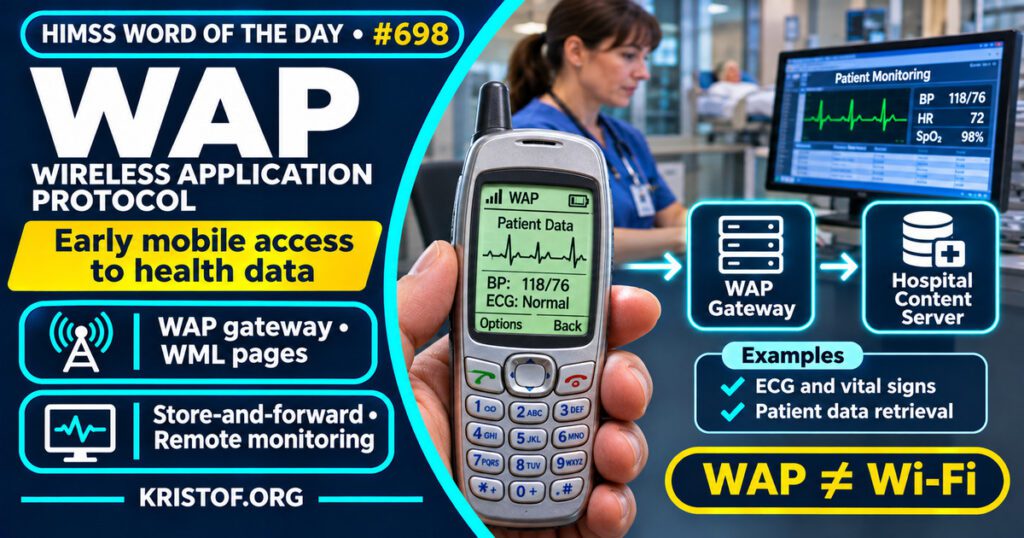
The HIMSS Dictionary describes the Wireless Application Protocol (WAP) as a secure specification that lets users reach information instantly from handheld wireless devices. Its examples include phones, pagers, radios, and communicators.
A 1998 position paper by Unwired Planet to a W3C workshop on mobile access says the WAP Forum was founded in June 1997 by Ericsson, Motorola, Nokia, and Unwired Planet, and that WAP specifies access to Internet content and advanced telephony services on digital cellular phones and other narrowband wireless terminals. WAP is a legacy technology, and this post treats it that way. The studies below are from 2002 to 2005.
| Piece | What it describes | Where it appears in this post |
|---|---|---|
| WAP device | A phone or other handheld that supports WAP | Hung and Zhang; Salvador et al. |
| WAP gateway | The service that connects the WAP device to a content server | Hung and Zhang |
| Content format | Wireless markup language (WML) and WMLScript for the small screen | Hung and Zhang |
| Delivery mode | Store-and-forward retrieval of data, not live streaming | Hung and Zhang |
| Health use | Monitoring, data retrieval, and patient communication | All five papers |
⚠️ Exam Alert: WAP is not Wi-Fi. WAP is a set of specifications for getting information to mobile devices, while Wi-Fi is a wireless local area network technology. WAP is also not the same as WML, which is the markup language used for WAP pages, and not the same as SMS, the short text messaging service. Questions may ask which of several wireless terms describes access to information from a handheld device, and the answer in older vocabulary is WAP.
🌐 Why It Matters: Real-World Healthcare IT Context
Where it shows up. WAP appears in health IT mostly through early mobile and telemedicine work, in which a phone replaced a computer as the way to see patient data. The five papers below describe prototypes, pilots, and design discussions. I read the abstracts only.
A prototype for monitoring. Hung and Zhang (2003) describe a WAP-based telemedicine system for patient monitoring built in their laboratory. Authorized users could browse general patient data, monitored blood pressure, and electrocardiogram (ECG) data on WAP devices in store-and-forward mode. The applications were written in wireless markup language, WMLScript, and Perl and resided on a content server with a MySQL database. For testing, they used a phone compliant with WAP 1.1 on GSM 1800 MHz by circuit-switched data, connected through a WAP gateway provided by a mobile phone service provider in Hong Kong. Data were retrieved and displayed on the phone, and the authors conclude WAP is feasible for remote patient monitoring and patient data retrieval. The test showed technical feasibility, not clinical effect.
A pilot with patients. Salvador et al. (2005) described Airmed-cardio, a platform for out-of-hospital follow-up of patients with chronic heart disease who were in stable condition, with emergencies deliberately excluded. Patients had portable recording equipment and a cellular phone that supported ECG transmission and WAP for other parameters and questionnaires, and health care agents could reach patient folders through the web and WAP. The pilot enrolled 89 patients with a mean participation of 50.1 days. It recorded 2,168 ECGs with network errors under 0.1%, 4,011 short messages with none lost, and 6,083 WAP sessions with network failures under 0.1%. The authors also evaluated the subjective component of usability and describe the evolution of patient acceptance over time, though the abstract does not give the result.
Prototype with sensors and WAP phones. Pollard et al. (2002) described a remote monitoring prototype that used non-invasive sensors on patients at home and delivered information to authorized medical staff through a web browser or WAP-enabled mobile telephones. The authors describe it as a hardware and software prototype built to demonstrate the approach, and say research was continuing.
Patient communication through a contact center. Maglaveras et al. (2002), in the International Journal of Medical Informatics, described a generic contact center designed for an EU-funded project called the Citizen Health System, focusing on the modules that connect patients to the center by mobile telecommunications. They say the application shows the usefulness of wireless technology for health services and the value of interactivity through the limited browsing capabilities of WAP. That is the authors’ conclusion about a design, not a trial result.
Acceptance was still open. In a second 2002 paper, Maglaveras et al. reviewed tele-health technologies for regional health networks and discussed WAP among the enabling technologies. They concluded that, although the IT solutions were advanced, user acceptance and user friendliness issues were still unresolved, and that mobile telecommunication solutions might hold the key to wide-scale implementation.
What I could not confirm. I did not find a primary source describing WAP’s current status, so my description of it as a legacy technology rests on the dates of the studies and on general knowledge that smartphone web browsers and apps replaced it; this is worth verifying. All five papers are prototypes, pilots, or design discussions from 2002 to 2005, so they say nothing about modern mobile security or performance. The dictionary calls WAP secure, but none of the abstracts evaluates its security. I did not read the full papers.
Common WAP-era problems:
- Very small screens and limited browsing that make complex data hard to read
- Dependence on a gateway and a particular network service
- Early circuit-switched connections with limited capacity
- Unresolved user acceptance and friendliness issues, as one review noted
- Prototype results that do not show clinical benefit
What supports WAP use in these papers:
- Data retrieval on an ordinary phone without a computer
- Store-and-forward access to readings and ECGs
- A reported network failure rate under 0.1% in one pilot of 89 patients
- Low-bandwidth operation that fit the networks of the time
- A route for authorized staff to see monitored data away from a desk
🏥 The Nurse’s Perspective: Clinical, Bedside, & Workflow
None of the abstracts describes nurses as study participants, so this section is workflow context and not evidence.
At the Bedside
The idea behind WAP, seeing a patient’s data on a handheld device, is familiar from today’s mobile devices. The studies describe monitoring readings such as blood pressure and ECG, which nurses record and interpret in many settings. The older systems displayed only small amounts of data, so the bedside check still depended on the person.
In Clinical Workflow
The monitoring studies show a basic pattern still used today: a device captures a reading, a server stores it, and an authorized person reviews it. Which readings are reviewed, by whom, and how often is a workflow decision, and the abstracts do not address it.
In EHR Implementation (Go-Live Perspective)
During an Epic Go-Live, analysts and at-the-elbow support staff deal with current mobile devices and apps, not WAP phones. The older papers still show a lasting issue, which is that a technology can work in a pilot and still face acceptance and friendliness problems in daily use. That observation comes from one review and is context only.
🎓 CAHIMS / CPHIMS & HIMSS Perspective
CAHIMS Exam Domain Mapping
WAP appears in questions about wireless terminology and mobile access:
| CAHIMS Domain | How WAP Appears |
|---|---|
| Healthcare & Technology Environments | Wireless and mobile technology terms |
| Clinical Informatics | Mobile access to patient data and monitoring |
| Healthcare Information & Systems Management | Networks, gateways, and device support |
| Management & Leadership | Evaluating older technology against current options |
Key Terms to Know Alongside WAP
- mHealth — health services and information delivered through mobile devices
- Telehealth — health care and information delivered at a distance by telecommunications
- Remote patient monitoring — collecting patient data outside the clinic and sending it to a care team
- Store-and-forward — capturing data and sending it for review at a later time
- Wi-Fi — wireless local area network technology
- ZigBee — a low-power wireless standard used for short-range device communication
HIMSS Organizational Position
HIMSS offers education and research on health information and technology topics through its Resource Center. Members can find related information on the HIMSS Resource Center page.
🧭 More HIMSS Word of The Day Terms
Related terms in the Connected Health series:
Browse all Connected Health terms or the A–Z glossary.
🔗 Explore Further: External References
- W3C Workshop on Mobile Access (1998) — Unwired Planet Position: WAP Position Paper https://www.w3.org/Mobile/1998/Workshop/Papers/WAPForum
- Hung and Zhang (2003), IEEE Transactions on Information Technology in Biomedicine — Implementation of a WAP-based telemedicine system for patient monitoring. https://pubmed.ncbi.nlm.nih.gov/12834165/
- Salvador et al. (2005), IEEE Transactions on Information Technology in Biomedicine — Airmed-cardio: a GSM and Internet services-based system for out-of-hospital follow-up of cardiac patients. https://pubmed.ncbi.nlm.nih.gov/15787010/
- Pollard et al. (2002), Medical Informatics and the Internet in Medicine — Wireless and Web-based medical monitoring in the home. https://pubmed.ncbi.nlm.nih.gov/12507266/
- Maglaveras et al. (2002), International Journal of Medical Informatics — Home care delivery through the mobile telecommunications platform: the Citizen Health System (CHS) perspective. https://pubmed.ncbi.nlm.nih.gov/12467795/
- Maglaveras et al. (2002), Methods of Information in Medicine — Information technology can enhance quality in regional health delivery. https://pubmed.ncbi.nlm.nih.gov/12501811/
- HIMSS — Resource Center https://www.himss.org/resource-center
Term source: HIMSS Dictionary of Health Information and Technology Terms, Acronyms, and Organizations, 6th Edition (2025). All definitions in this series are paraphrased for editorial purposes. Readers are encouraged to consult the primary source for exact language.
Eric Andrew Kristof, RN, CAHIMS is a Healthcare IT professional and HIMSS Arkansas Chapter member based in Hot Springs Village, AR, with hands-on Epic Go-Live experience and a diverse healthcare and IT background. He writes at kristof.org at the intersection of clinical care and healthcare technology.
Leave a Reply