By Eric Andrew Kristof, RN, CAHIMS | Healthcare IT Professional | HIMSS Arkansas Chapter Member
About This Series: The HIMSS Word of The Day is a running blog series drawing from the HIMSS Dictionary of Health Information and Technology Terms, Acronyms, and Organizations, 6th Edition (2025) — the authoritative reference for healthcare IT professionals and the primary study resource for CAHIMS and CPHIMS certification. Each post paraphrases the term in plain language, grounds it in real-world healthcare IT context, and adds a bedside nursing perspective you won’t find in a textbook.
📖 The Term: W3C (World Wide Web Consortium)
Source: HIMSS Dictionary of Health Information and Technology Terms, Acronyms, and Organizations, 6th Edition (2025)
🔍 Plain-Language Definition
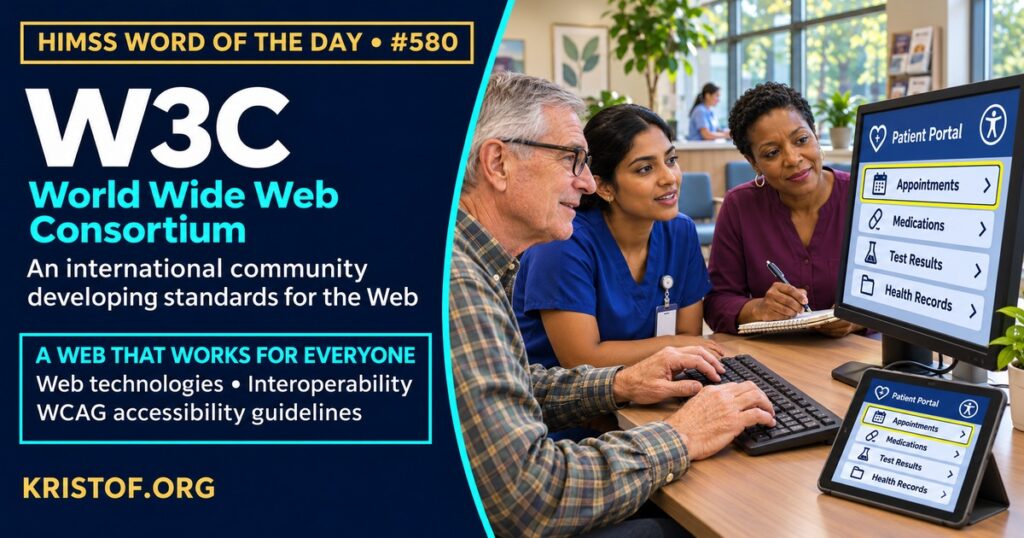
The HIMSS Dictionary lists W3C (World Wide Web Consortium) in its organizations appendix. It describes an international community in which member organizations, a full-time staff, and members of the public jointly build standards for the Web. It states the mission as helping the Web reach its full potential through protocols and guidelines that support its long-term growth.
W3C’s own About page describes it as an international public-interest non-profit and frames its mission as making the web work for everyone. The page says Tim Berners-Lee founded W3C in 1994 and is now Emeritus Director. It says W3C is led by a President and CEO and a Board of Directors, that its standards are developed under a published Process Document and a royalty-free Patent Policy, and that decisions are made by consensus. It reports more than 330 members and about 50 staff, without a date for those counts, so they are best read as approximate figures from W3C itself.
W3C’s history page says Berners-Lee founded W3C in October 1994 at the MIT Laboratory for Computer Science, in collaboration with CERN and with support from DARPA and the European Commission. For years, universities and research organizations served as hosts: MIT first, then a European host from 1995, Keio University in Japan from 1996, ERCIM taking over the European role in 2003, and Beihang University announced in 2013. The About page says W3C became its own legal entity and public-interest non-profit in January 2023, after 28 years of host institutions handling its legal and financial roles.
W3C calls the standards it publishes Recommendations. Its standards page describes them as blueprints for a consistent, connected web that are free to use and developed with royalty-free patent commitments. It names HTML as the cornerstone of the web and lists CSS, SVG, WOFF, WebRTC, and XML among the technologies that extend it. The page names interoperability, security, privacy, accessibility, and internationalization as goals.
| Item | Detail |
|---|---|
| Type | International public-interest non-profit (W3C’s description) |
| Founded | 1994, by Tim Berners-Lee (W3C’s pages) |
| Own legal entity since | January 2023 (W3C About page) |
| Focus | Web standards: HTML, CSS, XML, accessibility, and more |
| Standards called | Recommendations, developed by consensus |
| Accessibility work | WCAG, through the Web Accessibility Initiative |
| Relation to HIMSS | None described on the pages read for this post |
⚠️ Exam Alert: W3C develops Web standards such as HTML, CSS, and XML and publishes the WCAG accessibility guidelines. HL7 is a different body that develops health data standards such as FHIR. IETF (Internet protocols) and ISO (international standards across many industries) are also separate organizations. CAHIMS and CPHIMS come from HIMSS, not from W3C.
🌐 Why It Matters: Real-World Healthcare IT Context
Because W3C is an organization rather than a research topic, this section draws on W3C’s own pages and two outside documents about its health-sector reach, all read for this post. The W3C pages show how W3C describes itself, not an independent evaluation of it.
Process. W3C’s standards page says its Recommendations come from a consensus process, are reviewed by groups inside and outside W3C, and are strengthened by interoperability testing.
Accessibility. W3C’s WCAG page describes the Web Content Accessibility Guidelines as an international standard for making web content more accessible to people with disabilities. WCAG 2.0 was published on 11 December 2008, WCAG 2.1 on 5 June 2018, and WCAG 2.2 on 5 October 2023, which adds nine success criteria to 2.1. The page describes WCAG 3.0 as an early draft. Success criteria are testable and sit at three conformance levels: A, AA, and a most demanding top level. The page says content that meets 2.2 also meets 2.1 and 2.0, and that the Accessibility Guidelines Working Group of W3C’s Web Accessibility Initiative develops the guidelines.
A health-sector rule. A Federal Register document published on May 11, 2026, from the HHS Office for Civil Rights, is an interim final rule that names WCAG 2.1 Level AA as the technical standard for web content and mobile apps provided by covered recipients of HHS federal financial assistance. The rule amends 45 CFR 84.84(b). It extends the compliance dates: recipients with 15 or more employees move from May 11, 2026 to May 11, 2027, and smaller recipients move from May 10, 2027 to May 10, 2028. The document says it took effect on May 7, 2026, with comments due July 6, 2026. This was read through a fetch tool summary of the first part of the document, and later agency action is possible, so the Federal Register should be checked for the current status.
A health data specification. HL7’s SMART Health Cards specification, which describes verifiable health records that patients can carry, uses the issuer, holder, and verifier model from the W3C Verifiable Credentials data model. It also encodes health cards as JSON Web Signatures and maps the credential’s issuer and issuance date to standard token claims. W3C is not a health standards body, and this is one example of HL7 building on W3C work.
Common W3C mix-ups:
- Treating W3C as a health data standards body, when HL7 publishes FHIR
- Assuming web standards means only HTML and CSS
- Confusing WCAG, a W3C guideline, with the laws and rules that may require it
- Treating WCAG 3.0 as a finished standard
- Thinking W3C Recommendations are laws, when a law or contract has to adopt them
What W3C offers health IT professionals:
- Free, royalty-free, consensus-built web standards
- WCAG as a testable yardstick for web and mobile accessibility
- Technologies such as HTML, CSS, SVG, and XML that health IT systems rely on
- A public process and open documents that vendors can cite in requirements
- A base that other standards groups, including HL7, build on
🏥 The Nurse’s Perspective: Clinical, Bedside, & Workflow
Nurses meet W3C’s work through the screens patients and clinicians use every day.
At the Bedside
Patients with low vision, limited dexterity, or other disabilities may rely on screen readers, larger text, or keyboard navigation to use a patient portal or an education page. Nurses who teach portal enrollment or discharge instructions see quickly when a web page works for a patient and when it does not. Accessible design is one reason a patient can read results or message the care team without extra help.
In Clinical Workflow
Nurse informaticists review patient-facing tools, forms, and education content before release. WCAG gives them a common vocabulary for accessibility concerns, such as contrast, labels, and keyboard use, and gives vendors a testable standard to meet. Questions about whether a portal meets an accessibility requirement are usually answered by the vendor and compliance staff, with nurse input on how patients use the tool.
In EHR Implementation (Go-Live Perspective)
During an Epic Go-Live, patient portal activation and instructions are part of the plan, and analysts at the elbow hear patient and family questions about signing in and finding results. Accessibility problems surface as practical complaints, such as a page that a screen reader cannot read. Early testing with real patients and staff reduces those surprises.
🎓 CAHIMS / CPHIMS & HIMSS Perspective
CAHIMS Exam Domain Mapping
W3C connects standards, accessibility, and web-based systems:
| CAHIMS Domain | How W3C Appears |
|---|---|
| Healthcare & Technology Environments | Standards organizations and how web standards underlie health IT |
| Clinical Informatics | Patient-facing tools and accessibility in clinical workflows |
| Healthcare Information & Systems Management | Web-based systems, procurement requirements, and accessibility testing |
| Management & Leadership | Compliance planning, vendor requirements, and rule timelines |
Key Terms to Know Alongside W3C
- Standards development organization — group that creates and maintains technical standards through a defined process
- XML — Extensible Markup Language, a W3C Recommendation for structuring data in text documents
- Web services — software functions that systems call over a network using web protocols
- Section 508 — provision of U.S. law on the accessibility of federal electronic and information technology
- FHIR — HL7’s Fast Healthcare Interoperability Resources standard for exchanging health data
- Patient portal — secure website or app where patients view parts of their health record
HIMSS Organizational Position
HIMSS offers education and research on health information and technology topics through its Resource Center. Members can find related information on the HIMSS Resource Center page.
🧭 More HIMSS Word of The Day Terms
Related terms in the Interoperability and Standards series:
- Application Programming Interface (API)
- Semantic Web
- SOAP (Simple Object Access Protocol)
- VAN (Value-Added Network)
Browse all Interoperability and Standards terms or the A–Z glossary.
🔗 Explore Further: External References
- W3C — About W3C https://www.w3.org/about/
- W3C — History https://www.w3.org/about/history/
- W3C — Standards https://www.w3.org/standards/
- W3C Web Accessibility Initiative — Web Content Accessibility Guidelines (WCAG) Overview https://www.w3.org/WAI/standards-guidelines/wcag/
- Federal Register — Extension of Compliance Dates for Nondiscrimination on the Basis of Disability; Accessibility of Web Content and Mobile Applications of Recipients of Departmental Financial Assistance (HHS, May 11, 2026) https://www.federalregister.gov/documents/2026/05/11/2026-09266/extension-of-compliance-dates-for-nondiscrimination-on-the-basis-of-disability-accessibility-of-web
- HL7 — SMART Health Cards and Links Implementation Guide: Health Cards Specification https://hl7.org/fhir/uv/smart-health-cards-and-links/cards-specification.html
- HIMSS — Resource Center https://www.himss.org/resource-center
Term source: HIMSS Dictionary of Health Information and Technology Terms, Acronyms, and Organizations, 6th Edition (2025). All definitions in this series are paraphrased for editorial purposes. Readers are encouraged to consult the primary source for exact language.
Eric Andrew Kristof, RN, CAHIMS is a Healthcare IT professional and HIMSS Arkansas Chapter member based in Hot Springs Village, AR, with hands-on Epic Go-Live experience and a diverse healthcare and IT background. He writes at kristof.org at the intersection of clinical care and healthcare technology.
Leave a Reply