By Eric Andrew Kristof, RN, CAHIMS | Healthcare IT Professional | HIMSS Arkansas Chapter Member
About This Series: The HIMSS Word of the Day is a running blog series drawing from the HIMSS Dictionary of Health Information and Technology Terms, Acronyms, and Organizations, 6th Edition (2025) — the authoritative reference for healthcare IT professionals and the primary study resource for CAHIMS and CPHIMS certification. Each post paraphrases the term in plain language, grounds it in real-world healthcare IT context, and adds a bedside nursing perspective you won’t find in a textbook.
📖 The Term: Store-and-Forward Telehealth
Source: HIMSS Dictionary of Health Information and Technology Terms, Acronyms, and Organizations, 6th Edition (2025)
🔍 Plain-Language Definition
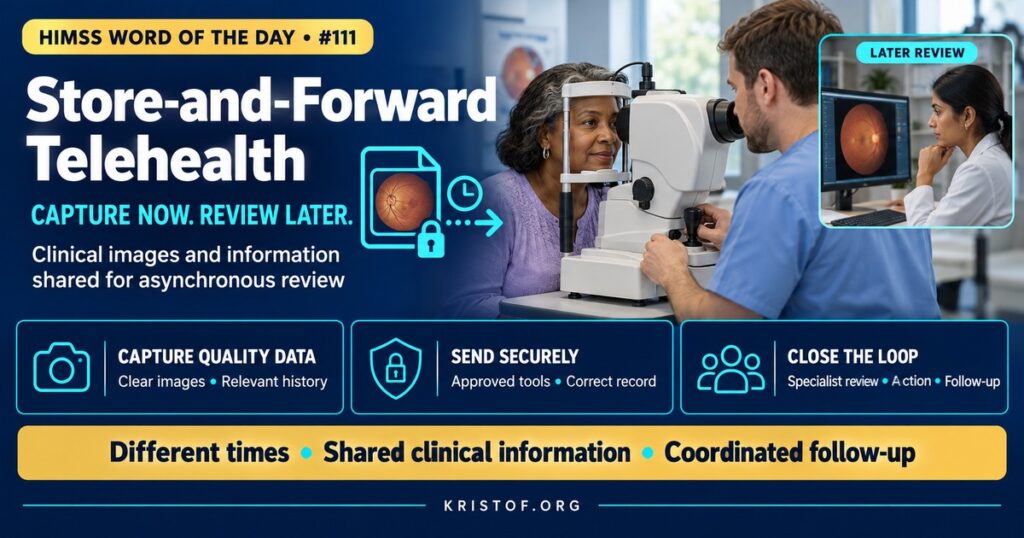
Store-and-forward telehealth, also called asynchronous telehealth, captures clinical information, such as images, video or audio clips, or test results, and sends it securely to a clinician who reviews it later. The patient and the reviewing clinician do not need to be available at the same time.
The HIMSS Dictionary describes store-and-forward as transmitting still images or audio-video clips to remote storage, where a clinician can retrieve them for review and consultation at any time. It notes that this removes the need for both parties to be available simultaneously and lowers transmission costs because less bandwidth is required.
| Telehealth Mode | How It Works | Example |
|---|---|---|
| Synchronous (Live) | Real-time interaction by video or phone | A video visit with a primary care provider |
| Store-and-Forward (Asynchronous) | Information captured and reviewed later | A dermatologist reviewing photos of a skin lesion |
| Remote Patient Monitoring | Ongoing transmission of physiologic data | Daily blood pressure readings sent to a care team |
| E-Consult (Provider-to-Provider) | One clinician asks a specialist for advice asynchronously | A primary care provider asks a cardiologist about an ECG |
⚠️ Exam Alert: Store-and-forward is asynchronous; participants do not interact in real time. Synchronous telehealth is live. Remote patient monitoring involves continuous or recurring data collection over time. Store-and-forward often uses lower bandwidth than live video, making it useful in rural or low-connectivity settings. Payment rules for asynchronous services differ from those for live visits.
🌐 Why It Matters: Real-World Healthcare IT Context
Store-and-forward expands access to specialty expertise. Patients in rural or underserved areas may wait months for a dermatology or eye appointment, or travel long distances. When a primary care nurse or technician captures high-quality images and a specialist reviews them asynchronously, many patients can get an answer, or a prioritized referral, without traveling.
Common uses include:
- Teledermatology, where photos of skin lesions are reviewed by dermatologists
- Teleretinal screening, where retinal photographs of patients with diabetes are reviewed for diabetic retinopathy
- Teleradiology, where images are transmitted for interpretation by remote radiologists
- Wound care, where wound photos and measurements are reviewed by specialists
- E-consults, where clinicians share questions and data with specialists for written guidance
Asynchronous review fits specialists’ schedules, allows batching of reviews, and reduces no-show problems. Because it uses less bandwidth, it can work where live video is unreliable.
Quality depends on the inputs. A blurry photo, poor lighting, missing measurements, or incomplete history can make review impossible or lead to the wrong recommendation. Standardized capture protocols, approved devices, and structured templates for clinical history are essential.
Integration with the EHR matters as much as the capture device. When images and consult requests travel through a separate platform, results may never make it back into the chart, and the referring team may not know a recommendation arrived. Programs that build the request, the media, and the response into the EHR, with a work queue for specialists and a notification for the ordering clinician, close the loop more reliably and keep a complete record.
Payment and policy vary. Medicare has historically restricted payment for many asynchronous services outside specific circumstances, while e-consult codes and some state Medicaid programs support asynchronous care. Organizations need to understand payment rules before scaling programs.
Privacy deserves attention as well. Clinical photographs can be highly sensitive, especially for dermatology and wound care, so organizations should use approved capture tools that store images securely in the record rather than on personal phones or unsecured messaging apps.
Common challenges with store-and-forward:
- Images that are poorly lit, out of focus, or lack scale
- Missing clinical history needed for interpretation
- Images stored outside the EHR or attached to the wrong encounter
- Unclear responsibility for acting on recommendations
- Payment and licensure limitations
- Turnaround times that do not meet clinical needs
What makes asynchronous programs work:
- Standardized image and data capture protocols
- Approved devices that attach images directly to the right patient and encounter
- Structured referral templates with key history
- Defined turnaround targets and escalation paths
- Clear closed-loop communication of recommendations
- Integration with scheduling for patients who still need visits
🏥 The Nurse’s Perspective: Clinical, Bedside, & Workflow
Nurses are frequently the people who capture store-and-forward data, which makes their technique central to the quality of the consult.
At the Bedside
Capturing a useful clinical image takes skill: consistent lighting, a plain background, a measurement scale, multiple angles, and close-ups as the protocol requires. For retinal screening, positioning and image quality determine whether the images are gradable. Nurses who follow capture protocols carefully reduce the number of patients who must return for repeat imaging.
Patient preparation and consent matter too. Explaining what will be photographed, why, and who will see it, and using approved devices rather than personal phones, protects privacy.
Patient-submitted photos are a growing variation. Some programs allow patients to upload images through the portal for review, which can save visits but requires clear instructions on lighting, angles, and privacy, and a reliable process for clinicians to review submissions promptly.
In Clinical Workflow
The clinical history that accompanies images is as important as the images themselves. Duration, changes over time, symptoms, prior treatments, and relevant history help the specialist interpret what they see. Structured templates help nurses include everything the reviewer needs.
When recommendations return, someone must act on them. Nurses often coordinate the next steps, such as scheduling a biopsy, starting treatment, or arranging an in-person visit, closing the loop so the consult leads to care.
In EHR Implementation (Go-Live Perspective)
During an Epic implementation, store-and-forward workflows depend on media capture tools, e-consult order types, and routing to specialist queues. Testing should confirm that images attach to the correct patient and encounter, that consult requests reach the right specialists, and that responses return to the ordering clinician.
At-the-elbow support analysts can help nurses use approved capture apps, attach images, and complete e-consult templates in the new system.
🎓 CAHIMS / CPHIMS & HIMSS Perspective
CAHIMS Exam Domain Mapping
Store-and-forward appears in telehealth and connected health questions:
| CAHIMS Domain | How Store-and-Forward Appears |
|---|---|
| Healthcare & Technology Environments | Telehealth modes; payment and licensure policy; rural access |
| Clinical Informatics | Image capture protocols, consult templates, closed-loop follow-up |
| Healthcare Information & Systems Management | Secure transmission, image storage, DICOM and media integration |
| Management & Leadership | Program design, turnaround targets, reimbursement strategy |
Key Terms to Know Alongside Store-and-Forward
- Synchronous Telehealth — real-time interaction between patient and clinician by video or phone
- Asynchronous Telehealth — information exchanged and reviewed at different times
- E-Consult — an asynchronous consultation between clinicians through the EHR or a secure platform
- Teledermatology — remote evaluation of skin conditions, often using images
- Teleretinal Screening — remote review of retinal images, often for diabetic eye disease
- Remote Patient Monitoring — ongoing collection of patient data at a distance for clinician review
HIMSS Organizational Position
HIMSS supports telehealth in all its forms, including asynchronous models, through its Virtual Care Community and policy engagement on telehealth access and payment. Members can find related education and research through the HIMSS Resource Center.
🔗 Explore Further: External References
- CMS — Telehealth https://www.cms.gov/medicare/coverage/telehealth
- ONC — Telemedicine and Telehealth https://healthit.gov/public-health/telemedicine-and-telehealth/
- DICOM Standard — About DICOM https://www.dicomstandard.org/about
- CMS — Physician Fee Schedule https://www.cms.gov/medicare/payment/fee-schedules/physician
- HHS — Health Information Technology and HIPAA https://www.hhs.gov/hipaa/for-professionals/special-topics/health-information-technology/index.html
- HIMSS — Virtual Care Community https://www.himss.org/networking/communities/virtual-care/
Term source: HIMSS Dictionary of Health Information and Technology Terms, Acronyms, and Organizations, 6th Edition (2025). All definitions in this series are paraphrased for editorial purposes. Readers are encouraged to consult the primary source for exact language.
Eric Andrew Kristof, RN, CAHIMS is a Healthcare IT professional and HIMSS Arkansas Chapter member based in Hot Springs Village, AR, with hands-on Epic Go-Live experience and a diverse healthcare and IT background. He writes at kristof.org at the intersection of clinical care and healthcare technology.
Leave a Reply