By Eric Andrew Kristof, RN, CAHIMS | Healthcare IT Professional | HIMSS Arkansas Chapter Member
About This Series: The HIMSS Word of the Day is a running blog series drawing from the HIMSS Dictionary of Health Information and Technology Terms, Acronyms, and Organizations, 6th Edition (2025) — the authoritative reference for healthcare IT professionals and the primary study resource for CAHIMS and CPHIMS certification. Each post paraphrases the term in plain language, grounds it in real-world healthcare IT context, and adds a bedside nursing perspective you won’t find in a textbook.
📖 The Term: Wi-Fi
Source: HIMSS Dictionary of Health Information and Technology Terms, Acronyms, and Organizations, 6th Edition (2025)
🔍 Plain-Language Definition
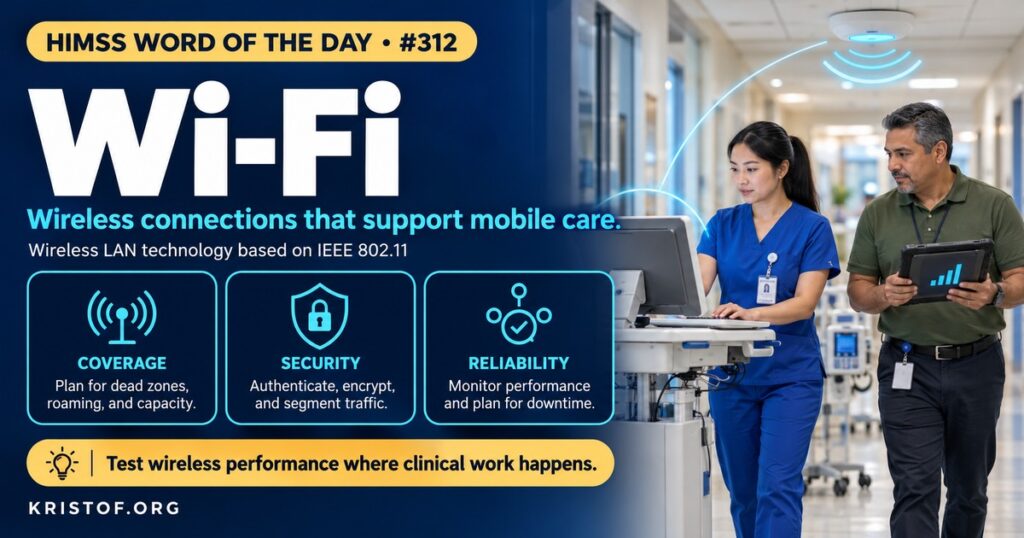
Wi-Fi is a wireless networking technology that relies on radio signals to deliver fast connections to networks and the internet. The HIMSS Dictionary explains that the Wi-Fi Alliance, which owns the registered trademark, defines Wi-Fi as wireless local area network (WLAN) products based on the standards of the Institute of Electrical and Electronics Engineers (IEEE) known as 802.11. The term first referred to products based on the 2.4 GHz 802.11b standard, but the Alliance later widened it to cover products based on any of the 802.11 standards, in part to reduce confusion about whether wireless products work together.
Two organizations are involved. The IEEE 802.11 working group writes the technical standards for wireless LANs. The Wi-Fi Alliance certifies products for interoperability and owns the brand name. In practice, people use “Wi-Fi” for any wireless LAN, and a hospital’s wireless network may include many access points, controllers, and several frequency bands that carry different kinds of traffic.
| Component | Role | Example |
|---|---|---|
| Access point | Provides the radio connection | Ceiling-mounted unit in a corridor |
| Controller or cloud management | Configures and monitors access points | Central console |
| Authentication | Verifies who or what connects | Staff credentials, device certificates |
| Encryption | Protects data over the air | Current Wi-Fi security protocols |
| Network segmentation | Separates traffic types | Clinical, guest, and device networks |
⚠️ Exam Alert: IEEE 802.11 is the standard; Wi-Fi is the trademarked certification brand from the Wi-Fi Alliance. A WLAN is the network; an access point is a device that provides coverage. The HIPAA transmission security standard applies to ePHI sent over any electronic communications network, including wireless.
🌐 Why It Matters: Real-World Healthcare IT Context
Wireless networks carry much of a hospital’s daily work: mobile workstations, smartphones, barcode scanners, nurse call, telehealth, and a growing number of connected medical devices. That puts requirements on coverage, capacity, reliability, and security.
On security, the HIPAA Security Rule‘s transmission security standard at 45 CFR 164.312(e) requires technical measures to guard against unauthorized access to ePHI sent over an electronic communications network. It includes integrity controls and an encryption specification, both addressable in the current text, which an organization implements where reasonable and appropriate or documents why not. NIST Special Publication 800-153, Guidelines for Securing Wireless Local Area Networks, published in February 2012, explains that WLAN security depends on how well each component, including client devices, access points, and wireless switches, is secured throughout its lifecycle, from design and deployment through ongoing maintenance and monitoring. Hospitals typically separate guest, staff, and device traffic, use strong authentication and encryption, monitor for rogue access points, and update equipment as older security protocols are retired.
Medical devices raise the stakes. A 2023 review in the Journal of Clinical Monitoring and Computing observed that the growing wired and wireless connectivity of anesthesia and intensive care devices, including ventilators, infusion pumps, pacing devices, and monitors, creates additional opportunities for attackers once devices are connected to hospital networks, and that cybersecurity underinvestment in health care left the sector exposed. Wireless links therefore need the same scrutiny as wired ones, along with device-specific controls such as segmentation and restricted access.
Wireless coexistence is a separate engineering problem. Wi-Fi shares unlicensed radio spectrum with other technologies used by medical devices. A paper in IEEE Transactions on Electromagnetic Compatibility by researchers described the ANSI C63.27 consensus standard for evaluating wireless coexistence, which the FDA has recognized, and proposed using logistic regression to estimate the likelihood that a device will coexist with other wireless systems in its intended environment. In a test scenario, an IEEE 802.11n Wi-Fi network was the interfering system and a ZigBee-based device was the system under test, and results were combined with a spectrum survey in a Monte Carlo simulation to estimate the likelihood of coexistence in a hospital setting. The paper is a methods study rather than a clinical evaluation, but it illustrates that radio planning is part of device safety, not just network design.
Operationally, hospitals invest in wireless site surveys before deployment, plan for device density and roaming between access points, and monitor performance after go-live. Clinical areas have particular needs: operating rooms, imaging suites, and elevators can create dead zones, and high-traffic areas such as emergency departments need capacity. Clinical engineering, networking, and security teams coordinate on which medical devices use which networks and what happens when connectivity drops. Downtime plans address wireless failure, since the loss of Wi-Fi can disable mobile documentation and scanning even when the EHR itself is working.
Common Wi-Fi problems:
- Coverage gaps in elevators, stairwells, or shielded rooms
- Insufficient capacity for device density
- Guest, staff, and device traffic on the same network
- Outdated security protocols on older equipment
- Unmanaged devices that connect without review
- Interference between wireless systems
What supports reliable and secure Wi-Fi:
- Site surveys and post-deployment performance monitoring
- Network segmentation by user and device type
- Strong authentication and encryption aligned with NIST guidance
- Inventory and approval of connected devices
- Coordination among networking, security, and clinical engineering
- Downtime procedures for wireless loss
🏥 The Nurse’s Perspective: Clinical, Bedside, & Workflow
Nurses experience Wi-Fi as the difference between a mobile workstation that works and one that freezes at the bedside.
At the Bedside
A scanner that cannot connect, a workstation on wheels that loses its session, or a phone with no signal in a patient room each cause delays and workarounds. Nurses report exactly where and when problems occur, which helps network teams find dead zones or capacity issues.
In Clinical Workflow
Nurse managers track repeated connectivity issues by location and shift and bring them to IT. They make sure staff know the downtime process for mobile devices. Charge nurses direct staff to paper or wired workstations when a unit loses coverage.
Nurse informaticists help test wireless performance with real workflows before go-live, such as scanning during medication rounds, and review how new connected devices will use the network.
In EHR Implementation (Go-Live Perspective)
An Epic Go-Live increases the load on wireless networks as hundreds of staff use mobile devices at once. At-the-elbow support analysts and command center staff log where connections drop, which units are affected, and what workflows fail, so that network teams can adjust capacity and coverage quickly.
🎓 CAHIMS / CPHIMS & HIMSS Perspective
CAHIMS Exam Domain Mapping
Wi-Fi appears in infrastructure, security, and device questions:
| CAHIMS Domain | How Wi-Fi Appears |
|---|---|
| Healthcare & Technology Environments | Standards bodies, spectrum, medical device regulation |
| Clinical Informatics | Mobile workflow, bedside scanning, device integration |
| Healthcare Information & Systems Management | WLAN design, security, monitoring, segmentation |
| Management & Leadership | Capacity planning, vendor management, risk management |
Key Terms to Know Alongside Wi-Fi
- IEEE 802.11 — family of standards for wireless local area networks
- WLAN — wireless local area network
- Access Point — device that connects wireless clients to a network
- Wireless Coexistence — ability of wireless systems to operate in a shared environment without harmful interference
- Network Segmentation — dividing a network into zones to limit exposure
- Transmission Security — safeguards for data sent over a network
HIMSS Organizational Position
HIMSS supports reliable, secure health information infrastructure through its research, education, and community work. Members can find related resources through the HIMSS Resource Center.
🔗 Explore Further: External References
- IEEE 802.11 Working Group — The Working Group for WLAN Standards https://www.ieee802.org/11/
- Wi-Fi Alliance https://www.wi-fi.org/
- NIST — SP 800-153, Guidelines for Securing Wireless Local Area Networks (WLANs) https://csrc.nist.gov/pubs/sp/800/153/final
- eCFR — 45 CFR 164.312, Technical Safeguards https://www.ecfr.gov/current/title-45/subtitle-A/subchapter-C/part-164/subpart-C/section-164.312
- Al Kalaa et al. (2018), IEEE Transactions on Electromagnetic Compatibility — Estimating the Likelihood of Wireless Coexistence Using Logistic Regression: Emphasis on Medical Devices https://pubmed.ncbi.nlm.nih.gov/36248761/
- Cartwright (2023), Journal of Clinical Monitoring and Computing — The Elephant in the Room: Cybersecurity in Healthcare https://pubmed.ncbi.nlm.nih.gov/37088852/
Term source: HIMSS Dictionary of Health Information and Technology Terms, Acronyms, and Organizations, 6th Edition (2025). All definitions in this series are paraphrased for editorial purposes. Readers are encouraged to consult the primary source for exact language.
Eric Andrew Kristof, RN, CAHIMS is a Healthcare IT professional and HIMSS Arkansas Chapter member based in Hot Springs Village, AR, with hands-on Epic Go-Live experience and a diverse healthcare and IT background. He writes at kristof.org at the intersection of clinical care and healthcare technology.
Leave a Reply