By Eric Andrew Kristof, RN, CAHIMS | Healthcare IT Professional | HIMSS Arkansas Chapter Member
About This Series: The HIMSS Word of The Day is a running blog series drawing from the HIMSS Dictionary of Health Information and Technology Terms, Acronyms, and Organizations, 6th Edition (2025) — the authoritative reference for healthcare IT professionals and the primary study resource for CAHIMS and CPHIMS certification. Each post paraphrases the term in plain language, grounds it in real-world healthcare IT context, and adds a bedside nursing perspective you won’t find in a textbook.
📖 The Term: CPC (Comprehensive Primary Care Initiative)
Source: HIMSS Dictionary of Health Information and Technology Terms, Acronyms, and Organizations, 6th Edition (2025)
🔍 Plain-Language Definition
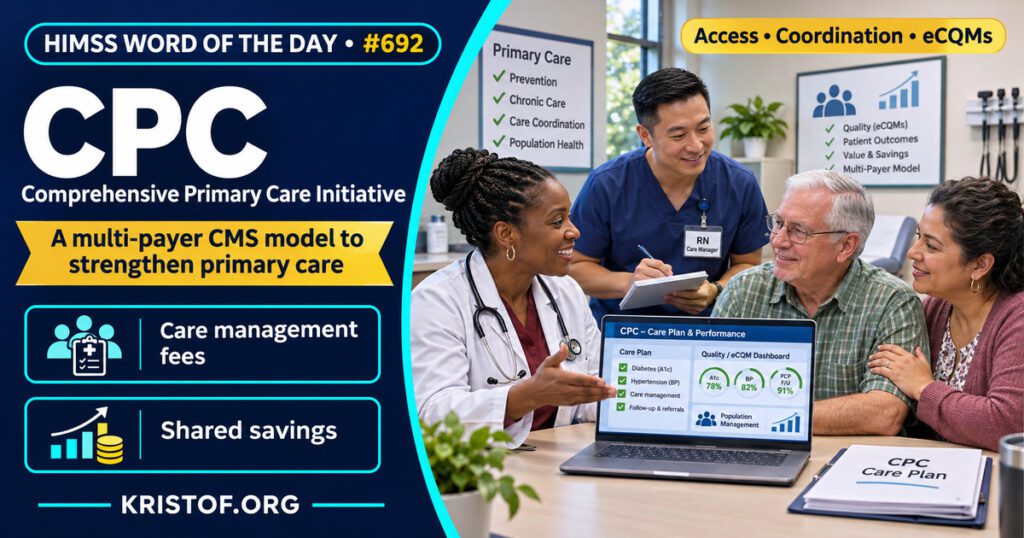
The HIMSS Dictionary describes the Comprehensive Primary Care Initiative (CPC) as a four-year, multi-payer initiative from the Centers for Medicare & Medicaid Services (CMS) meant to strengthen primary care. CMS worked with commercial and state health plans in selected regions. Practices received population-based care management fees and a chance at shared savings to support five core functions: risk-stratified care management, access and continuity, planned care for chronic and preventive needs, patient and caregiver engagement, and coordination of care across the medical neighborhood. The dictionary presents CPC as the base on which Comprehensive Primary Care Plus (CPC+) was built and points readers to that entry.
CMS’s own page describes CPC as having started in October 2012 and ended in December 2016. The studies below evaluate that period or look at the data work that supported it.
| Element | What it describes | Study in this post |
|---|---|---|
| Payment and support | Care management fees and shared savings from several payers | Peikes et al.; Fu et al. |
| Care delivery change | Five functions practices were asked to build | Peikes et al. |
| Emergency and urgent care use | Visits that better access and primary care could avoid | Timmins et al. |
| Quality data | Electronic clinical quality measures used in shared savings | LaBonte et al. |
| Payer data sharing | Combining claims from several payers for practice feedback | Mutti et al. |
⚠️ Exam Alert: CPC, CPC+, a patient-centered medical home, and an accountable care organization are different things. CPC was a CMS model with a four-year run, CPC+ was its successor, a medical home is a care delivery model that practices adopt, and an accountable care organization is a group of providers that takes responsibility for the cost and quality of a defined population. Questions often test which one pays practices a care management fee and which one shares savings across a network.
🌐 Why It Matters: Real-World Healthcare IT Context
Where it shows up. CPC is a primary care model, but its evaluations speak to health IT in two ways: it used electronic clinical quality measures from EHRs in its shared savings arrangement, and it pushed payers to share claims data with practices. The five studies below were read as abstracts only.
The first evaluation was mixed. Peikes et al. (2018) evaluated the 502 practices that took part, comparing fee-for-service Medicare beneficiaries attributed to CPC practices with those attributed to matched comparison practices. CPC practices reported improvements in primary care delivery, including care management for high-risk patients, enhanced access, and better coordination of care transitions. The initiative slowed growth in emergency department visits by 2 percent. However, it did not reduce Medicare spending enough to cover the care management fees, and it did not appreciably improve physician or beneficiary experience or practice performance on a limited set of claims-based quality measures.
Longer follow-up shows later effects. Fu et al. (2022) followed 565,674 beneficiaries attributed to 502 CPC Classic practices and 1,165,284 attributed to 908 comparison practices for six years. Relative to comparison practices, hospitalizations grew 3.1% less in year 5 and 3.5% less in year 6, and total ED visits grew roughly 2% slower each year from year 3 through year 6. Medicare Part A and B expenditures, excluding care management fees, did not change appreciably. The authors suggest that primary care transformation takes time to show up as fewer hospitalizations. The abstract also notes that the successor model, CPC+, added health information technology support.
Where the ED savings came from. Timmins et al. (2020) used Medicare claims for beneficiaries attributed to 497 CPC practices and 908 comparison practices from October 2012 through December 2016. CPC practices had 2% lower growth in all-cause ED visits, 3% lower growth in ED visits that primary care could substitute for, and 3% lower growth in ED visits that primary care could potentially prevent. Growth in urgent care center visits was 9% lower. A falsification test using injury visits showed no difference. The authors read the results as suggesting that better access and more effective primary care both contributed.
Electronic quality measures can support payment. LaBonte et al. (2019) built benchmarks for 11 electronic clinical quality measures and compared CPC practices with benchmark practices. CPC practices did better on 8 measures in 2015, by 6.3 to 17.7 percentage points, and on 9 measures in 2016, by 1.7 to 20 percentage points. They improved significantly on 7 measures from 2015 to 2016. The authors conclude that eCQMs can be used for payment. The comparison depends on the benchmarks the authors built.
Payers had to share data. Mutti et al. (2020) describe how practices in most regions got separate, confidential claims-based reports from several payers that varied in content and gave an incomplete picture of the patient panel. In several regions, payers worked together to produce aggregated performance feedback. The authors call aggregation across payers a potential game changer and describe approaches, challenges, and lessons for other efforts. The abstract does not report outcome numbers.
What I could not confirm. The practice counts differ by source: the abstracts above cite 502 practices, and the CMS page cites 442 participating practice sites as of October 2016, and I did not reconcile the two. I did not verify the current status of CPC+ in this post, which is covered in post #566. None of the studies measured nurse staffing, care manager roles, or the cost of the health IT that practices used.
Common CPC problems:
- Care management fees not offset by Medicare savings in the first evaluation
- No appreciable improvement in beneficiary experience in that evaluation
- Hospitalization effects that took five or six years to appear
- Separate, incomplete claims reports from each payer
- Benchmarks and attribution methods that shape what an evaluation can show
What supports CPC:
- Reported improvements in care management, access, and coordination of care transitions
- Slower growth in ED visits and, in the long-term analysis, in hospitalizations
- Better performance than benchmark practices on most electronic clinical quality measures studied
- Payers cooperating to give practices combined claims feedback
- Five defined functions that gave practices a common target
🏥 The Nurse’s Perspective: Clinical, Bedside, & Workflow
None of the five studies measured nurses’ work directly, so this section is workflow context and not evidence.
At the Bedside
CPC was a primary care model, so the setting is the office visit and the phone call. Risk-stratified care management and coordination of care transitions are functions that depend on someone identifying high-risk patients and following up after hospital stays or emergency visits. The abstracts do not say which roles filled those jobs, and practices made their own choices.
In Clinical Workflow
Electronic clinical quality measures depend on how data are entered. When a blood pressure, a screening, or a medication reconciliation is documented in a structured field, it can count. When it is entered as free text, it may not. The 2019 study shows that measures from EHR data were used in payment, which is why documentation habits matter to nursing staff.
In EHR Implementation (Go-Live Perspective)
During an Epic Go-Live, analysts and at-the-elbow support staff see how workflows translate into reportable data. Measure logic, flowsheet rows, and registry or care management tools all sit behind quality reporting. That is general workflow context, and none of the studies reviewed examines go-lives.
🎓 CAHIMS / CPHIMS & HIMSS Perspective
CAHIMS Exam Domain Mapping
CPC appears in questions about payment models, quality reporting, and data sharing:
| CAHIMS Domain | How CPC Appears |
|---|---|
| Healthcare & Technology Environments | Payers, CMS models, and how primary care is paid |
| Clinical Informatics | Care management, quality measures from EHR data |
| Healthcare Information & Systems Management | Claims data aggregation and performance feedback |
| Management & Leadership | Practice transformation and incentive design |
Key Terms to Know Alongside CPC
- CPC+ — the successor model that built on CPC
- Patient-Centered Medical Home — a primary care delivery model built around coordinated, team-based care
- Care management — help for patients with high needs to follow plans and use services well
- Care coordination — organizing a patient’s care across providers and settings
- Alternative Payment Models — payment approaches that reward quality or value, not volume alone
- Electronic clinical quality measure — a quality measure calculated from EHR data
HIMSS Organizational Position
HIMSS offers education and research on health information and technology topics through its Resource Center. Members can find related information on the HIMSS Resource Center page.
🧭 More HIMSS Word of The Day Terms
Related terms in the Value-Based Care series:
Browse all Value-Based Care terms or the A–Z glossary.
🔗 Explore Further: External References
- CMS — Comprehensive Primary Care Initiative https://www.cms.gov/priorities/innovation/innovation-models/comprehensive-primary-care-initiative
- Peikes et al. (2018), Health Affairs — The Comprehensive Primary Care Initiative: Effects On Spending, Quality, Patients, And Physicians. https://pubmed.ncbi.nlm.nih.gov/29791190/
- Fu et al. (2022), Journal of General Internal Medicine — Long-Term Effects of the Comprehensive Primary Care Model on Health Care Spending and Utilization. https://pubmed.ncbi.nlm.nih.gov/34236603/
- Timmins et al. (2020), Health Services Research — Pathways to reduced emergency department and urgent care center use: Lessons from the comprehensive primary care initiative. https://pubmed.ncbi.nlm.nih.gov/33258126/
- LaBonte et al. (2019), American Journal of Medical Quality — Performance on Electronic Clinical Quality Measures in the Comprehensive Primary Care Initiative. https://pubmed.ncbi.nlm.nih.gov/30132334/
- Mutti et al. (2020), American Journal of Medical Quality — Aggregating Claims Data Across Payers: Approaches, Challenges, and Lessons Learned From the Comprehensive Primary Care Initiative. https://pubmed.ncbi.nlm.nih.gov/30991814/
- HIMSS — Resource Center https://www.himss.org/resource-center
Term source: HIMSS Dictionary of Health Information and Technology Terms, Acronyms, and Organizations, 6th Edition (2025). All definitions in this series are paraphrased for editorial purposes. Readers are encouraged to consult the primary source for exact language.
Eric Andrew Kristof, RN, CAHIMS is a Healthcare IT professional and HIMSS Arkansas Chapter member based in Hot Springs Village, AR, with hands-on Epic Go-Live experience and a diverse healthcare and IT background. He writes at kristof.org at the intersection of clinical care and healthcare technology.
Leave a Reply