By Eric Andrew Kristof, RN, CAHIMS | Healthcare IT Professional | HIMSS Arkansas Chapter Member
About This Series: The HIMSS Word of the Day is a running blog series drawing from the HIMSS Dictionary of Health Information and Technology Terms, Acronyms, and Organizations, 6th Edition (2025) — the authoritative reference for healthcare IT professionals and the primary study resource for CAHIMS and CPHIMS certification. Each post paraphrases the term in plain language, grounds it in real-world healthcare IT context, and adds a bedside nursing perspective you won’t find in a textbook.
📖 The Term: Fee-for-Service (FFS)
Source: HIMSS Dictionary of Health Information and Technology Terms, Acronyms, and Organizations, 6th Edition (2025)
🔍 Plain-Language Definition
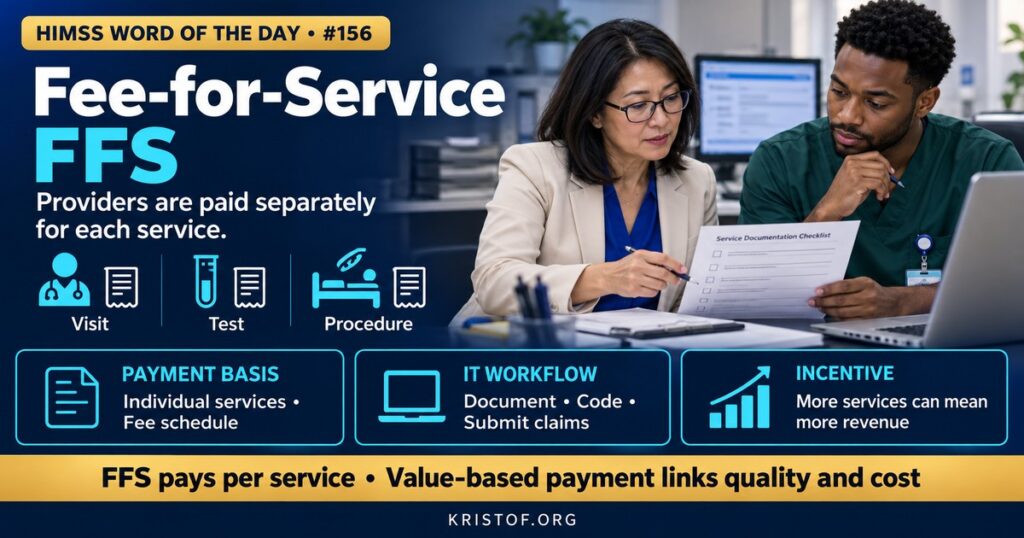
Fee-for-service (FFS) is a payment model in which providers are paid a set amount for each individual service, such as a visit, test, or procedure, rather than for outcomes or for caring for a population over time.
The HIMSS Dictionary describes FFS as paying a set amount for each treatment based on what kind of care was given, whatever the result. It notes that federal payment systems continue trying to move providers away from FFS and toward value-based care.
| Payment Approach | How Providers Are Paid | Incentive Created |
|---|---|---|
| Fee-for-Service | Separately for each service | More services generate more revenue |
| FFS With Quality Incentives | Per service, adjusted by performance | Volume plus attention to measured quality |
| Bundled Payment | One price for an episode of care | Efficiency within the episode |
| Shared Savings | FFS plus a share of savings against a benchmark | Reduce total cost while meeting quality goals |
| Capitation or Population-Based Payment | A fixed amount per person per period | Keep patients healthy and avoid unnecessary care |
⚠️ Exam Alert: FFS pays for volume; value-based payment links payment to quality and cost. Many alternative payment models are built on FFS, with claims still paid per service and reconciled later. Original Medicare is often called “Medicare fee-for-service” to distinguish it from Medicare Advantage, which pays plans on a capitated basis.
🌐 Why It Matters: Real-World Healthcare IT Context
FFS has been the dominant way to pay for healthcare in the United States for decades. Its logic is straightforward: providers deliver services, document them, code them, and submit claims, and payers reimburse each service according to a fee schedule or contracted rate.
Medicare fee schedules illustrate how FFS works in practice. The Medicare Physician Fee Schedule sets payment for thousands of services using relative value units that reflect physician work, practice expense, and malpractice costs, adjusted for geography. Other fee schedules cover services such as clinical laboratory tests, durable medical equipment, and ambulance services, while hospitals are paid through prospective systems such as DRGs for inpatient stays.
FFS has strengths. It rewards providers for the work they perform, supports access when more services are needed, and is relatively simple to administer with established claims infrastructure. Claims data generated by FFS also fuels research, quality measurement, and analytics.
Its weaknesses are well known. FFS encourages volume, including services of limited value, and rarely pays for activities that keep people healthy, such as care coordination, patient education, outreach, and communication between clinicians. It can fragment care because each provider is paid separately, with no shared responsibility for overall outcomes.
Payment reform builds on FFS rather than discarding it overnight. The Health Care Payment Learning & Action Network framework places FFS without links to quality in its first category and FFS linked to quality in its second, with alternative payment models and population-based payment in higher categories. Programs such as the Merit-based Incentive Payment System adjust FFS payments based on performance, and many accountable care organizations still pay claims on an FFS basis and then reconcile against spending benchmarks.
Medicare has also added FFS codes that recognize work beyond face-to-face visits, such as chronic care management, transitional care management, and remote monitoring, partly to address gaps in what FFS historically paid for.
Health IT is deeply tied to FFS. Charge capture, coding, claims submission, and remittance processing depend on accurate documentation and standard transactions. Organizations moving toward value-based care must maintain these FFS capabilities while adding population health, risk adjustment, and quality reporting tools.
Data from FFS claims has limits. Claims show what was billed, not necessarily what happened clinically, and they may miss services that were not separately paid.
Common FFS-related problems:
- Incentives for volume over value
- Little payment for coordination and prevention
- Fragmented care across separately paid providers
- Administrative burden of coding and claims
- Missed charges when documentation is incomplete
- Claims data that omits unpaid clinical work
How organizations manage FFS while shifting to value:
- Accurate documentation and charge capture
- Use of care management and transitional care codes
- Participation in quality incentive programs
- Gradual adoption of alternative payment models
- Analytics combining claims and clinical data
- Clear alignment of incentives with quality goals
🏥 The Nurse’s Perspective: Clinical, Bedside, & Workflow
Much nursing work is essential to outcomes yet invisible to fee-for-service billing.
At the Bedside
In hospitals, nursing care is generally bundled into room and board or DRG payments rather than billed separately. As a result, the value of nursing time and expertise is often hidden in financial data, even though it drives quality, safety, and length of stay.
In outpatient settings, certain nursing services, such as injections, infusions, and some education or care management services, can be billed when documented according to requirements. Accurate documentation of what was done and how long it took supports appropriate payment.
In Clinical Workflow
Care management and transitional care codes have created opportunities for nurse-led programs in primary care. Nurses who call patients after discharge, reconcile medications, and coordinate follow-up contribute to billable services when documentation and supervision requirements are met.
Charge capture built into nursing documentation, such as recording supplies, procedures, and infusion times, helps organizations bill accurately and avoid lost revenue.
Understanding payment models helps nurses see why organizations emphasize certain documentation and why value-based programs place growing importance on prevention and coordination.
Nurse leaders increasingly advocate for measuring nursing’s contribution to outcomes, which becomes more visible in value-based arrangements than in FFS.
In EHR Implementation (Go-Live Perspective)
During an Epic Go-Live, revenue cycle teams configure charge capture, fee schedules, and claims workflows. Testing that nursing documentation triggers the correct charges, such as infusion start and stop times, prevents revenue loss.
At-the-elbow support analysts often field questions about where to document billable nursing activities. Routing charge-related issues to revenue cycle teams quickly helps prevent claim errors.
🎓 CAHIMS / CPHIMS & HIMSS Perspective
CAHIMS Exam Domain Mapping
Fee-for-service appears in payment, policy, and revenue cycle questions:
| CAHIMS Domain | How FFS Appears |
|---|---|
| Healthcare & Technology Environments | Medicare fee schedules; payment reform; HCP-LAN framework |
| Clinical Informatics | Documentation for billing, care management codes, charge capture |
| Healthcare Information & Systems Management | Claims transactions, coding, revenue cycle systems, claims data analytics |
| Management & Leadership | Financial strategy, transition to value-based care, incentive alignment |
Key Terms to Know Alongside FFS
- Fee Schedule — a list of payment amounts for specific services
- Relative Value Unit (RVU) — a measure used to set physician payment based on work, practice expense, and malpractice costs
- Value-Based Care — care delivery and payment focused on quality and outcomes relative to cost
- Capitation — a fixed payment per person per period
- Alternative Payment Model (APM) — a payment approach that rewards quality and efficiency
- Charge Capture — recording billable services so they appear on claims
HIMSS Organizational Position
HIMSS supports the transition to value-based care through education on data, analytics, and interoperability, and engages on CMS payment policy through its public policy work. Members can find related education and research through the HIMSS Resource Center.
🔗 Explore Further: External References
- CMS — Physician Fee Schedule https://www.cms.gov/medicare/payment/fee-schedules/physician
- HCP-LAN — APM Framework https://hcp-lan.org/apm-framework/
- CMS — Original Medicare Providers Information Center https://www.cms.gov/original-medicare-providers-information-center
- MedPAC — Medicare Payment Advisory Commission https://www.medpac.gov/
- CMS — Care Management Services https://www.cms.gov/medicare/payment/fee-schedules/physician/care-management
- HIMSS — Public Policy & Advocacy https://www.himss.org/public-policy-advocacy-overview
Term source: HIMSS Dictionary of Health Information and Technology Terms, Acronyms, and Organizations, 6th Edition (2025). All definitions in this series are paraphrased for editorial purposes. Readers are encouraged to consult the primary source for exact language.
Eric Andrew Kristof, RN, CAHIMS is a Healthcare IT professional and HIMSS Arkansas Chapter member based in Hot Springs Village, AR, with hands-on Epic Go-Live experience and a diverse healthcare and IT background. He writes at kristof.org at the intersection of clinical care and healthcare technology.
Leave a Reply