By Eric Andrew Kristof, RN, CAHIMS | Healthcare IT Professional | HIMSS Arkansas Chapter Member
About This Series: The HIMSS Word of the Day is a running blog series drawing from the HIMSS Dictionary of Health Information and Technology Terms, Acronyms, and Organizations, 6th Edition (2025) — the authoritative reference for healthcare IT professionals and the primary study resource for CAHIMS and CPHIMS certification. Each post paraphrases the term in plain language, grounds it in real-world healthcare IT context, and adds a bedside nursing perspective you won’t find in a textbook.
📖 The Term: Clinical Pathways (CPWs)
Source: HIMSS Dictionary of Health Information and Technology Terms, Acronyms, and Organizations, 6th Edition (2025)
🔍 Plain-Language Definition
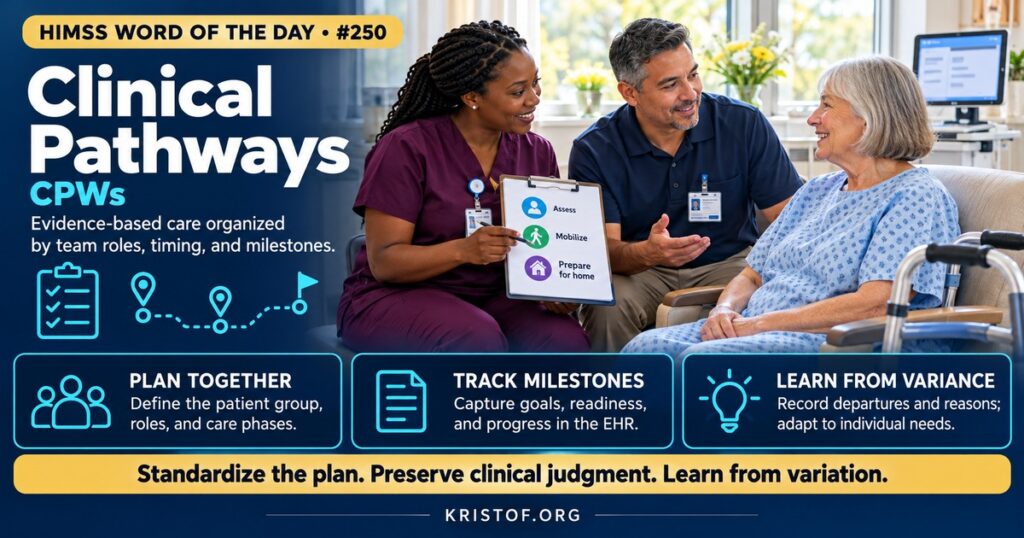
A clinical pathway (CPW) is a tool for putting evidence-based care into practice by converting clinical practice guideline recommendations into the processes of care used in a particular setting. The HIMSS Dictionary describes a CPW as a structured, multidisciplinary care plan that lays out the steps of a course of treatment, whether written as a plan, algorithm, guideline, protocol, or other list of actions, and that seeks to make care consistent for one clinical problem, procedure, or episode within a defined group of patients.
A pathway differs from a guideline in scope and in use. A guideline offers recommendations, often broad. A pathway assigns tasks to roles and times: what happens on the day of surgery, what the nurse assesses each shift, what criteria allow discharge. Pathways often include variance tracking, which records and analyzes departures from the plan so the team can learn from them.
| Pathway Element | Purpose | Example |
|---|---|---|
| Target population | Defines who the pathway applies to | Adults having elective total hip replacement |
| Timeline | Organizes care by phase or day | Preoperative, day of surgery, postoperative days |
| Interventions | Lists orders, assessments, teaching | Pain plan, early mobility, venous thromboembolism prevention |
| Goals and outcomes | Sets milestones | Walking on postoperative day 1 |
| Discharge criteria | Defines readiness | Pain controlled with oral medication, safe mobility |
| Variance tracking | Records deviations and reasons | Delayed mobilization due to nausea |
⚠️ Exam Alert: A clinical practice guideline gives recommendations; a clinical pathway turns them into a local, time-based plan for the team. An order set is a group of orders that may support a pathway. Variance means a departure from the pathway, and it is not automatically an error.
🌐 Why It Matters: Real-World Healthcare IT Context
Care for a single condition can vary widely from clinician to clinician and unit to unit. Some variation is appropriate because patients differ, and some is unwarranted. Pathways aim to reduce unwarranted variation by agreeing on a standard approach and making it easy to follow, while leaving room for clinical judgment.
The strongest evidence comes from a 2025 Cochrane systematic review that updated an earlier version. It included 58 studies involving 24,841 patients and 2,027 health care professionals, of which 71 percent were randomized trials. The authors noted the risk of bias was high overall, in part because of possible contamination between groups within the same hospital. For stand-alone pathways compared with usual care, the review found moderate-certainty evidence that pathways likely reduce in-hospital complications, from 10 percent versus 17 percent, and likely reduce length of stay by about 1.12 days on average. For in-hospital mortality and mortality up to six months, the evidence did not show a clear difference and was of low certainty. It was very uncertain whether pathways reduce readmissions. Costs and charges were generally lower in nine studies, but the evidence was very low certainty. Stand-alone pathways might slightly increase adherence to recommended practice, with low certainty. For multifaceted interventions that included a pathway, most outcomes were uncertain. The studies most often tested pathways in general acute wards, emergency departments, and intensive care, for conditions such as asthma, stroke, mechanical ventilation, and myocardial infarction.
Single-site reports add detail. A Chinese hospital designed a comprehensive pathway for total hip replacement by reviewing literature, drafting the plan, and refining it through expert consensus. In the validation phase, 126 patients were assigned to a control or an experimental group. The pathway group had shorter hospital stays and lower costs, better joint function, less fear of movement, higher readiness for discharge, and greater satisfaction with follow-up, while the highest postoperative pain score did not differ significantly. The report supports the idea that well-designed pathways can improve efficiency and recovery in a focused setting, though it is a single center and the findings may not apply elsewhere.
Together, the evidence suggests moderate benefits for complications and length of stay, with weaker or unclear effects on mortality and readmissions. It also suggests that implementation matters. A pathway that is printed and ignored does little. A pathway embedded in the EHR with order sets, reminders, and dashboards, owned by an interdisciplinary team, and reviewed using variance data has a better chance of changing care. The Cochrane authors scored interventions on how well they followed an evidence-based implementation process, which reflects the same point.
Informatics supports pathways at several levels. Order sets and care plan templates make the recommended actions the default. Documentation tools capture goals and milestones. Clinical decision support prompts the team when a step is missed. Analytics show adherence and outcomes by unit and clinician, and variance reports reveal where the plan does not fit real patients. Governance matters too: each pathway needs an owner, a review schedule, and a process to update it when evidence changes.
Common clinical pathway problems:
- Pathways written without input from the nurses and therapists who carry them out
- Plans on paper but not built into the EHR workflow
- Rigid use that ignores individual patient needs
- No variance tracking, so there is no learning
- Out-of-date content after new evidence or guidelines
- Outcomes measured by length of stay alone
What supports effective pathways:
- Interdisciplinary design and ownership
- EHR build with order sets, goals, and reminders
- Clear criteria for when to deviate and how to document it
- Variance and outcome dashboards reviewed regularly
- A scheduled review cycle tied to evidence updates
- Patient-friendly versions that explain the plan
🏥 The Nurse’s Perspective: Clinical, Bedside, & Workflow
Pathways describe much of what nurses do each shift, so nursing insight shapes whether they work.
At the Bedside
A pathway tells the nurse what to expect and what to do on a given day: assess, mobilize, teach, prepare for discharge. It also gives patients and families a clear picture of the plan. When a patient does not meet the day’s goal, the nurse documents why, which is the variance that helps the team learn.
Judgment still leads. If a patient’s condition does not fit the pathway, the nurse raises the concern with the team and the plan is adjusted.
In Clinical Workflow
Nurse managers and educators help design pathways, train staff, and track compliance. They bring practical details, such as how much time mobilization takes or when teaching works best. Case managers use pathway milestones to plan discharge and arrange services early.
Nurse informaticists build and test pathway tools in the EHR, including order sets, flowsheet rows for goals, and reports for variance. They make sure the build supports the way care is actually delivered, not an idealized version.
In EHR Implementation (Go-Live Perspective)
An Epic Go-Live is often when pathways are converted into order sets, care plans, and goals. Teams test them with real scenarios across units. At-the-elbow support analysts see where nurses cannot find a pathway step, where a goal duplicates other documentation, or where an order set conflicts with unit routines, and they pass those findings to the build team.
🎓 CAHIMS / CPHIMS & HIMSS Perspective
CAHIMS Exam Domain Mapping
Clinical pathways appear in evidence-based practice, quality, and clinical decision support questions:
| CAHIMS Domain | How Clinical Pathways Appear |
|---|---|
| Healthcare & Technology Environments | Guidelines, evidence-based practice, quality improvement |
| Clinical Informatics | Order sets, care plans, decision support, variance analysis |
| Healthcare Information & Systems Management | System build, reporting, data capture, maintenance |
| Management & Leadership | Governance, change management, interdisciplinary teams |
Key Terms to Know Alongside Clinical Pathways
- Clinical Practice Guideline — evidence-based recommendations for care
- Order Set — grouped orders for a condition or procedure
- Variance — departure from the planned pathway
- Care Plan — individualized plan of care for a patient
- Evidence-Based Practice — use of best available evidence in care decisions
- Enhanced Recovery — perioperative pathway approach aimed at faster recovery
HIMSS Organizational Position
HIMSS supports clinical informatics and evidence-based practice through its education, research, and community work. Members can find related resources through the HIMSS Resource Center.
🔗 Explore Further: External References
- Rotter et al. (2025), Cochrane Database of Systematic Reviews — Clinical Pathways for Secondary Care and the Effects on Professional Practice, Patient Outcomes, Length of Stay and Hospital Costs https://pubmed.ncbi.nlm.nih.gov/40365866/
- Zhang et al. (2025), International Journal of Orthopaedic and Trauma Nursing — Application of a Comprehensive Clinical Care Pathway in Patients Undergoing Total Hip Arthroplasty https://pubmed.ncbi.nlm.nih.gov/40939484/
- Chandra et al. (2025), Journal of Evaluation in Clinical Practice — Use and Impact of Clinical Pathways Across Various Healthcare Settings: A Protocol for an Umbrella Review of Global Evidence https://pubmed.ncbi.nlm.nih.gov/39445915/
- AHRQ — Evidence-Based Practice https://www.ahrq.gov/evidencenow/index.html
- HealthIT.gov — Health IT Playbook https://www.healthit.gov/playbook/
Term source: HIMSS Dictionary of Health Information and Technology Terms, Acronyms, and Organizations, 6th Edition (2025). All definitions in this series are paraphrased for editorial purposes. Readers are encouraged to consult the primary source for exact language.
Eric Andrew Kristof, RN, CAHIMS is a Healthcare IT professional and HIMSS Arkansas Chapter member based in Hot Springs Village, AR, with hands-on Epic Go-Live experience and a diverse healthcare and IT background. He writes at kristof.org at the intersection of clinical care and healthcare technology.
Leave a Reply