By Eric Andrew Kristof, RN, CAHIMS | Healthcare IT Professional | HIMSS Arkansas Chapter Member
About This Series: The HIMSS Word of the Day is a running blog series drawing from the HIMSS Dictionary of Health Information and Technology Terms, Acronyms, and Organizations, 6th Edition (2025) — the authoritative reference for healthcare IT professionals and the primary study resource for CAHIMS and CPHIMS certification. Each post paraphrases the term in plain language, grounds it in real-world healthcare IT context, and adds a bedside nursing perspective you won’t find in a textbook.
📖 The Term: LIP (Licensed Independent Practitioner)
Source: HIMSS Dictionary of Health Information and Technology Terms, Acronyms, and Organizations, 6th Edition (2025)
🔍 Plain-Language Definition
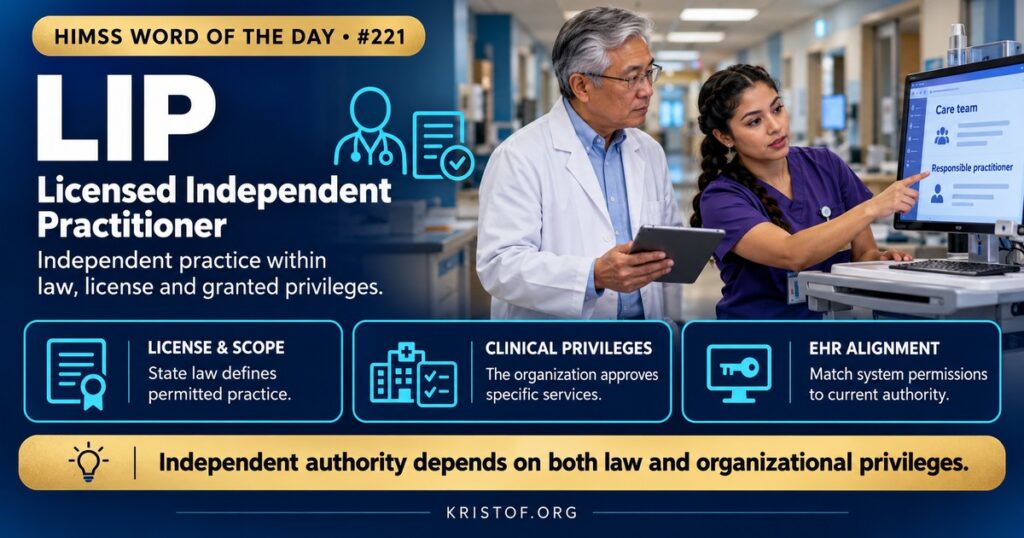
A licensed independent practitioner (LIP) is a clinician who, as allowed by law and regulation and by the organization itself, may deliver care and services on their own, without being directed or supervised. The authority has two limits: what the person’s license covers and the clinical privileges the organization has granted. The HIMSS Dictionary adds that each state has its own laws about who may practice without supervision.
The LIP label therefore depends on the setting. A physician usually qualifies. A nurse practitioner, physician assistant, certified nurse midwife, or other practitioner may or may not qualify, depending on state scope-of-practice law and on what the organization has approved. The American Association of Nurse Practitioners maintains a state-by-state practice environment map that shows how authority varies.
| Concept | What It Means | Who Decides |
|---|---|---|
| License | Legal permission to practice a profession | State licensing board |
| Scope of Practice | What the license allows | State law |
| Credentialing | Verification of qualifications | Organization and medical staff |
| Privileges | Specific services the practitioner may perform here | Governing body, on medical staff recommendation |
| LIP Status | Authority to practice independently within license and privileges | Combination of the above |
⚠️ Exam Alert: LIP status needs both a license that permits independent practice and privileges granted by the organization. A license alone does not give privileges at a given hospital. Each state sets its own rules, so the same type of clinician may be an LIP in one state and not in another.
🌐 Why It Matters: Real-World Healthcare IT Context
Hospitals do not let every licensed clinician do everything. Under the Medicare Conditions of Participation at 42 CFR 482.22, the medical staff must be composed of doctors of medicine or osteopathy and, in accordance with state law, including scope-of-practice laws, may also include other categories of physicians and non-physician practitioners determined eligible for appointment by the governing body. The medical staff examines the credentials of eligible candidates and recommends appointment to the governing body, and those appointed are bound by the medical staff bylaws, rules, and regulations. The regulation also allows a hospital receiving telemedicine services to rely on credentialing and privileging decisions made by a distant-site hospital when specified conditions are met in a written agreement.
The same rule family shapes how orders and documentation work. In the hospital record rules at 42 CFR 482.24, all orders, including verbal orders, must be dated, timed, and authenticated promptly by the ordering practitioner or by another practitioner responsible for the patient’s care, but only if that practitioner is acting in accordance with state law, including scope-of-practice laws, hospital policies, and medical staff bylaws and rules. In other words, who may order, sign, or co-sign is an organizational decision grounded in law, and the EHR has to carry it out.
That is where informatics comes in. The provider master file or its equivalent holds each practitioner’s type, credentials, identifiers, and privileges. EHR security classes use that information to control who can enter which orders, sign notes, prescribe medications, or cosign for others. Errors in the provider record can cause real harm: an order accepted from someone without privileges, an order refused for someone with privileges, a note routed to the wrong inbox, or an alert sent to the wrong person.
Identifying the responsible LIP is also a patient safety function. A 2018 report from an 800-bed academic hospital described the problem plainly: safe inpatient care depends on accurately identifying the licensed independent practitioner primarily responsible for each admitted patient, and failure to do so causes poor communication, delays, and delayed critical result reporting. The hospital built a First-Contact Provider designation in its EHR to identify the responsible LIP for each inpatient. Over a nine-month study, the weekly share of patients with exactly one first-contact provider documented at noon reached 98.6 percent, daily best practice alerts about a missing designation dropped from 5,313 to fewer than 50, and the monthly share of critical results reported directly to LIPs rose from 18.0 percent at baseline to 87.8 percent. The results show how a precise definition of who is responsible, built into the system, can improve a safety-critical process.
Credentialing data also touches regulatory reporting, billing, and e-prescribing. Prescriber identifiers, controlled substance registration, and identity proofing for electronic prescribing depend on accurate practitioner data. Because rules change, organizations review practitioner types and privileges whenever state law or medical staff policy changes.
Common LIP-related problems:
- Provider records that do not match current credentialing decisions
- Different definitions of LIP across policies, bylaws, and the EHR
- Orders from practitioners whose privileges lapsed or changed
- Unclear who receives critical results or consult responses
- Co-signature rules that nobody has reviewed in years
- State law changes not reflected in system build
What supports accurate LIP management:
- Single source of truth for practitioner data feeding the EHR
- Defined practitioner types mapped to security classes
- Regular reconciliation between credentialing and system access
- Clear responsible-practitioner field for each patient
- Policies that state which roles may order, sign, or cosign
- Prompt updates when privileges are granted, changed, or ended
🏥 The Nurse’s Perspective: Clinical, Bedside, & Workflow
Nurses depend on the LIP concept every day, often without naming it: whom to call, whose order to follow, and who must sign.
At the Bedside
When a patient’s condition changes, a nurse needs to reach the practitioner who is responsible and has authority to act. If the care team list is wrong, time is lost. Nurses who notice that the listed practitioner is not the right one help by reporting it and by using the escalation chain until the patient is safe.
Nurses also need to know which orders they may accept from which team members. Questions about an order from a practitioner whose role is unclear belong in the chain of command and with pharmacy or nursing leadership, not in a silent workaround.
In Clinical Workflow
Advanced practice registered nurses are LIPs in many settings, subject to state law and privileges. Nurse leaders work with the medical staff office to make sure titles, privileges, and EHR roles line up for these clinicians. Policies for verbal orders, telephone orders, and co-signatures are written with LIP definitions in mind.
Nurse informaticists help maintain accuracy by working with medical staff services and IT on provider build, reviewing alerts that route to practitioners, and testing that critical results reach the person who can act.
In EHR Implementation (Go-Live Perspective)
An Epic Go-Live demands clean practitioner data. Analysts check that every provider has the right type, security class, and credentials and that on-call and coverage rules are correct. At-the-elbow support analysts hear about the gaps first, such as an order that cannot be signed or a result that goes to someone no longer covering, and they pass these to the build team the same day.
🎓 CAHIMS / CPHIMS & HIMSS Perspective
CAHIMS Exam Domain Mapping
LIP concepts appear in regulatory, access control, and workflow questions:
| CAHIMS Domain | How the LIP Appears |
|---|---|
| Healthcare & Technology Environments | State scope-of-practice law, Medicare Conditions of Participation |
| Clinical Informatics | Order entry, co-signature, responsible-provider workflows |
| Healthcare Information & Systems Management | Provider master file, security classes, role-based access |
| Management & Leadership | Credentialing governance, policy alignment, patient safety |
Key Terms to Know Alongside the LIP
- Credentialing — verifying a practitioner’s qualifications
- Clinical Privileges — services a practitioner is approved to perform at an organization
- Scope of Practice — activities permitted by a professional license under state law
- Provider Master File — system record of practitioner identity, type, and credentials
- Co-signature — second practitioner’s authentication of an entry or order
- Role-Based Access Control — assigning system permissions by role
HIMSS Organizational Position
HIMSS supports patient safety and effective clinical workflows through its education, research, and communities for physicians and nurses. Members can find related resources through the HIMSS Resource Center and community pages.
🔗 Explore Further: External References
- eCFR — 42 CFR 482.22, Condition of Participation: Medical Staff https://www.ecfr.gov/current/title-42/chapter-IV/subchapter-G/part-482/subpart-C/section-482.22
- eCFR — 42 CFR 482.24, Condition of Participation: Medical Record Services https://www.ecfr.gov/current/title-42/chapter-IV/subchapter-G/part-482/subpart-C/section-482.24
- AANP — State Practice Environment https://www.aanp.org/advocacy/state/state-practice-environment
- Chandiramani et al. (2018), Joint Commission Journal on Quality and Patient Safety — “Who’s Covering This Patient?” Developing a First-Contact Provider (FCP) Designation in an Electronic Health Record https://pubmed.ncbi.nlm.nih.gov/29389459/
- NIST — Role-Based Access Control https://csrc.nist.gov/projects/role-based-access-control
- HIMSS — Physician Community https://www.himss.org/networking/communities/physician/
Term source: HIMSS Dictionary of Health Information and Technology Terms, Acronyms, and Organizations, 6th Edition (2025). All definitions in this series are paraphrased for editorial purposes. Readers are encouraged to consult the primary source for exact language.
Eric Andrew Kristof, RN, CAHIMS is a Healthcare IT professional and HIMSS Arkansas Chapter member based in Hot Springs Village, AR, with hands-on Epic Go-Live experience and a diverse healthcare and IT background. He writes at kristof.org at the intersection of clinical care and healthcare technology.
Leave a Reply